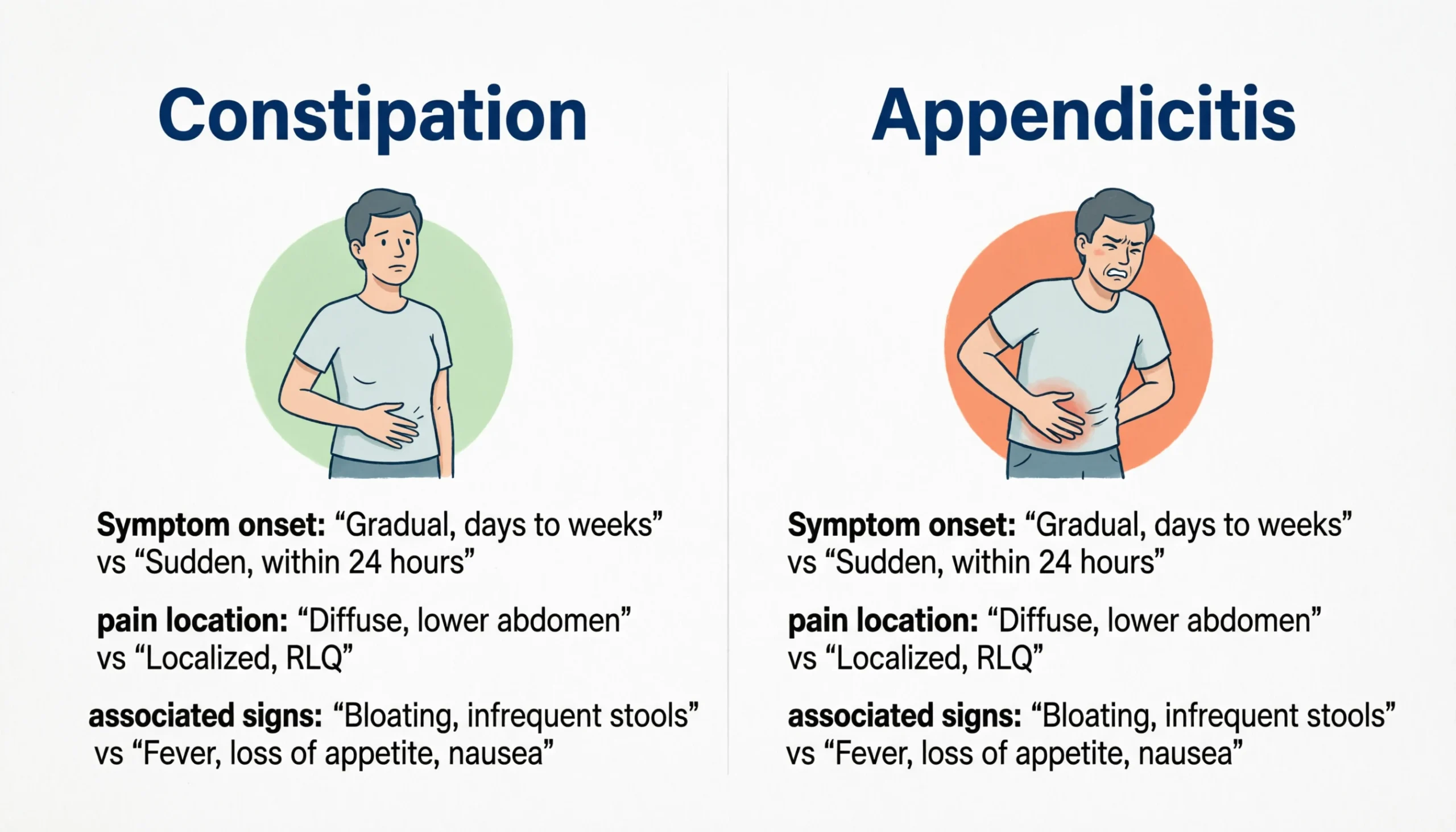
Constipation or appendicitis can be difficult to tell apart because both may cause abdominal discomfort, bloating, and changes in bowel movements. Constipation commonly involves hard or difficult-to-pass stools, while appendicitis often causes abdominal pain that can begin around the belly button and move toward the lower-right side. Appendicitis can also cause nausea, vomiting, fever, constipation, or diarrhea, so symptoms can sometimes overlap.
If you are searching for constipation or appendicitis, you may be trying to understand what your symptoms could mean and when they require medical attention. This guide explains the key differences, common symptoms, and warning signs to know. Because appendicitis can become serious if untreated, severe or worsening abdominal pain, especially pain that moves to the lower right, should be evaluated promptly by a healthcare professional.
When you have stomach pain and trouble passing stool, it can be hard to know if you have constipation or appendicitis. Both can cause belly pain, nausea, and changes in bowel habits, but they are not the same problem. Constipation often causes bloating, hard stools, and pain that may improve after a bowel movement. Appendicitis can cause pain that becomes stronger and often moves to the lower right side of the abdomen.
People search for this phrase because early appendicitis can sometimes look like a simple stomach or bowel problem. Knowing the common signs can help you understand what may be happening and when you need medical care. This guide explains the differences in simple terms. It also covers symptoms, common mistakes, everyday examples, and when abdominal pain may need urgent attention. If you have severe or worsening abdominal pain, especially with fever, vomiting, or severe pain in the lower right abdomen, seek urgent medical care rather than trying to diagnose it at home.
Constipation or Appendicitis – Quick Answer
Constipation happens when bowel movements become difficult, infrequent, or hard to pass. Common signs include:
- Hard or dry stools
- Straining during bowel movements
- Bloating
- Feeling that you have not fully emptied your bowel
- Mild to moderate belly discomfort
Appendicitis happens when the appendix becomes inflamed. Typical symptoms can include:
- Pain that starts near the belly button and may move to the lower right abdomen
- Pain that gets worse over time
- Loss of appetite
- Nausea or vomiting
- Fever
- Abdominal tenderness
A key difference is how the pain behaves. Constipation-related discomfort may improve after passing stool or gas. Appendicitis pain often continues or becomes worse.
However, symptoms can vary. Constipation can occur alongside appendicitis, so having a bowel movement does not always rule out appendicitis.
If you have severe, persistent, or worsening abdominal pain, especially with fever or vomiting, get medical help promptly.
The Origin of Constipation or Appendicitis
The terms constipation and appendicitis come from different medical and linguistic roots.
Constipation
“Constipation” comes from Latin roots related to the idea of pressing or making something tight. Over time, the word became associated with difficulty passing stool.
Modern medicine uses constipation to describe a bowel problem involving difficult or infrequent bowel movements.
Appendicitis
“Appendicitis” is built from appendix and the suffix -itis.
- Appendix refers to the small, tube-shaped structure attached to the large intestine.
- -itis is a medical suffix meaning inflammation.
So, appendicitis literally refers to inflammation of the appendix.
Unlike spelling pairs such as color/colour or center/centre, constipation or appendicitis is not a British-versus-American spelling question. These are two different medical terms for two different conditions.
British English vs American English Spelling
There is an important point to understand here: constipation and appendicitis are spelled the same in British and American English.
| Term | American English | British English | Difference |
| Constipation | constipation | constipation | None |
| Appendicitis | appendicitis | appendicitis | None |
| Constipated | constipated | constipated | None |
| Appendix | appendix | appendix | None |
| Abdominal pain | abdominal pain | abdominal pain | None |
Some medical words do have spelling differences between American and British English. For example:
| American English | British English |
| anemia | anaemia |
| diarrhea | diarrhoea |
| tumor | tumour |
| pediatric | paediatric |
But constipation and appendicitis do not change spelling based on English variety.
Which Spelling Should You Use?
You do not need to choose between different spellings for these two words.
Use:
- constipation in both US and UK English.
- appendicitis in both US and UK English.
If you are writing for an American audience, use the standard American medical terms.
If you are writing for readers in the UK, Pakistan, Australia, or other Commonwealth countries, constipation and appendicitis remain correct.
For global health content, these spellings are also appropriate.
The bigger issue is not spelling. It is using the correct term for the condition you are describing.
For example:
“The patient has constipation.”
This describes difficulty with bowel movements.
“The patient was diagnosed with appendicitis.”
This describes inflammation of the appendix.
Do not use the two words as synonyms.
Common Mistakes with Constipation or Appendicitis
Because both conditions can involve abdominal discomfort, people sometimes confuse them.
Mistake 1: Treating all stomach pain as constipation
Not every stomachache comes from constipation. Abdominal pain has many possible causes.
Better: Consider the full group of symptoms and how the pain changes.
Mistake 2: Assuming a bowel movement rules out appendicitis
Having a bowel movement does not automatically exclude appendicitis.
Better: Pay attention to persistent or worsening pain and other symptoms.
Mistake 3: Calling appendicitis “just gas”
Gas can cause discomfort, but severe or persistent abdominal pain needs proper attention.
Mistake 4: Waiting for every classic symptom
Not everyone with appendicitis has the same symptoms.
Better: Seek medical advice when abdominal pain is severe, persistent, or getting worse.
Mistake 5: Using the terms interchangeably
Constipation and appendicitis are separate medical conditions.
Correct:
“Constipation can cause difficult bowel movements.”
Correct:
“Appendicitis involves inflammation of the appendix.”
Constipation or Appendicitis in Everyday Examples
These terms appear in many types of health communication.
In an Email
“I have had constipation for several days and would like advice on what to do.”
Another example:
“My abdominal pain is getting worse, so I plan to contact a doctor.”
In News Writing
A health article might say:
“Doctors advise people with severe abdominal pain to seek medical attention.”
News reports may discuss appendicitis when someone needs emergency treatment.
On Social Media
A person might write:
“Has anyone else dealt with constipation after changing their diet?”
Health posts should avoid making a diagnosis based only on symptoms.
In Formal Writing
A medical report may say:
“The patient reported abdominal pain and constipation.”
Another report might say:
“The examination raised concern for possible appendicitis.”
The exact medical wording depends on the patient’s symptoms, examination, and test results.
Constipation or Appendicitis – Google Trends & Usage Data
Search interest in constipation and appendicitis can change by country, season, news coverage, and health concerns.
Search behavior also differs based on what people want to know.
Someone searching “constipation symptoms” may be looking for information about bowel movements, diet, fluids, or home care.
Someone searching “appendicitis symptoms” may be trying to understand sudden abdominal pain.
Searches such as:
- “constipation or appendicitis”
- “constipation vs appendicitis”
- “can constipation cause appendicitis”
- “how to tell constipation from appendicitis”
- “appendicitis pain location”
Show a more specific concern: people want to distinguish two conditions that can produce abdominal symptoms.
Google Trends data should be interpreted carefully. Search volume shows what people search for, not how many people actually have a disease. Trends can also change because of news stories, seasonal behavior, and changes in public awareness.
For health topics, search trends are therefore useful for understanding public interest, but they cannot diagnose a person or measure disease rates directly.
Constipation or Appendicitis: Comparison Table
| Feature | Constipation | Appendicitis |
| Main problem | Difficulty passing stool | Inflammation of the appendix |
| Bowel movements | Often difficult or infrequent | May change, but not always |
| Stool | Often hard or dry | Usually not the defining symptom |
| Pain | Can cause cramps or discomfort | Often becomes stronger and more focused |
| Pain location | Can vary | Often moves toward the lower right abdomen |
| Bloating | Common | May occur |
| Nausea | Possible | Common |
| Vomiting | Less typical | Can occur |
| Fever | Not typical | Can occur |
| Pain progression | May improve after bowel movement | Often worsens over time |
| Medical urgency | Depends on severity and cause | Can require urgent treatment |
This table gives general patterns, not a way to diagnose yourself. Several abdominal conditions can cause similar symptoms.
FAQs
1. Can constipation feel like appendicitis?
Yes. Constipation can cause abdominal pain and cramping that may feel concerning. However, appendicitis can also begin with less specific pain. Persistent or worsening pain needs medical evaluation.
2. What is the main difference between constipation and appendicitis?
Constipation mainly affects bowel movements and often causes hard stools, straining, and bloating. Appendicitis involves inflammation of the appendix and commonly causes worsening abdominal pain, sometimes moving to the lower right abdomen.
3. Can constipation cause appendicitis?
Constipation and appendicitis are different conditions. Constipation does not simply mean that someone has appendicitis. However, bowel symptoms can sometimes occur alongside appendicitis.
4. Where does appendicitis pain usually occur?
Appendicitis pain often starts around the belly button and may move toward the lower right abdomen. The pattern is not identical for everyone.
5. Can appendicitis cause constipation?
Appendicitis can sometimes occur with changes in bowel habits, including constipation or diarrhea. These symptoms alone cannot confirm or rule out appendicitis.
6. When should I seek medical help?
Seek urgent medical care for severe or worsening abdominal pain, particularly when it occurs with fever, repeated vomiting, marked tenderness, or pain that becomes focused in the lower right abdomen.
7. Are constipation and appendicitis spelled differently in British English?
No. Both constipation and appendicitis have the same spelling in British and American English.
Conclusion:
Understanding constipation or appendicitis starts with knowing that they are two different medical conditions. Constipation mainly involves difficult or infrequent bowel movements and may cause hard stools, bloating, and abdominal discomfort. Appendicitis involves inflammation of the appendix and can cause abdominal pain that becomes stronger, sometimes moving toward the lower right side.
The terms themselves do not have British and American spelling differences. Constipation and appendicitis are spelled the same in both forms of English. The important distinction is their meaning, not their spelling.
If you are experiencing abdominal pain, do not rely on a search result to diagnose the cause. Symptoms can overlap, and appendicitis may become serious if treatment is delayed. Severe, persistent, or worsening pain, especially with fever, vomiting, or significant tenderness, deserves prompt medical attention. When in doubt, speaking with a healthcare professional is safer than assuming the problem is simply constipation.

I am Ethan Whitmore is the founder and lead writer of Grammlii.com, passionate about exploring meanings, language, literature, and insightful ideas. Through well-researched and engaging content, he helps readers discover the deeper significance behind words, expressions, and everyday concepts.