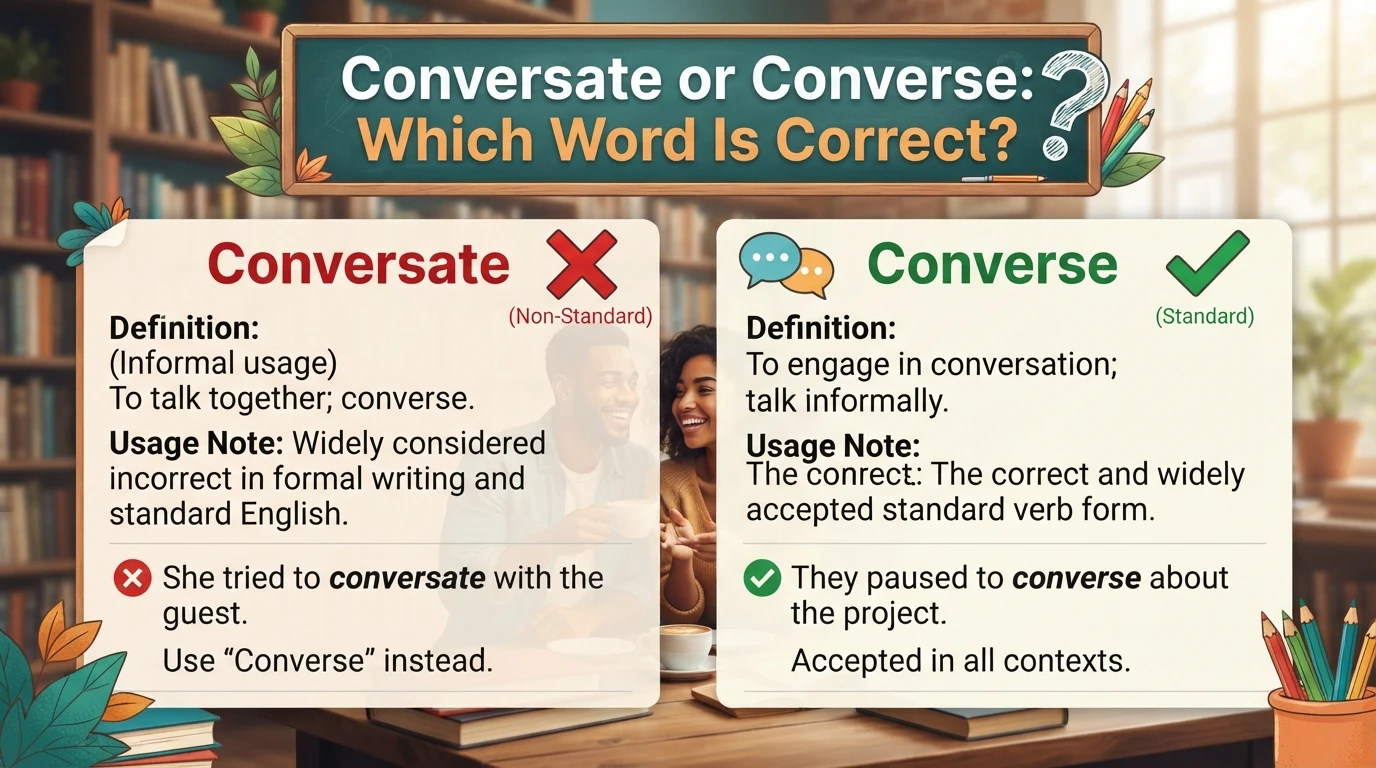
The Conversate or converse is a common grammar question that often sparks debate among English speakers and writers. While both words are used to describe talking with someone, they are not viewed equally in standard English. Converse has long been the traditional and widely accepted verb meaning “to engage in conversation,” whereas conversate has gained popularity in informal speech but is still considered nonstandard by many dictionaries and style guides. Understanding the difference can help you choose the most appropriate word for academic writing, professional communication, and everyday conversations. In this guide, we’ll explain the meanings of converse and conversate, explore their history, and clarify when each term is appropriate to use.
If you’ve ever wondered whether to use conversate or converse, you’re not alone. Both words are heard in everyday speech, social media, music, and television, but many people question whether conversate is proper English. This confusion has sparked grammar debates for years.
People search for converse ” or ” conversate “ because they want to know which word is grammatically correct, appropriate for professional writing, and accepted in modern English. While both words can refer to talking with someone, they are not viewed the same way by dictionaries, style guides, or language experts.
The good news is that the distinction is fairly simple. Converse is the traditional and widely accepted verb in Standard English, while conversate has become popular in informal speech and certain dialects. This guide explains the origins, meanings, usage, common mistakes, examples, and when each word is appropriate.
Conversate or Converse – Quick Answer
The quick answer is:
- ✅ Converse is the standard and widely accepted verb meaning “to have a conversation.”
- ⚠️ Conversate is considered nonstandard by many dictionaries and style guides, although it is commonly used in informal speech and some regional dialects.
Examples
- We conversed after the meeting. ✅
- Let’s converse about your ideas. ✅
- We conversated for hours. ⚠️ (Common in informal speech but generally avoided in formal writing.)
Comparison Table
| Word | Meaning | Formal Writing |
| Converse | To talk or have a conversation | ✅ Yes |
| Conversate | To converse | ⚠️ Usually No |
The Origin of Conversate or Converse
Origin of Converse
The word converse comes from Latin and has been part of English for centuries. It means to speak or exchange thoughts with another person.
Origin of Conversate
Conversate appeared later in English and became more common in informal speech. Although it has historical roots dating back centuries, it has never gained the same level of acceptance as converse in formal Standard English.
Why the Confusion Exists
People often create verbs by adding -ate to nouns or existing verbs. Since “conversation” is common, many naturally assume “conversate” is the correct verb.
British English vs American English Spelling
This is not a British versus American spelling difference.
Comparison Table
| Region | Preferred Standard Word |
| United States | Converse |
| United Kingdom | Converse |
| Canada | Converse |
| Australia | Converse |
Key Point
Across major English-speaking countries, converse remains the preferred choice in formal writing.
Which Word Should You Use?
Your choice depends on your audience.
Use Converse If:
- Writing academic papers.
- Writing business emails.
- Creating professional content.
- Giving presentations.
- Taking exams.
Conversate May Appear If:
- Speaking informally.
- Quoting someone.
- Writing dialogue.
- Reflecting regional speech.
- Using conversational language intentionally.
Audience-Based Advice
| Audience | Recommended Word |
| Students | Converse |
| Business Professionals | Converse |
| Journalists | Converse |
| Academic Writers | Converse |
| Casual Conversation | Converse or Conversate (depending on context) |
Common Mistakes with Conversate or Converse
Mistake 1: Using Conversate in Formal Writing
Most editors recommend using converse instead.
Mistake 2: Assuming Conversate Is Always Wrong
Although many style guides discourage it in formal writing, conversate is used in some dialects and informal speech.
Mistake 3: Confusing Conversation with Converse
“Conversation” is the noun, while “converse” is the standard verb.
Mistake 4: Believing Converse Is Old-Fashioned
Converse remains the preferred modern English verb.
Mistake 5: Ignoring Your Audience
Informal conversations allow greater flexibility than professional documents.
Conversate or Converse in Everyday Examples
Business Email
“Let’s converse about the project tomorrow.”
Classroom Example
“The students conversed respectfully during the discussion.”
Social Media Example
“I love to converse with people from different cultures.” (Informal)
News Example
“The leaders conversed before signing the agreement.”
Friendly Conversation
“We sat outside and conversed for hours.”
Conversate or Converse – Google Trends & Usage Data
Interest in conversate or converse remains high because grammar questions about the two words are common.
Popular Search Queries
- Conversate vs converse
- Is conversate a real word?
- Converse meaning
- Can you say conversate?
- Proper word converse or conversate
Common Search Intent
Users want to know:
- Correct grammar
- Dictionary acceptance
- Professional usage
- Meaning differences
- Writing recommendations
Popular Contexts
- Grammar lessons
- School assignments
- Business communication
- Social media
- English learning
Conversate vs Converse Comparison Table
| Feature | Conversate | Converse |
| Dictionary Recognition | Listed by some dictionaries, often labeled nonstandard or informal | Yes |
| Formal Writing | Not Recommended | Recommended |
| Informal Speech | Common in Some Communities | Yes |
| Academic Writing | Avoid | Yes |
| Professional Communication | Avoid | Yes |
| Standard English | Generally No | Yes |
FAQs
Which is correct, conversate or converse?
Converse is the standard verb accepted in formal English.
Is conversate a real word?
Yes. It appears in some dictionaries, but it is often labeled as nonstandard, informal, or dialectal.
Why do people say conversate?
Many speakers use it naturally in casual conversation or regional dialects.
Can I use conversate in business writing?
It is generally better to use converse in professional communication.
What does converse mean?
It means to talk or exchange ideas with another person.
Is conversational grammar incorrect?
It is widely considered nonstandard in formal English, though it is commonly used in informal speech.
Which word should students use?
Students should generally use conversational language, especially in essays, exams, and academic writing.
Conclusion:
When comparing conversate or converse, converse is the clear choice for formal, academic, and professional writing. It has been part of Standard English for centuries and is the preferred verb in dictionaries, style guides, and educational settings.
Conversate, while used by many speakers in everyday conversation and certain dialects, is still viewed as nonstandard by many language authorities. That doesn’t mean it is meaningless or never used; it simply means it may not be appropriate in situations where standard grammar is expected.
If you’re writing an email, school paper, report, or article, choose converse. If you’re writing dialogue or reflecting casual speech, conversate may appear naturally depending on the context and audience. Understanding the difference helps you communicate more effectively and choose the right word for every situation.

I am Ethan Whitmore is the founder and lead writer of Grammlii.com, passionate about exploring meanings, language, literature, and insightful ideas. Through well-researched and engaging content, he helps readers discover the deeper significance behind words, expressions, and everyday concepts.