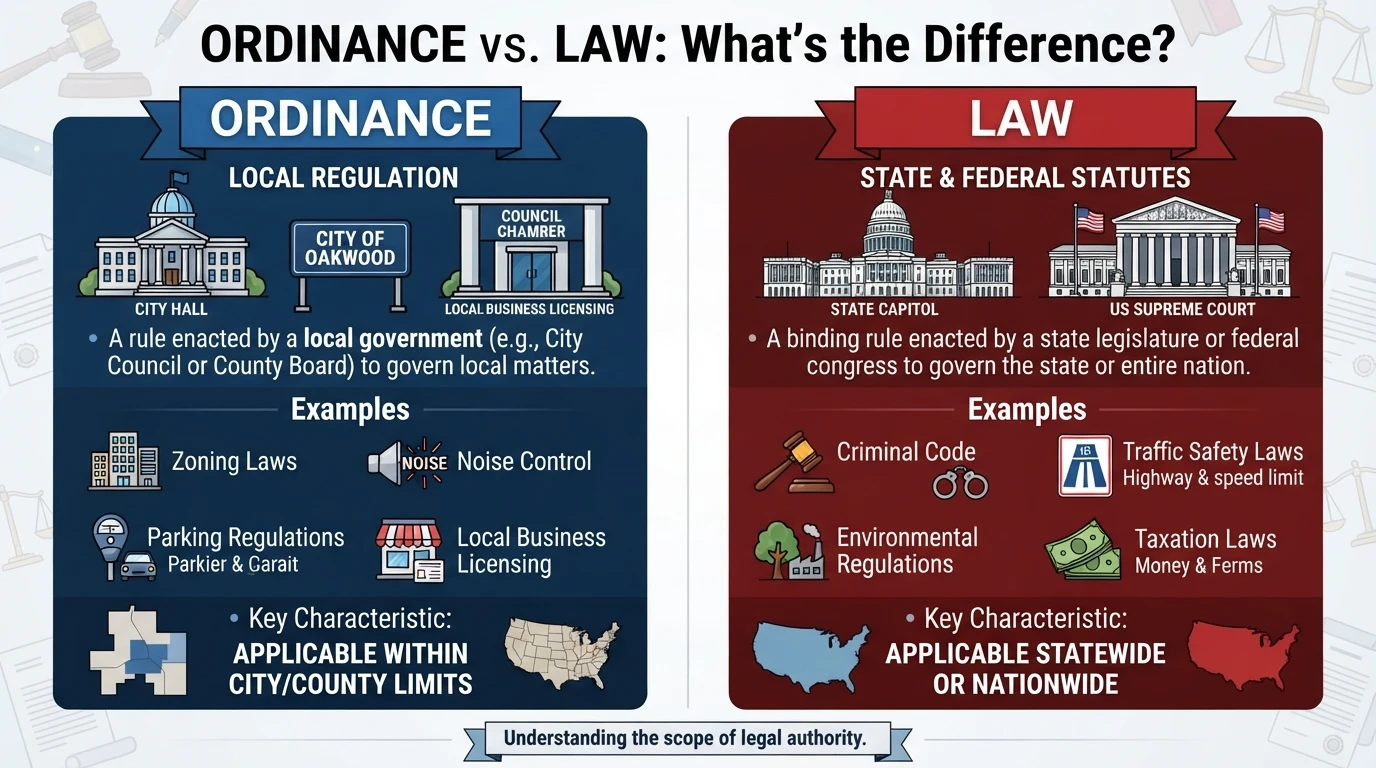
An ordinance or law is a common comparison for people trying to understand how rules are created and enforced within different levels of government. While the terms are often used interchangeably in everyday conversation, they have distinct legal meanings and apply in different contexts. Generally, a law is enacted by a state or national legislative body, whereas an ordinance is a rule or regulation adopted by a local government, such as a city or municipality. Knowing the difference between an ordinance and a law can help citizens better understand their rights, responsibilities, and the regulations that affect daily life. In this guide, we’ll explore what ordinances and laws are, how they differ, and why both play important roles in maintaining order and governance.
If you’ve ever wondered about ordinance or law, you’re not alone. These terms are often used in legal discussions, government documents, news reports, and public policies. Because both create rules that people must follow, many people assume they mean the same thing. However, there are important differences between an ordinance and a law.
People search for an ordinance or law because they want to understand how government rules are created, who has the authority to enforce them, and which one takes priority when conflicts arise. Understanding the distinction is especially important for business owners, property owners, students, and anyone interested in government or civic affairs.
The simplest way to think about it is that a law is generally created by a state or national legislative body, while an ordinance is usually created by a local government, such as a city, town, or county. This guide explains the differences, origins, examples, common mistakes, and practical applications of ordinances and laws.
Ordinance or Law – Quick Answer
The quick answer is:
- A law is a rule enacted by a state or national government.
- An ordinance is a rule enacted by a local government, such as a city or county.
Examples
- A national tax regulation is a law.
- A city noise restriction is an ordinance.
Comparison Table
| Feature | Ordinance | Law |
| Created By | Local Government | State or National Government |
| Geographic Scope | Local Area | State or Country |
| Legal Authority | Local | Broader |
| Examples | Noise rules, zoning | Criminal laws, tax laws |
The Origin of Ordinance or Law
Origin of Law
The concept of law dates back thousands of years. Laws were created to establish order, resolve disputes, protect rights, and regulate society.
Today, laws are generally passed by legislatures at the national or state level.
Origin of Ordinance
The word “ordinance” comes from a term meaning an official order or regulation. Local governments began adopting ordinances to address community-specific issues that broader laws might not cover.
Why Both Exist
National and state governments cannot effectively regulate every local issue. Ordinances allow communities to create rules tailored to local needs.
Ordinance vs Law: Key Differences
Ordinance Characteristics
- Passed by cities, towns, or counties
- Applies locally
- Often addresses community issues
- Can regulate zoning, parking, and noise
Law Characteristics
- Passed by legislatures
- Applies more broadly
- Covers major legal matters
- Can regulate crimes, taxes, and civil rights
Comparison Table
| Category | Ordinance | Law |
| Government Level | Local | State/National |
| Coverage Area | Limited | Broad |
| Enforcement | Local Authorities | State/Federal Authorities |
| Subject Matter | Community Issues | Major Legal Issues |
Which One Takes Priority?
Generally, laws have greater authority than ordinances.
When an Ordinance Applies
A local government may create an ordinance if it does not conflict with higher-level laws.
When a Law Applies
State and federal laws usually override local ordinances if there is a conflict.
Priority Table
| Situation | Higher Authority |
| City vs State Rule | State Law |
| County vs State Rule | State Law |
| Local vs Federal Rule | Federal Law |
| Community Issue | Ordinance May Apply |
Common Mistakes with Ordinance or Law
Mistake 1: Assuming They Mean the Same Thing
While similar, they come from different levels of government.
Mistake 2: Believing Ordinances Are Optional
Violating an ordinance can result in fines or penalties.
Mistake 3: Ignoring Jurisdiction
An ordinance may apply only within a specific city or county.
Mistake 4: Assuming Local Governments Can Override National Laws
Local ordinances generally cannot conflict with higher-level laws.
Mistake 5: Confusing Policies with Laws
Not every government policy is legally binding.
Ordinance or Law in Everyday Examples
City Example
“The city passed a new parking ordinance.”
State Example
“The state legislature approved a new traffic law.”
News Example
“Officials debated whether the ordinance conflicted with existing law.”
Business Example
“Businesses must comply with both local ordinances and state laws.”
Ordinance or Law – Google Trends & Usage Data
Interest in ordinance or law often increases during:
- Elections
- Local government debates
- Zoning disputes
- Public policy discussions
- Legal research projects
Popular Search Queries
- Ordinance vs law
- What is an ordinance?
- Local ordinance meaning
- Difference between ordinance and law
- Can an ordinance override a law?
Common Search Intent
Users want to understand:
- Government authority
- Legal enforcement
- Civic responsibilities
- Regulatory compliance
Ordinance vs Law Comparison Table
| Feature | Ordinance | Law |
| Definition | Local Regulation | Broader Legal Rule |
| Passed By | Local Government | Legislature |
| Scope | Local | State or National |
| Enforcement | Local Agencies | Government Authorities |
| Examples | Noise Limits, Zoning | Criminal Codes, Tax Rules |
| Overrides Other Rules | Rarely | Often |
FAQs
What is the difference between an ordinance and a law?
An ordinance is usually created by a local government, while a law is typically created by a state or national legislature.
Is an ordinance legally enforceable?
Yes. Violating an ordinance can lead to penalties, fines, or other consequences.
Can a city create its own ordinances?
Yes. Cities commonly adopt ordinances to address local issues.
Which has more authority, an ordinance or a law?
Generally, laws have greater authority than ordinances.
Can an ordinance conflict with a state law?
In most cases, local ordinances cannot legally conflict with higher-level laws.
Are zoning regulations ordinances?
Often, yes. Many zoning rules are established through local ordinances.
Do ordinances apply outside the city that created them?
No. Ordinances generally apply only within the jurisdiction that adopted them.
Conclusion:
Understanding ordinances or laws is important because both play significant roles in governing society. Although they share the common purpose of establishing rules, they differ in scope, authority, and the level of government that creates them.
In everyday life, people often encounter both. A city may have ordinances governing parking, zoning, or noise levels, while state and national laws regulate broader matters such as taxation, criminal offenses, and public safety. Understanding which rules apply and how they interact can help individuals and businesses remain compliant and informed.
Whenever you’re deciding between an ordinance or law, remember that ordinances are local rules, while laws generally come from higher levels of government and carry broader authority.

I am Oliver Bennett is the founder and writer behind Grammlii.com, where he shares insightful content on language, meanings, expressions, and effective communication. Passionate about making knowledge simple and accessible, he helps readers explore words, ideas, and their deeper significance.