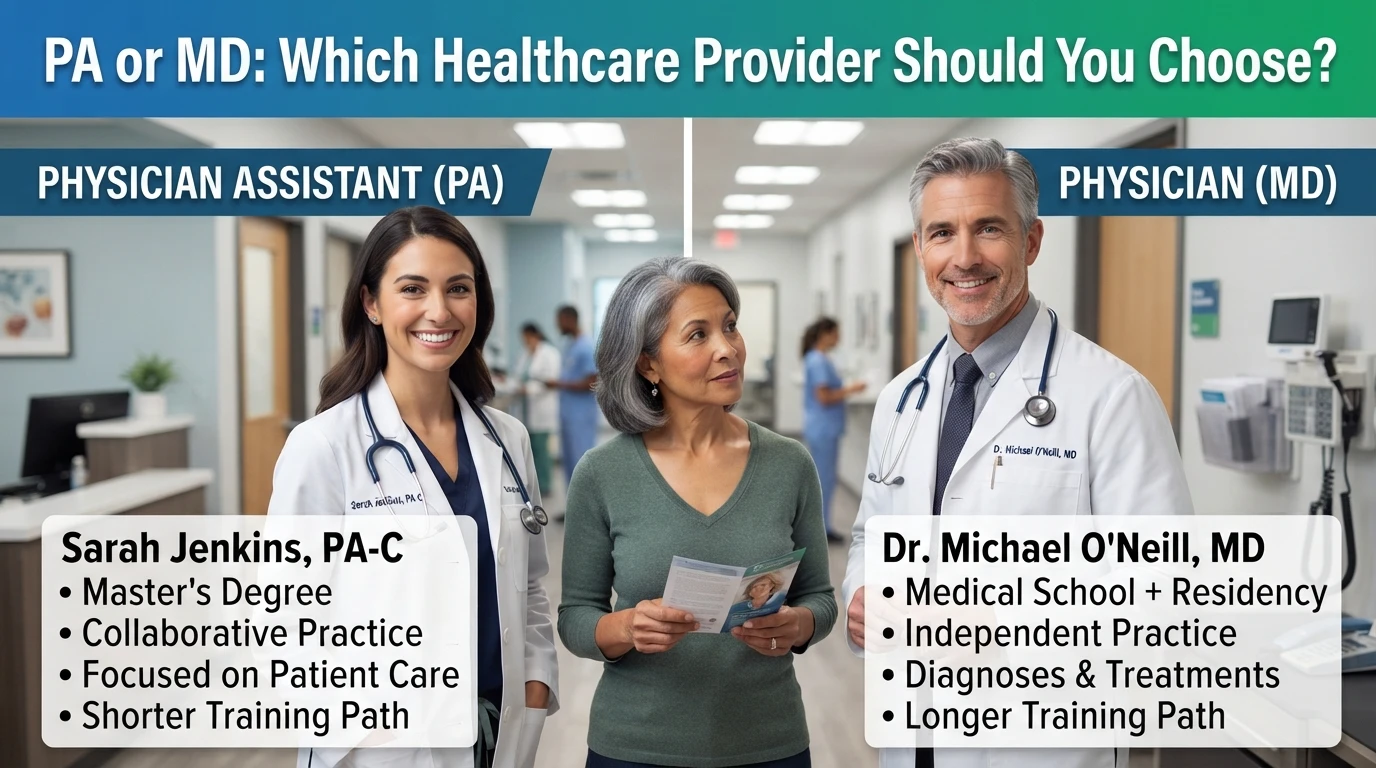
PA or MD is a common comparison for patients trying to understand who is providing their medical care. Both Physician Assistants (PAs) and Medical Doctors (MDs) play important roles in diagnosing illnesses, prescribing treatments, and helping patients stay healthy. However, their education, training, responsibilities, and scope of practice are not the same. Knowing the differences between a PA and an MD can help you make informed healthcare decisions and better understand the medical professionals you encounter. In this guide, we’ll explore what PAs and MDs do, how they differ in training and authority, and when you might choose one healthcare provider over the other.
If you’ve ever scheduled a medical appointment, you may have noticed that your healthcare provider is listed as a PA or MD. This often raises questions about qualifications, responsibilities, and whether one is better than the other. Many patients wonder if they should see a Physician Assistant (PA) or a Medical Doctor (MD) for their healthcare needs.
People search for PA or MD because they want to understand the differences in education, training, authority, and patient care. Some worry that seeing a PA means receiving lower-quality care, while others want to know when an MD is necessary.
The truth is that both PAs and MDs play important roles in modern healthcare. They often work together to diagnose illnesses, prescribe treatments, and help patients stay healthy. Understanding their similarities and differences can help you make informed healthcare decisions and feel confident about the care you receive.
PA or MD – Quick Answer
The quick answer is:
- PA (Physician Assistant or Physician Associate): A licensed medical professional who diagnoses illnesses, develops treatment plans, and often works with physicians.
- MD (Medical Doctor): A physician who has completed medical school and extensive residency training and can independently practice medicine.
Example
- A PA may treat a sinus infection, perform physical exams, and prescribe medication.
- An MD may handle complex surgeries, specialized treatments, and advanced medical cases.
| Feature | PA | MD |
| Medical License | Yes | Yes |
| Can Diagnose Patients | Yes | Yes |
| Can Prescribe Medication | Yes (varies by location) | Yes |
| Medical School Required | No | Yes |
| Residency Required | No | Yes |
| Independent Practice | Limited in some areas | Yes |
The Origin of PA and MD
Origin of PA
The Physician Assistant profession was created in the United States during the 1960s to address physician shortages and improve access to healthcare. The profession has grown significantly and now plays a major role in hospitals, clinics, and private practices.
Origin of MD
The title Doctor of Medicine (MD) has existed for centuries. Medical education evolved through universities and formal medical training programs, eventually becoming the standard path for physicians worldwide.
Why the Comparison Exists
Patients often compare PA and MD because both professionals can provide many of the same healthcare services, including diagnosing illnesses and prescribing treatments.
PA vs MD Education and Training
One of the biggest differences between a PA and an MD is training length.
Physician Assistant (PA)
- Bachelor’s degree
- PA master’s program
- Clinical rotations
- National licensing examination
Typical training: 6–8 years
Medical Doctor (MD)
- Bachelor’s degree
- Medical school
- Residency training
- Optional fellowship specialization
Typical training: 11–15+ years
Comparison Table
| Education Step | PA | MD |
| Bachelor’s Degree | Yes | Yes |
| Graduate Program | PA School | Medical School |
| Residency | Usually No | Required |
| Fellowship | Rare | Optional |
| Total Training Time | 6–8 Years | 11–15+ Years |
Which Provider Should You Choose?
The best choice depends on your medical needs.
Choose a PA If:
- You need routine healthcare.
- You have a minor illness.
- You need preventive care.
- You want faster appointment availability.
Choose an MD If:
- You have a complex medical condition.
- You need specialized treatment.
- You require surgery.
- You have a rare or difficult diagnosis.
Audience-Based Advice
| Situation | Recommended Provider |
| Routine Checkup | PA or MD |
| Common Illness | PA or MD |
| Chronic Disease Management | PA or MD |
| Major Surgery | MD |
| Complex Diagnosis | MD |
| Preventive Care | PA or MD |
Common Mistakes with PA or MD
Mistake 1: Assuming PAs Are Nurses
PAs are not nurses. They receive specialized medical training and practice medicine.
Mistake 2: Believing Only MDs Can Diagnose Illnesses
PAs regularly diagnose and treat many conditions.
Mistake 3: Thinking PAs Provide Lower-Quality Care
Studies often show high patient satisfaction with PA-provided care.
Mistake 4: Avoiding PAs for Routine Care
Many routine healthcare needs can be effectively managed by a PA.
Mistake 5: Assuming All Cases Require an MD
Many common medical issues can be safely handled by either provider.
PA or MD in Everyday Examples
Email Example
“I have an appointment with a PA next week for my annual physical.”
News Example
“Healthcare systems are increasingly using both PAs and MDs to improve patient access.”
Social Media Example
“My PA was very knowledgeable and helped me understand my treatment options.”
Formal Writing Example
“The clinic employs both PAs and MDs to provide comprehensive patient care.”
PA or MD – Google Trends & Usage Data
Interest in PA or MD searches has grown as healthcare systems rely more heavily on team-based care.
Popular Search Countries
- United States
- Canada
- Australia
- United Kingdom
Common Search Queries
- PA vs MD salary
- PA vs doctor
- Is a PA the same as an MD?
- Can a PA prescribe medication?
- PA or MD for primary care
Search Intent
Most users want to understand:
- Qualifications
- Scope of practice
- Salary differences
- Career paths
- Patient care differences
PA vs MD Comparison Table
| Category | PA | MD |
| Full Meaning | Physician Assistant/Associate | Medical Doctor |
| Medical Training | Advanced | Extensive |
| Diagnoses Patients | Yes | Yes |
| Prescribes Medication | Yes | Yes |
| Performs Surgery | Limited Assistance | Yes |
| Independent Practice | Varies | Yes |
| Typical Education Length | 6–8 Years | 11–15+ Years |
| Specialization Options | Some | Extensive |
FAQs
Is a PA the same as an MD?
No. Both provide medical care, but MDs receive more extensive education and training.
Can a PA prescribe medication?
Yes. In most regions, licensed PAs can prescribe medications.
Is it okay to see a PA instead of an MD?
Yes. Many routine medical concerns can be managed effectively by a PA.
Who earns more, a PA or an MD?
MDs generally earn significantly more due to their longer training and broader responsibilities.
Can a PA perform surgery?
PAs may assist in surgeries, but MD surgeons typically perform major surgical procedures.
Do PAs work independently?
Rules vary by location, but many PAs work collaboratively with physicians.
Which provider is better for primary care?
Both PAs and MDs can provide excellent primary care services.
Conclusion:
When comparing PA or MD, it is important to understand that both are highly trained healthcare professionals who play valuable roles in patient care. While MDs complete more years of education and residency training, PAs are also qualified to diagnose illnesses, prescribe medications, order tests, and develop treatment plans for many medical conditions.
For routine healthcare, preventive services, and common illnesses, many patients receive excellent care from PAs. For highly specialized conditions, major surgeries, or complex diagnoses, an MD may be the preferred choice. In many healthcare settings, PAs and MDs work together as part of a collaborative team to ensure patients receive high-quality care.
Rather than focusing solely on titles, patients should consider their healthcare needs, the provider’s experience, and the type of treatment required. Both PAs and MDs contribute significantly to modern healthcare and help improve access to medical services for millions of people.

I am Ethan Whitmore is the founder and lead writer of Grammlii.com, passionate about exploring meanings, language, literature, and insightful ideas. Through well-researched and engaging content, he helps readers discover the deeper significance behind words, expressions, and everyday concepts.