Unconsolable or inconsolable is a question many English learners, writers, and even native speakers search online. At first glance, both words seem correct because they look similar and share the same meaning. However, only one of them is accepted in standard English.
People often encounter this confusion while writing emails, essays, news articles, condolence messages, or social media posts. Spell-check tools may flag one version, leading writers to wonder whether the difference comes from British and American English rules or simple spelling mistakes.
If you’ve ever paused while typing and asked yourself, “Is it unconsolable or inconsolable?” this guide will clear up the confusion. You’ll learn the correct spelling, the origin of the word, whether regional English affects its usage, common mistakes to avoid, and how to use the word correctly in everyday writing.
By the end of this article, you’ll know exactly which spelling to choose and why.
Unconsolable or Inconsolable – Quick Answer
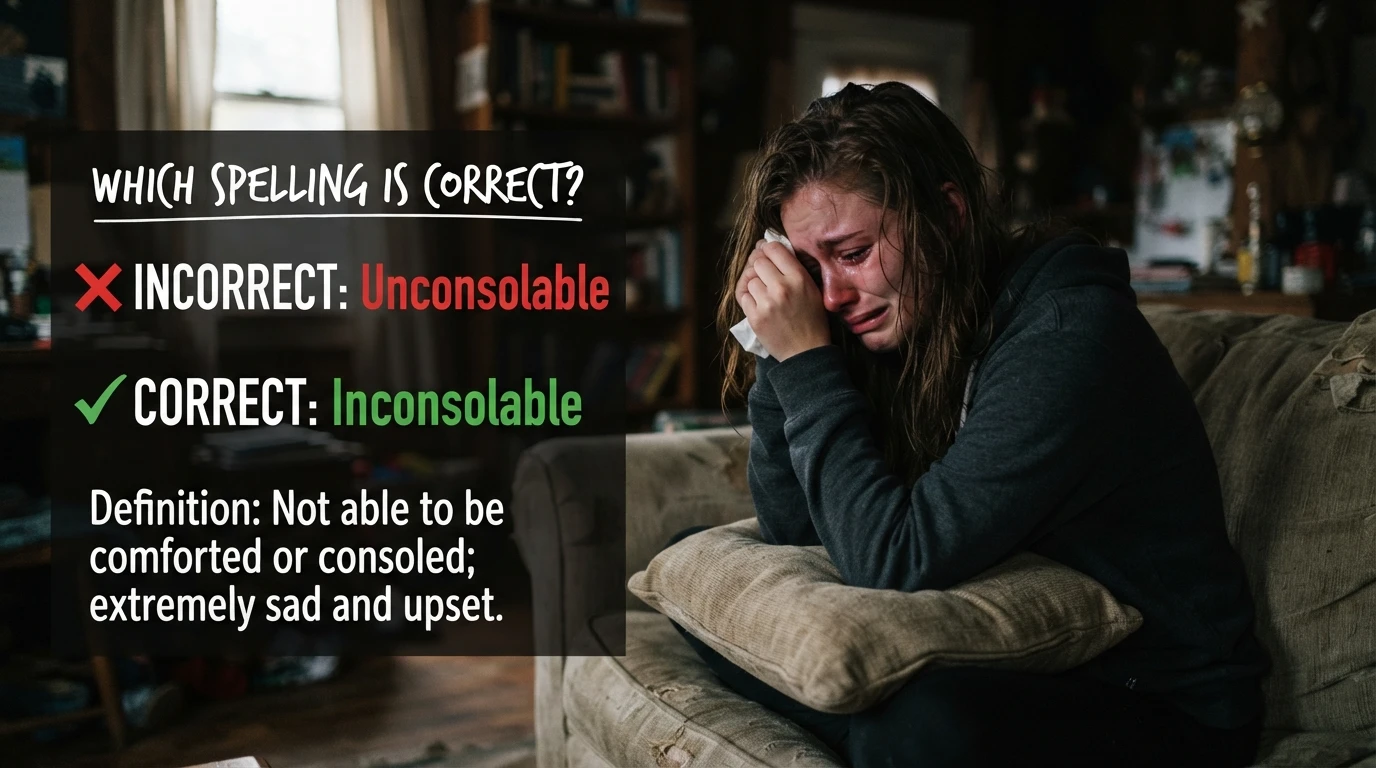
The correct spelling is inconsolable.
Unconsolable is considered incorrect in standard English and does not appear in major dictionaries as an accepted alternative spelling.
Correct Examples
- She was inconsolable after hearing the sad news.
- The child became inconsolable when he lost his favorite toy.
- Fans were inconsolable after the team’s defeat.
Incorrect Examples
- ❌ She was inconsolable after hearing the sad news.
- ❌ The baby remained inconsolable all night.
Quick Rule
- ✅ Inconsolable = Correct
- ❌ Unconsolable = Incorrect
The Origin of Inconsolable
The word inconsolable comes from the Latin word consolari, which means “to comfort” or “to soothe.”
The prefix in- means “not” or “unable to.” When combined, the word literally means:
Unable to be comforted.
The term entered English through French and has been used for centuries to describe deep grief or sadness that cannot easily be eased.
Why Does the Spelling Confusion Exist?
English contains many words that use either in- or un- as negative prefixes.
For example:
| Word | Meaning |
| Incomplete | Not complete |
| Invisible | Not visible |
| Unhappy | Not happy |
| Unfair | Not fair |
Because un- is a very common negative prefix, many people naturally assume that unconsolable should also be correct. However, historical usage established inconsolable as the standard form.
British English vs American English Spelling
Unlike words such as “colour/color” or “organise/organise,” this word does not change between British and American English.
Both varieties use the same spelling.
Comparison Table
| Feature | British English | American English |
| Correct spelling | Inconsolable | Inconsolable |
| Unconsolable accepted? | No | No |
| Meaning | Unable to be comforted | Unable to be comforted |
| Formal usage | Yes | Yes |
| Dictionary support | Yes | Yes |
Examples
British English:
- The family was inconsolable after the tragedy.
American English:
- The family was inconsolable after the tragedy.
The spelling remains identical across both forms of English.
Which Spelling Should You Use?
The answer is simple.
If You Write for a US Audience
Use inconsolable.
If You Write for a UK Audience
Use inconsolable.
If You Write for Australia, Canada, New Zealand, or Other Commonwealth Countries
Use inconsolable.
If You Write for a Global Audience
Use inconsolable.
There is no situation in professional writing where unconsolable is preferred.
Professional Advice
If you accidentally type unconsolable, revise it before publishing, submitting assignments, or sending formal communications.
Common Mistakes with Inconsolable
Many writers make similar errors when using this word.
1. Using “Unconsolable”
❌ The widow was inconsolable.
✅ The widow was inconsolable.
2. Confusing the Meaning
Some people think the word means “slightly upset.”
Actually, it describes extreme sadness that cannot be comforted.
❌ He was inconsolable because his coffee was cold.
✅ She was inconsolable after losing a loved one.
3. Overusing the Word
Because the word is strong, it works best for serious situations.
Use it carefully.
4. Spelling Errors
Common misspellings include:
- unconsolable
- inconsolible
- inconsolabel
- inconsoluble
The correct form is always:
✅ inconsolable
Inconsolable in Everyday Examples
Here are examples showing how the word appears in different contexts.
Emails
We were inconsolable after learning of your loss and extend our deepest sympathies.
News Writing
Witnesses described the parents as inconsolable following the accident.
Social Media
I just finished the final episode, and now I’m absolutely inconsolable.
Formal Writing
The patient appeared inconsolable despite repeated attempts at reassurance.
Casual Conversation
She was inconsolable when her dog ran away.
These examples show that the word can fit both formal and informal settings, depending on the situation.
Inconsolable – Google Trends & Usage Data
Search interest in “unconsolable or inconsolable” often rises because people question whether both spellings are acceptable.
Usage Patterns
- Inconsolable is widely used in books, newspapers, academic writing, and professional communication.
- Unconsolable mainly appears in user searches, spelling mistakes, and discussions about correct usage.
- English learners frequently search for the phrase to verify dictionary-approved spelling.
Popularity by Region
| Country/Region | Preferred Form |
| United States | Inconsolable |
| United Kingdom | Inconsolable |
| Canada | Inconsolable |
| Australia | Inconsolable |
| New Zealand | Inconsolable |
The evidence strongly supports inconsolable as the universal standard.
Comparison Table: Keyword Variations
| Variation | Correct? | Meaning | Recommended Use |
| Inconsolable | ✅ Yes | Unable to be comforted | Always |
| Unconsolable | ❌ No | Intended to mean the same thing | Avoid |
| Inconsolably | ✅ Yes | In a way that cannot be comforted | Acceptable |
| Consolable | ✅ Yes | Able to be comforted | Acceptable |
FAQs
Is unconsolable a real word?
No. Standard dictionaries recognize inconsolable as the correct spelling.
Is it inconsolable British or American?
It is used in both British and American English.
What does inconsolable mean?
It means being so upset or sad that comfort cannot ease the pain.
Why do people write inconsolable?
People often assume the negative prefix should be un- because many English words follow that pattern.
Can I use inconsolable in formal writing?
Yes. It is appropriate in academic, professional, journalistic, and literary contexts.
What is the opposite of inconsolable?
The opposite is consolable, meaning capable of being comforted.
Is inconsolable too dramatic?
It can be strong, so reserve it for situations involving intense distress or grief.
Conclusion:
The confusion between unconsolable and inconsolable is understandable. English contains many words that use different negative prefixes, making it easy to assume both versions are acceptable. However, standard English recognizes only one correct spelling: inconsolable.
The good news is that you do not need to worry about regional differences. British English, American English, and other major forms of English all use the same spelling. If you’re writing an email, school assignment, news article, or social media post, inconsolable is the word you should choose.
Remember that the term describes profound sadness or grief that cannot easily be comforted. Because of its emotional strength, use it thoughtfully and in appropriate situations.
If you ever hesitate between unconsolable and inconsolable, follow this simple rule: if you want the correct, professional, and widely accepted form, choose inconsolable every time.

I am Ethan Whitmore is the founder and lead writer of Grammlii.com, passionate about exploring meanings, language, literature, and insightful ideas. Through well-researched and engaging content, he helps readers discover the deeper significance behind words, expressions, and everyday concepts.