Have you ever stopped while writing and wondered whether to use awhile or a while? You are not alone.
These two forms look almost the same, sound the same, and have very close meanings. However, they are not always used in the same way.
The good news is that the difference is easy to learn. Both forms refer to a short or unspecified period of time.
The main difference is how they work in a sentence. Awhile is an adverb, while a while is a noun phrase. Knowing this small grammar rule can help you write better emails, school papers, blog posts, and everyday messages.
Many people search for this phrase because spell-check tools may accept both forms without explaining when to use each one.
This guide will show you the simple rules, common mistakes, and real-life examples. By the end, you will know exactly when to write awhile and when to write a while.
Awhile or a While – Quick Answer
The correct choice depends on how you use the phrase in a sentence.
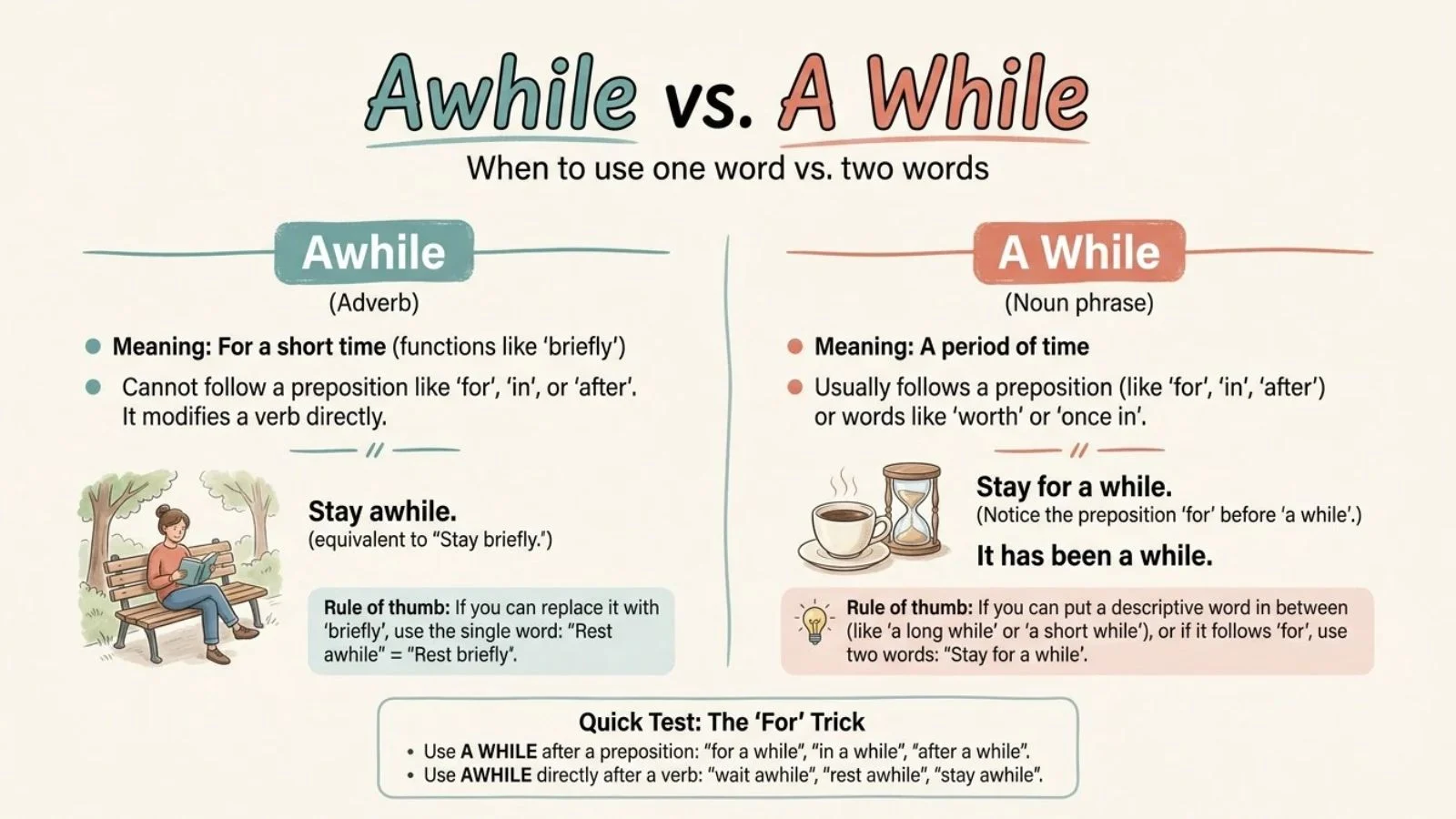
- Awhile: One word. It is an adverb that means for a short time.
- A while: Two words. It is a noun phrase that means a period of time.
Examples of Awhile:
- Please stay awhile.
- We talked awhile after dinner.
- Sit awhile and enjoy the view.
Examples of A While:
- I have not seen you in a while.
- Wait for a while before calling.
- It has been a while since we last met.
Easy Grammar Trick
Use awhile when you do not need the word “for” before it.
Use a while when the sentence needs a noun phrase, often after “for” or “in.”
For example:
- Correct: Stay awhile.
- Correct: Stay for a while.
- Incorrect: Stay for awhile.
Remember this simple rule, and you will avoid most mistakes.
The Origin of Awhile or a While
The words “awhile” and “a while” come from the same basic English expression.
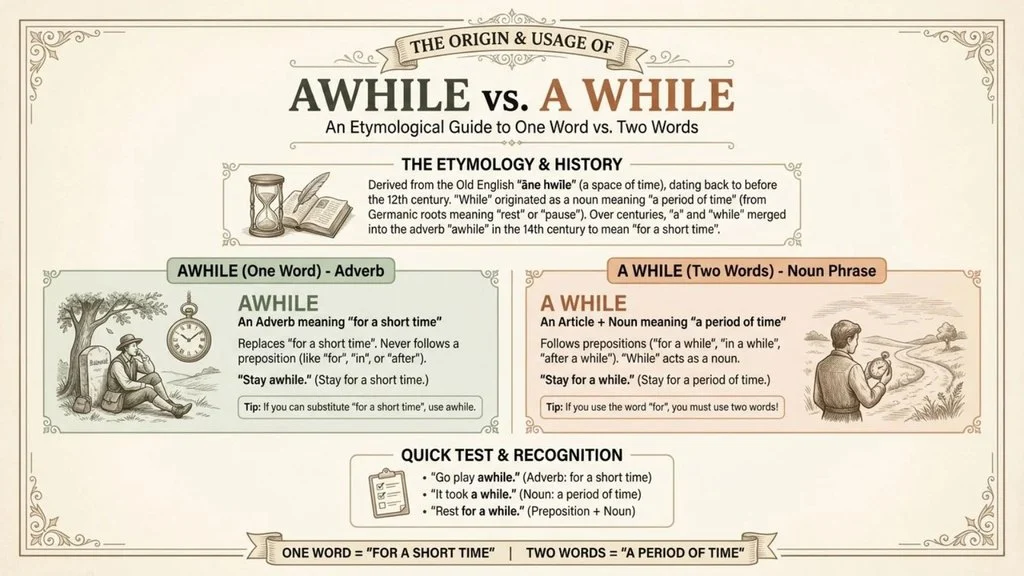
The word while has Old English roots. It comes from the Old English word hwil, which means a period of time or a space of time.
Over time, English speakers began using “a while” to describe a period of time. The two-word phrase became common in everyday speech and writing.
Later, “awhile” developed as a single-word form. It works as an adverb and means “for a short time.”
Although both forms share the same meaning, their grammar is different.
Here is how they developed:
- While: A word that describes a period of time.
- A while: A phrase that means a period of time.
- Awhile: An adverb that means for a short time.
Today, both forms are accepted in standard English. The important thing is to use the correct form in the right sentence.
British English vs American English Spelling
There is no major spelling difference between British and American English when it comes to awhile and a while.
Both forms are used in the United States and the United Kingdom. The grammar rules are also the same.
However, writing styles and personal preferences may affect which form people use more often.
American English
American writers use both forms.
Examples:
- Stay awhile.
- I have not visited in a while.
- We waited for a while.
British English
British writers also use both forms.
Examples:
- Come and sit awhile.
- It has been a while since we spoke.
- Please wait for a while.
British vs American Comparison Table
| Feature | American English | British English |
| Awhile | Correct | Correct |
| A while | Correct | Correct |
| Stay awhile | Correct | Correct |
| Wait for a while | Correct | Correct |
| In a while | Correct | Correct |
| Grammar rules | Same | Same |
Key takeaway: Neither spelling belongs to only British or American English. Both countries use the same grammar rules.
Which Spelling Should You Use?
Your choice should depend on the sentence, not the country where your readers live.
For American Readers
If you write for an American audience, use both forms according to their grammar roles.
Examples:
- I will be back awhile.
- I will be back in a while.
The second example is more natural in many everyday situations.
For British and Commonwealth Readers
British, Australian, Canadian, and other Commonwealth readers follow the same basic rule.
Examples:
- Rest awhile before you continue.
- We have not spoken in a while.
For Global Readers
If you write for a global audience, choose the form that makes your sentence clear.
Here are some useful tips:
- Use “awhile” after verbs when you mean for a short time.
- Use “a while” after prepositions such as “for” and “in.”
- Avoid changing the spelling just to match a country’s English style.
- Keep your grammar consistent.
Professional advice: Learn the difference between an adverb and a noun phrase. This will help you use both forms correctly in any type of English writing.
Common Mistakes with Awhile or a While
Many writers confuse these forms because they sound alike. However, a few simple rules can help you avoid errors.
1. Writing “For Awhile”
Incorrect: Please wait for awhile.
Correct: Please wait for a while.
Why? The word “for” needs a noun phrase. “A while” is the correct choice.
2. Writing “In Awhile”
Incorrect: I will see you in awhile.
Correct: I will see you in a while.
Why? The preposition “in” is followed by the noun phrase “a while.”
3. Using “A While” Without a Preposition
Incorrect: Please sit a while.
Correct: Please sit awhile.
Note: “Sit a while” can also be acceptable in some constructions, especially where “a while” functions as a time expression. However, “sit awhile” is a simple and natural choice.
4. Confusing Meaning and Grammar
Both forms refer to time, but they do not work in exactly the same way.
Incorrect: Stay for awhile.
Correct: Stay for a while.
5. Using One Form Everywhere
Do not assume that one spelling is always correct.
Examples:
- Wait awhile.
- Wait for a while.
- I will return in a while.
Each sentence uses a form that fits its grammar.
Awhile or a While in Everyday Examples
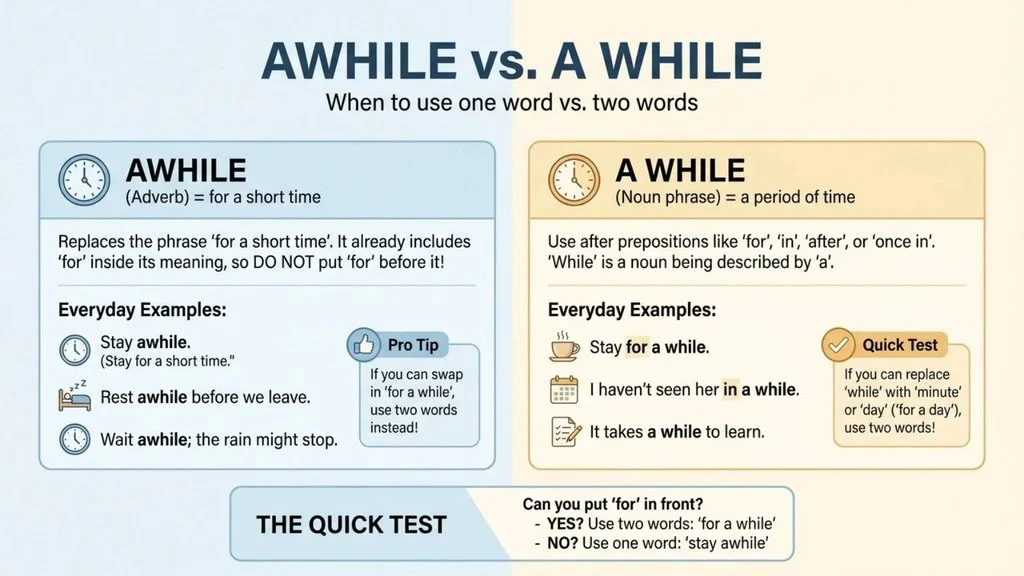
Understanding grammar is easier when you see it in real situations.
Here are examples from emails, news, social media, and formal writing.
1. In Emails
Emails often use these expressions when talking about time or asking someone to wait.
Examples:
- Please stay awhile after the meeting.
- I have not heard from you in a while.
- Could you wait for a while? I will send the details soon.
2. In News Writing
News articles may use these phrases to describe events that happen over time.
Examples:
- The team rested awhile before returning to practice.
- The city has not seen heavy rain in a while.
- Officials waited for a while before making an announcement.
3. On Social Media
People use these expressions in casual posts, comments, and captions.
Examples:
- Just relaxing awhile!
- It has been a while since our last trip.
- Stay awhile and enjoy the moment.
4. In Formal Writing
In professional writing, correct grammar helps make your message clear.
Examples:
- The committee paused awhile before continuing.
- The project has been under review for a while.
- The report will be available in a while.
5. In Everyday Conversations
These phrases are also common in daily speech.
Examples:
- Come over and stay awhile.
- I will call you in a while.
- Let’s sit here for a while.
Awhile or a While Google Trends & Usage Data
People often search for “awhile or a while” because both forms look correct and have similar meanings.
Search interest can change based on location, writing habits, education, and grammar questions.
There is no reliable fixed ranking that proves one form is more popular in every country. Google Trends also measures relative search interest, not the total number of times a phrase appears in writing.
Usage in Different Countries
| Country | Common Usage |
| United States | Both forms are used |
| United Kingdom | Both forms are used |
| Canada | Both forms are used |
| Australia | Both forms are used |
| New Zealand | Both forms are used |
| India | Both forms are used |
Why Do People Search for These Words?
There are several reasons:
- Grammar confusion: People want to know whether to use one word or two.
- Writing mistakes: Writers want to check their spelling.
- School assignments: Students need help with English grammar.
- Professional writing: Workers want their emails and reports to be correct.
- Search engine questions: People want a quick answer with simple examples.
Which Form Is More Common?
The two-word form “a while” is widely used in everyday expressions such as “in a while” and “for a while.”
The one-word form “awhile” is also correct, but it is more limited by its grammatical role.
For accurate country-by-country search comparisons, use the Google Trends tool and compare both phrases over the same time period.
Awhile vs A While: Comparison Table
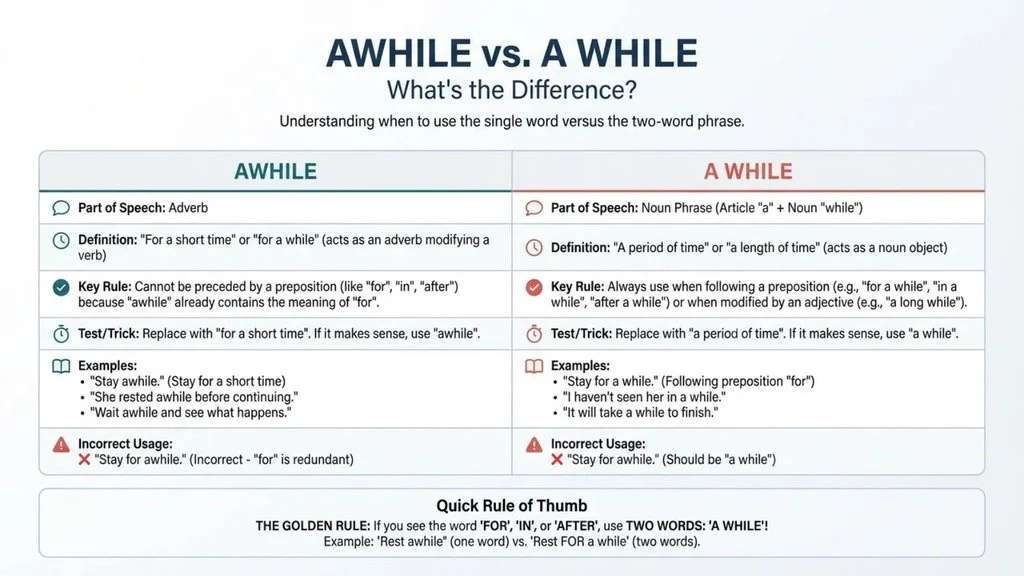
Here is a simple table to help you remember the difference.
| Word or Phrase | Meaning | Grammar | Example |
| Awhile | For a short time | Adverb | Stay awhile. |
| A while | A period of time | Noun phrase | Wait for a while. |
| For a while | During a period of time | Prepositional phrase | I stayed for a while. |
| In a while | After some time | Prepositional phrase | See you in a while. |
| Quite a while | A fairly long time | Noun phrase | It took quite a while. |
| Once in a while | Occasionally | Expression | I travel once in a while. |
Remember: Awhile is one word, while a while is two words. Both are correct, but their grammar is different.
FAQs About Awhile or a While
1. Is it awhile or a while?
Both are correct. “Awhile” is an adverb meaning for a short time. “A while” is a noun phrase meaning a period of time.
Examples:
- Stay awhile.
- Stay for a while.
2. Is “for awhile” grammatically correct?
No. In standard English, “for awhile” is incorrect because the preposition “for” should be followed by a noun phrase.
Correct: Wait for a while.
3. Should I write “in awhile” or “in a while”?
The correct form is “in a while.”
Example: I will see you in a while.
The word “in” takes the noun phrase “a while.”
4. Is awhile one word or two words?
“Awhile” is one word. It is an adverb that means for a short time.
Example: Please stay awhile.
“A while” is two words and refers to a period of time.
5. Is awhile formal or informal?
“Awhile” is acceptable in both formal and informal writing. However, “a while” is often more natural in everyday expressions such as “in a while” and “for a while.”
6. Is “stay awhile” correct?
Yes! “Stay awhile” is grammatically correct.
Example: Please stay awhile and enjoy the party.
Here, “awhile” describes how long someone should stay.
7. What is the difference between awhile and a long while?
“Awhile” means for a short or unspecified time. “A long while” means a fairly long period of time.
Examples:
- Sit awhile.
- I have not seen him in a long while.
Conclusion
Understanding the difference between awhile or a while is simple once you learn their grammar roles.
Both forms are correct, but they are not interchangeable in every sentence. “Awhile” is an adverb that means for a short time. “A while” is a noun phrase that refers to a period of time.
Remember the easiest rule: write “stay awhile” when you do not need the word “for.” Write “stay for a while” when you use the preposition “for.” The same idea applies to expressions such as “in a while” and “once in a while.”

I am Ethan Whitmore is the founder and lead writer of Grammlii.com, passionate about exploring meanings, language, literature, and insightful ideas. Through well-researched and engaging content, he helps readers discover the deeper significance behind words, expressions, and everyday concepts.