Have you ever wondered whether to write sneaked or snuck? You are not alone. Many English learners and native speakers find these two words confusing.
Both words describe the act of moving quietly, secretly, or without being noticed. However, they differ in how they are formed and how they are used.
The confusion often comes from irregular verbs. Most English verbs form their past tense by adding -ed.
For example, walk becomes walked, and talk becomes talked. But some verbs have different past forms. Sneak is one of them. Its two common past-tense forms are sneaked and snuck.
So, which one should you use in everyday writing? Is sneaked more correct than snuck? Does British English prefer one form, while American English prefers the other?
Sneaked or Snuck – Quick Answer
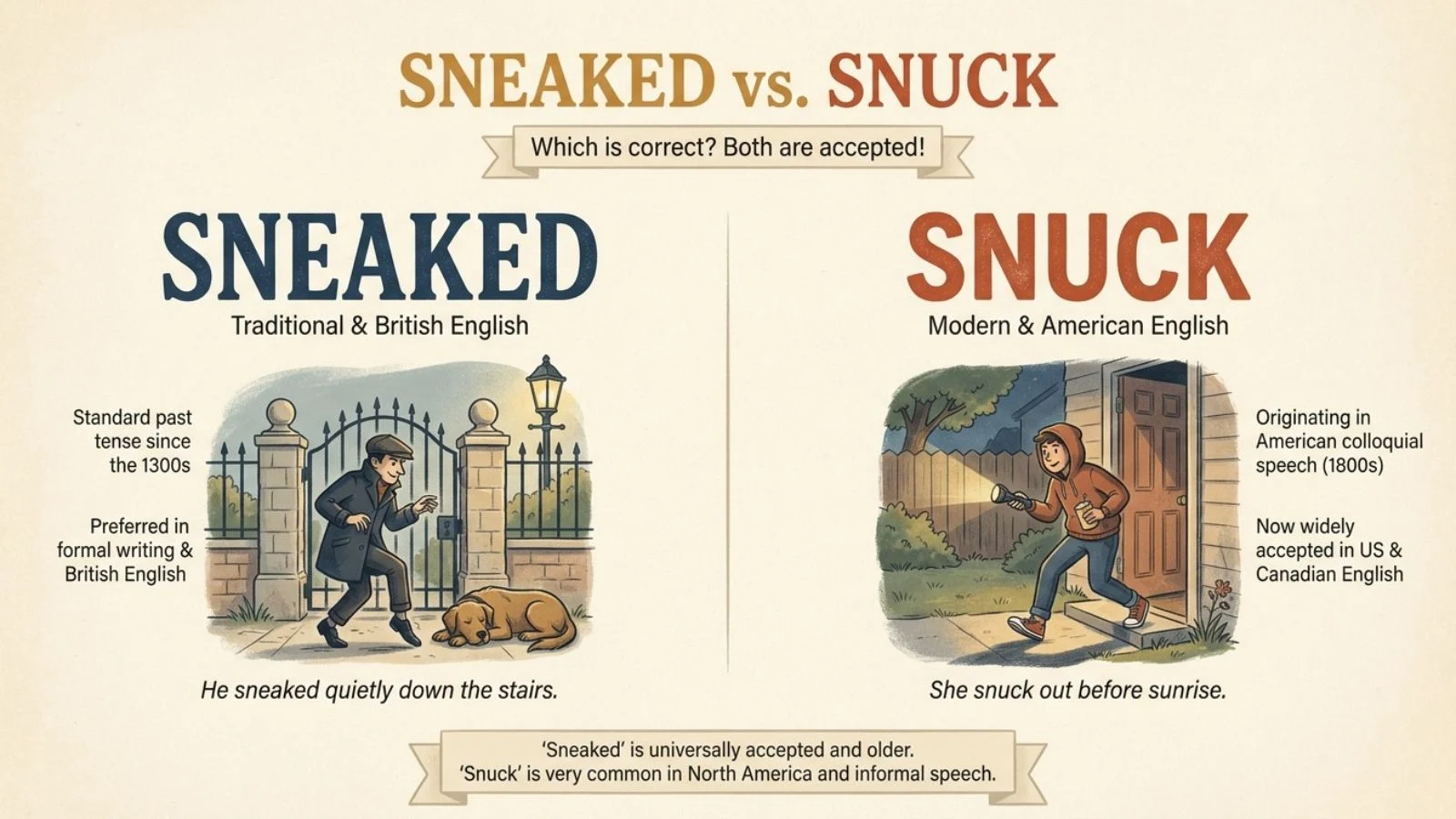
Both sneaked and snuck are correct past-tense forms of the verb sneak.
- Sneaked: The traditional regular past-tense form.
- Snuck: An irregular past-tense form that is especially common in American English.
Both words have the same meaning: to move quietly or secretly to avoid being seen or heard.
Examples:
- She sneaked into the kitchen at midnight.
- She snuck into the kitchen at midnight.
- He sneaked out of the house.
- He snuck out of the house.
Both versions are grammatically correct.
Quick tip: Use sneaked for a more traditional or formal tone. Use snuck for casual conversations and informal writing, especially in American English.
The Origin of Sneaked or Snuck
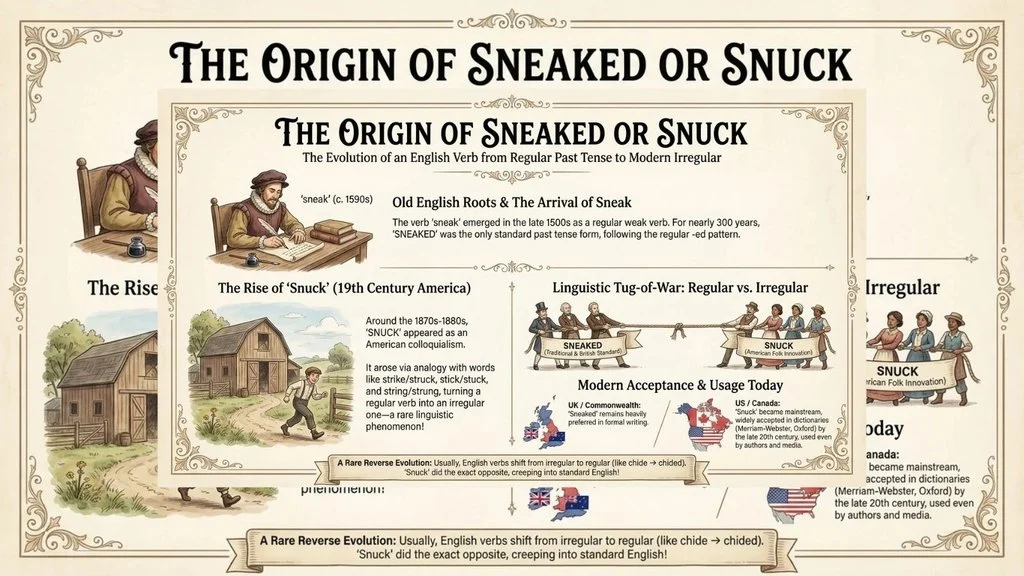
The word sneak has an interesting history. It has been used in English for centuries to describe someone who moves quietly or secretly.
The verb sneak appeared in English around the late 16th century. It was likely influenced by words related to creeping or moving silently.
Originally, sneak followed the regular English verb pattern. Speakers added -ed to form its past tense.
For example:
- Present: Sneak
- Past: Sneaked
- Past participle: Sneaked
Over time, people also began using snuck as an irregular past-tense form.
This form became popular in American English during the 19th century. It follows a pattern similar to other irregular verbs, such as:
- Stick → Stuck
- Strike → Struck
- Stick → Stuck
Although snuck started as a less traditional form, it became widely accepted through everyday speech and writing.
Today, both forms are recognized in modern English dictionaries.
British English vs American English Spelling
The difference between sneaked and snuck is not a simple spelling rule. Both forms are accepted in British and American English, but their popularity can vary.
American English
American English commonly uses both forms. However, snuck is especially popular in everyday conversation, informal writing, and storytelling.
Examples:
- The children snuck into the cinema.
- He sneaked a look at the answer.
- She snuck out after dinner.
British English
British English also accepts both forms. Sneaked has traditionally been more common in formal and traditional British writing.
Examples:
- He sneaked into the room.
- The cat sneaked past the sleeping dog.
- She snuck out before anyone noticed.
Comparison Table
| Feature | British English | American English |
| Sneaked | Common | Common |
| Snuck | Accepted | Very common |
| Formal writing | Sneaked often preferred | Both accepted |
| Casual speech | Both used | Snuck especially popular |
| Meaning | Same | Same |
The main difference is usage preference, not grammatical correctness. You can use either form in both varieties of English.
Which Spelling Should You Use?
Choosing between sneaked and snuck depends on your audience, writing style, and purpose.
Here is some simple advice.
1. For American English
Use either form. Snuck sounds natural in everyday conversations, while sneaked works well in both casual and formal writing.
Examples:
- He snuck into the office.
- He sneaked into the office.
2. For British English
Sneaked is a safe choice, especially for formal writing. However, snuck is also accepted and understood.
Examples:
- The boy sneaked downstairs.
- The boy snuck downstairs.
3. For Australian and Canadian English
Both forms are understood. Sneaked is a good traditional choice, while snuck is common in informal usage.
4. For Academic and Professional Writing
Choose the form that matches your organization’s style guide. If you are unsure, sneaked is a conservative choice.
5. For Global Audiences
Both words are correct, so focus on consistency. Avoid switching between the two forms without a reason.
Common Mistakes with Sneaked or Snuck
Although both forms are correct, people sometimes use them incorrectly.
Here are some common mistakes to avoid.
Mistake 1: Thinking Snuck Is Always Wrong
Incorrect idea: Snuck is not a real English word.
Correct: Snuck is a recognized irregular past-tense form of sneak.
Mistake 2: Using Sneak Instead of Sneaked
Incorrect: She sneak into the room yesterday.
Correct: She sneaked into the room yesterday.
Mistake 3: Mixing Past and Present Tense
Incorrect: He snuck into the room and takes the money.
Correct: He snuck into the room and took the money.
Mistake 4: Using Snucked
Incorrect: The dog snucked into the garden.
Correct: The dog snuck into the garden.
Snuck is already a past-tense form. It does not need another -ed.
Mistake 5: Thinking Both Words Have Different Meanings
Incorrect idea: Sneaked means moving quietly, while snuck means stealing.
Correct: Both words have the same basic meaning. The difference is their verb form and style.
Sneaked or Snuck in Everyday Examples
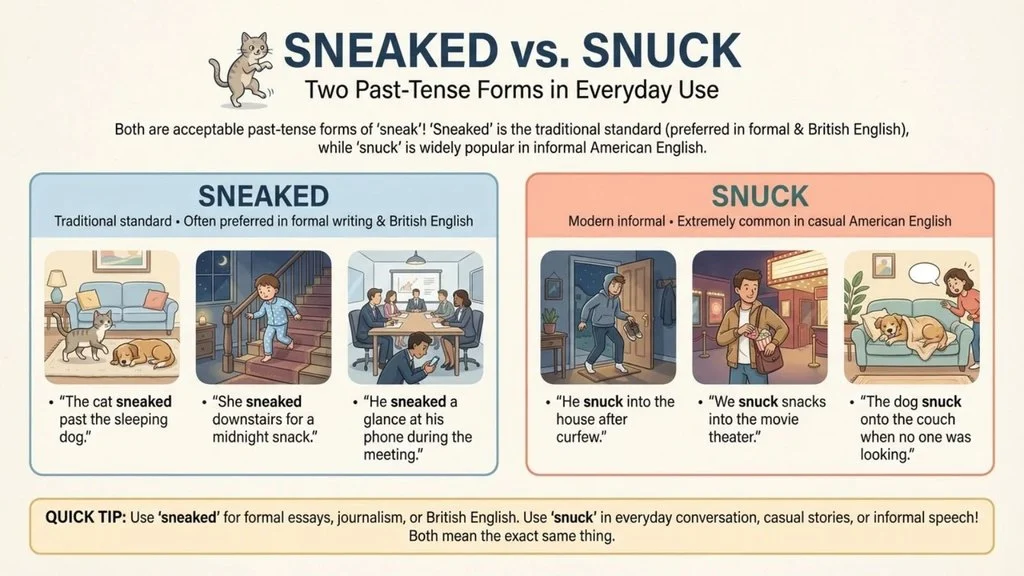
Understanding real-life examples makes it easier to choose the correct word.
Here are examples from different writing situations.
1. In Emails
- I sneaked out early because I had another appointment.
- He snuck into the meeting before it started.
For professional emails, sneaked may sound more traditional.
2. In News Writing
- The suspect sneaked into the building late at night.
- A stranger snuck into the restricted area.
Both forms can work in news reports. The choice depends on the publication’s style.
3. On Social Media
- I snuck into the kitchen for a midnight snack. 😂
- She sneaked a picture of her sleeping cat. 🐱
Snuck often sounds natural in casual social media posts.
4. In Formal Writing
- The employee sneaked into the office after closing time.
- The child sneaked out without telling his parents.
Sneaked is a safe choice for formal reports and academic writing.
5. In Everyday Conversations
- I snuck a cookie before dinner.
- He sneaked behind the door to surprise us.
- They snuck into the movie theater late.
These examples show that both forms fit naturally into everyday English.
Sneaked or Snuck Google Trends & Usage Data
The popularity of sneaked and snuck varies across English-speaking countries and writing styles.
In general, snuck is strongly associated with American English, while sneaked has a long history of use in British English and remains common in formal writing.
Here are some broad usage patterns:
| Country or Region | Common Preference | Usage Context |
| United States | Snuck | Everyday conversation |
| United Kingdom | Sneaked | Traditional and formal writing |
| Canada | Both | Casual and formal writing |
| Australia | Both | Everyday English |
| New Zealand | Both | General communication |
| Global English | Both | Depends on audience |
What About Google Trends?
Google Trends can help compare search interest for sneaked and snuck across different countries and time periods.
However, search interest does not directly measure how often people use a word in everyday speech or writing.
For accurate research, compare both search terms using the same country, time range, and search category.
You can explore the comparison here:
Google Trends: Sneaked vs Snuck
The important takeaway is that both forms are widely understood, but regional preferences and writing styles can influence which one people choose.
Sneaked vs Snuck: Comparison Table
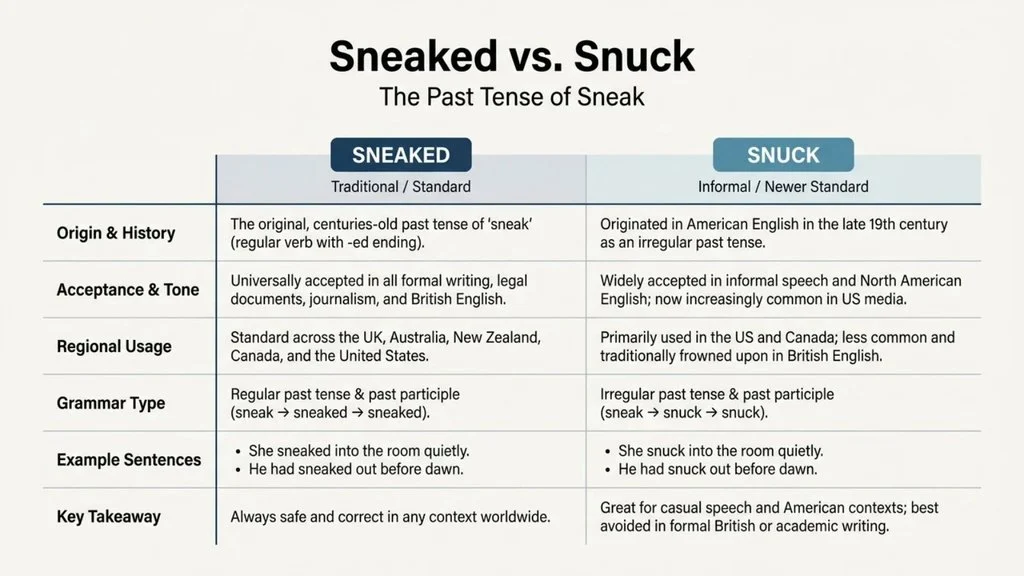
Here is a quick side-by-side comparison to help you remember the differences.
| Word | Grammar | Meaning | Example |
| Sneak | Present tense | Move secretly | I sneak outside. |
| Sneaked | Past tense | Moved secretly | I sneaked outside. |
| Snuck | Past tense | Moved secretly | I snuck outside. |
| Sneaked | Past participle | Moved secretly | I have sneaked outside. |
| Snuck | Past participle | Moved secretly | I have snuck outside. |
| Sneaking | -ing form | Moving secretly | I am sneaking outside. |
Remember: Sneaked and snuck can both be used with helping verbs such as have, has, and had.
Examples:
- She has sneaked into the house.
- She has snuck into the house.
- They had sneaked out earlier.
- They had snuck out earlier.
Frequently Asked Questions (FAQs)
1. Is sneaked or snuck correct?
Both are correct. Sneaked is the regular past-tense form of sneak, while snuck is an accepted irregular form. Both have the same meaning.
2. Is snuck a real word?
Yes. Snuck is a real English word recognized by modern dictionaries. It is especially common in American English.
3. Is sneaked more formal than snuck?
Sneaked often sounds more traditional and formal. Snuck is common in casual speech, but it is not grammatically incorrect in formal writing.
4. Do British people say snuck or sneaked?
British speakers use both forms. Sneaked has traditionally been more common, especially in formal writing, but snuck is also accepted.
5. Is snuck an irregular verb?
Yes. Snuck is an irregular past-tense form of sneak. It does not follow the usual pattern of adding -ed.
6. Can I use snuck in academic writing?
Yes, but check your style guide and audience. Sneaked is a conservative choice if you want a more traditional tone.
7. What is the past participle of sneak?
Both sneaked and snuck can be used as past participles.
Examples:
- I have sneaked into the room.
- I have snuck into the room.
Both sentences are correct.
Conclusion:
Choosing between sneaked and snuck is easier when you understand that both words are correct.
They are two different past-tense forms of the verb sneak, and they share the same meaning. The main difference is their history, style, and regional popularity.
Sneaked is the traditional regular form. It is a safe choice for formal writing, professional communication, and readers who prefer traditional English.
Snuck is an irregular form that became especially popular in American English. It sounds natural in everyday conversations, stories, and informal writing.
You do not need to worry about using snuck as if it were a grammar mistake. Modern English accepts both forms. The best choice depends on your audience and writing style.

I am Oliver Bennett is the founder and writer behind Grammlii.com, where he shares insightful content on language, meanings, expressions, and effective communication. Passionate about making knowledge simple and accessible, he helps readers explore words, ideas, and their deeper significance.