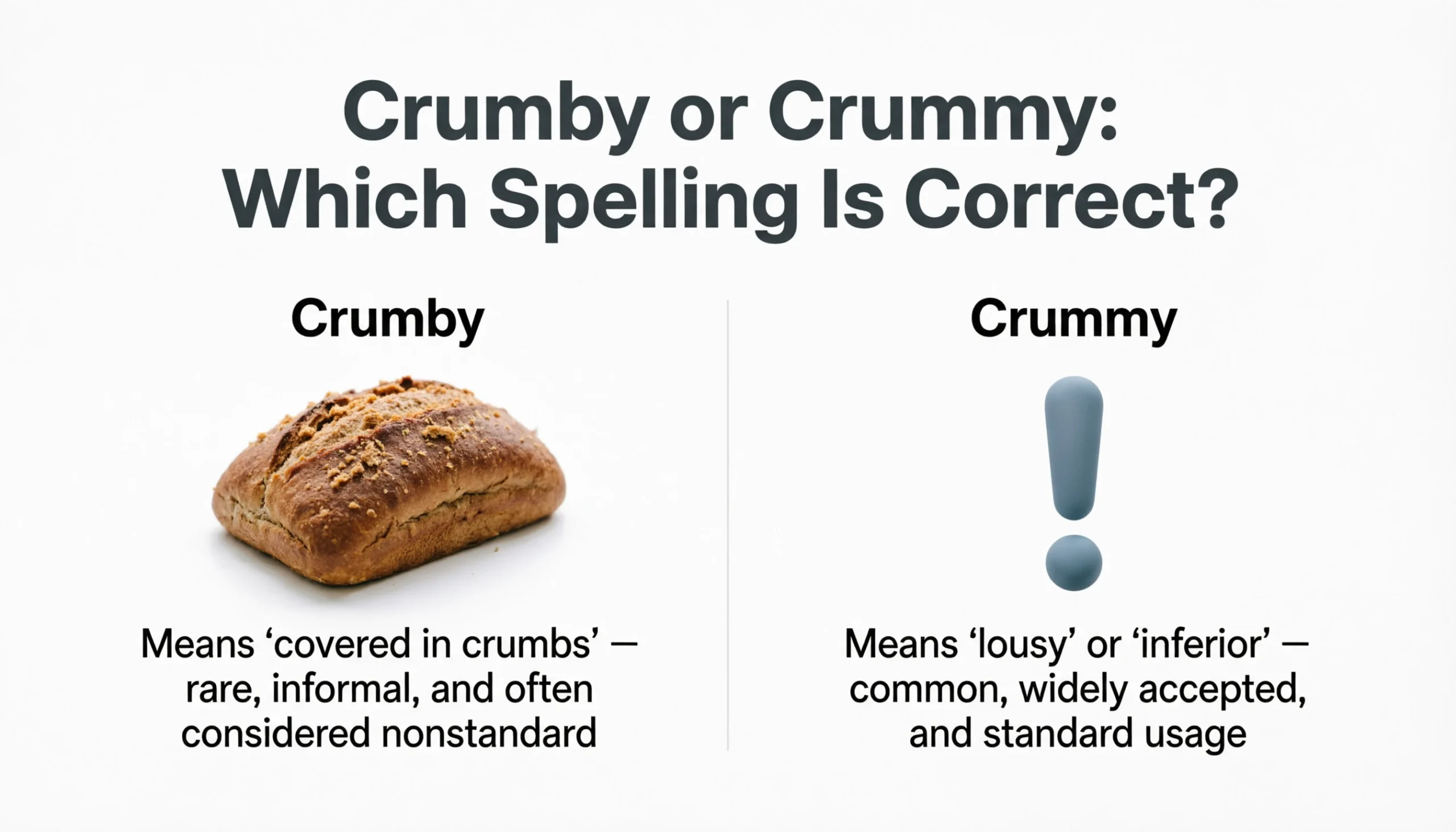
Crumby or crummy is a common spelling and usage question because both words appear in dictionaries and are sometimes used interchangeably. While they share similar meanings, they are not always the best choice in every context. Crummy is the more common modern spelling used to describe something poor in quality, unpleasant, or disappointing. Crumby, on the other hand, can also mean low-quality or shabby, but it is less common and is more often used literally to describe something covered with crumbs. Understanding the difference can help you choose the most accurate word for your writing. In this guide, we’ll compare crumby and crummy, explain their meanings and usage, and show when each word is the better choice.
If you’ve searched for crumby or crummy, you’re probably wondering which spelling is correct. Both words appear in books, articles, and online conversations, making it easy to think they’re interchangeable. While they are closely related and share similar meanings, one spelling is far more common in modern English.
People search for crumby or crummy because they want to use the correct spelling in writing, understand whether there’s a difference in meaning, and know which version is preferred in American and British English. Since dictionaries recognize both forms, the confusion usually comes down to usage rather than correctness.
The good news is that both “crumby” and “crummy” are correct, but crummy is much more common and is generally the preferred spelling in everyday English. This guide explains the differences, origins, usage, examples, and when to choose each spelling.
Crumby or Crummy – Quick Answer
The quick answer is:
- ✅ Crummy is the preferred and more commonly used spelling.
- ✅ Crumby is also correct but is less common.
Both words can mean:
- Of poor quality
- Unpleasant or disappointing
- Covered with crumbs (especially “crumby”)
Examples
- The hotel room was crummy.
- My shirt became crumby after eating the cookie.
Comparison Table
| Spelling | Correct | Common Usage |
| Crummy | ✅ Yes | Very Common |
| Crumby | ✅ Yes | Less Common |
The Origin of Crumby or Crummy
Origin of Crummy
The adjective crummy comes from the noun crumb. It originally described something full of crumbs before evolving to mean something cheap, unpleasant, or of poor quality.
Today, crummy is most often used figuratively.
Examples:
- A crummy excuse
- A crummy apartment
- A crummy day
Origin of Crumby
Crumby also comes from crumb and traditionally describes something literally covered in crumbs.
Although dictionaries recognize it, crumby is much less common than crummy in modern English.
Why the Confusion Exists
The confusion exists because:
- Both words come from crumb.
- Both are accepted by dictionaries.
- Their meanings overlap in some contexts.
British English vs American English Usage
Both British and American English recognize crumby and crummy, but crummy is overwhelmingly more common in both varieties.
Comparison Table
| English Version | Preferred Spelling |
| American English | Crummy |
| British English | Crummy |
| Canadian English | Crummy |
| Australian English | Crummy |
Key Point
For most modern writing, crummy is the safer choice.
Which Spelling Should You Use?
Choose the spelling based on your meaning.
Use Crummy If:
- Describing poor quality.
- Talking about a bad experience.
- Writing casually.
- Using everyday English.
Use Crumby If:
- Describing something literally covered with crumbs.
- Following a style guide that prefers this spelling.
- Writing about food or baking.
Audience-Based Advice
| Audience | Recommended Spelling |
| Students | Crummy |
| Writers | Crummy |
| Journalists | Crummy |
| Bloggers | Crummy |
| Food Writers | Crumby (when referring to crumbs) |
Common Mistakes with Crumby or Crummy
Mistake 1: Thinking One Is Incorrect
Both spellings are correct.
Mistake 2: Using Crumby for Poor Quality
While acceptable, crummy is much more natural when describing something bad or disappointing.
Mistake 3: Assuming They Have Completely Different Meanings
Their meanings overlap, but crumby is more often associated with actual crumbs.
Mistake 4: Ignoring Common Usage
Most native speakers naturally choose crummy.
Mistake 5: Overusing the Less Common Form
Unless you’re specifically referring to crumbs, crummy is usually the better choice.
Crumby or Crummy in Everyday Examples
Restaurant Example
“The food was crummy, so we won’t return.”
Food Example
“The kitchen floor became crumby after breakfast.”
School Example
“He gave a crummy excuse for missing class.”
Travel Example
“We stayed in a crummy motel.”
Baking Example
“The cookies left on the table were all crumby.”
Crumby or Crummy – Google Trends & Usage Data
Interest in crumby or crummy remains steady because writers and English learners often want to know which spelling is preferred.
Popular Search Queries
- Crumby or crummy
- Is crumby a word?
- Crummy meaning
- Crumby meaning
- Crummy vs crumby
Common Search Intent
Users want to know:
- Correct spelling
- Dictionary usage
- Meaning differences
- Writing advice
- Everyday examples
Popular Contexts
- Creative writing
- School assignments
- Blogging
- English learning
- Casual conversation
Crumby vs Crummy Comparison Table
| Feature | Crumby | Crummy |
| Correct Spelling | Yes | Yes |
| Dictionary Accepted | Yes | Yes |
| More Common | No | Yes |
| Means Poor Quality | Sometimes | Yes |
| Refers to Actual Crumbs | Yes | Sometimes |
| Best for Everyday Writing | No | Yes |
FAQs
Which is correct, crumby or crummy?
Both are correct, but crummy is much more common in modern English.
Is crumby a real word?
Yes. It is recognized by major dictionaries, although it is used less frequently than crummy.
What does crummy mean?
Crummy usually means poor quality, unpleasant, disappointing, or inferior.
What does crumby mean?
Crumby often means covered with crumbs, though it can sometimes also mean poor quality.
Which spelling should I use in writing?
For most situations, crummy is the preferred spelling.
Do British and American English use different spellings?
No. Both generally prefer crummy.
Is it crummy informal?
Yes. Crummy is considered an informal adjective commonly used in everyday conversation and writing.
Conclusion:
When comparing crumby or crummy, both spellings are correct, but crummy is the clear winner in modern English. It is the preferred spelling for describing something poor in quality, unpleasant, disappointing, or inferior. While crumby is still recognized by dictionaries, it appears far less often and is more likely to describe something that is literally covered with crumbs.
For students, writers, bloggers, and professionals, crummy is usually the best choice because it matches common usage and will sound more natural to most readers. If you’re specifically writing about food or something full of crumbs, crumby may also be appropriate.
Whenever you’re deciding between crumby or crummy, remember this simple rule: use “crummy” for poor quality and “crumby” mainly for actual crumbs.

I am Ethan Whitmore is the founder and lead writer of Grammlii.com, passionate about exploring meanings, language, literature, and insightful ideas. Through well-researched and engaging content, he helps readers discover the deeper significance behind words, expressions, and everyday concepts.