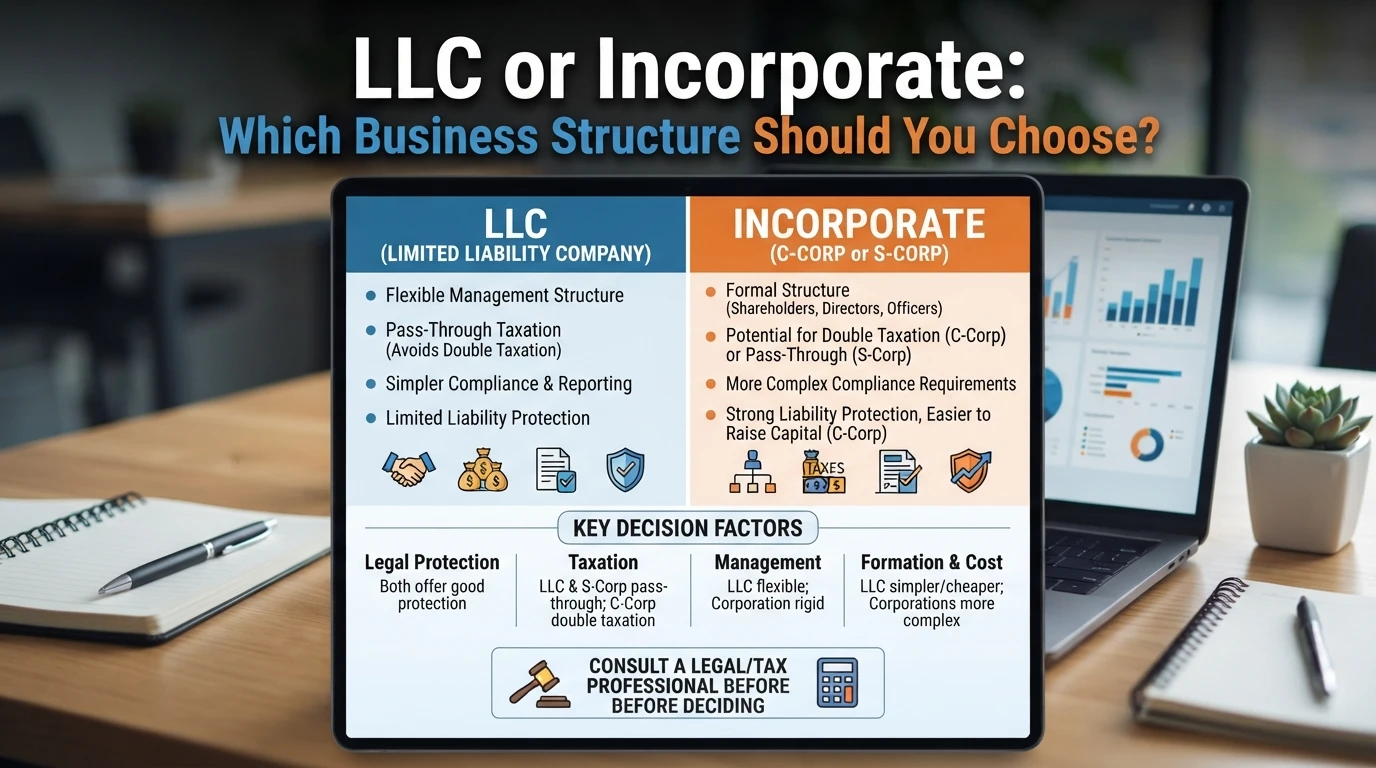
LLC or Incorporate is one of the most common questions entrepreneurs face when starting a new business. Both options provide legal protection by separating personal and business liabilities, but they differ significantly in taxation, management structure, ownership requirements, and long-term growth opportunities. Choosing the right business structure can affect everything from daily operations and compliance obligations to fundraising and profit distribution. While an LLC offers flexibility and simplicity, incorporating may provide advantages for businesses planning to attract investors or issue stock. In this guide, we’ll compare LLCs and corporations, explain their key differences, and help you determine which structure best aligns with your business goals and plans.
If you’re starting a business, one of the first major decisions you’ll face is choosing between an LLC or incorporate. Both options provide legal protection and help separate your personal assets from your business liabilities, but they operate differently and offer distinct advantages.
People search for LLC or incorporate because they want to understand which business structure is better for taxes, liability protection, ownership flexibility, fundraising, and long-term growth. Entrepreneurs often feel overwhelmed by legal terminology and conflicting advice online. The good news is that the choice becomes much easier once you understand the key differences.
An LLC (Limited Liability Company) is often favored for its simplicity and flexibility, while incorporation creates a corporation that may be better suited for businesses seeking investors or planning significant expansion. This guide explains the differences, origins, advantages, disadvantages, common mistakes, and practical considerations to help you choose the right structure for your business.
LLC or Incorporate – Quick Answer
The quick answer is:
- Choose an LLC if you want simplicity, flexible taxation, and easier management.
- Choose to incorporate if you plan to raise investment capital, issue stock, or build a large company.
Examples
- A local consulting business may choose an LLC.
- A technology startup seeking venture capital may incorporate.
Comparison Table
| Feature | LLC | Corporation |
| Liability Protection | Yes | Yes |
| Ownership Flexibility | High | Moderate |
| Stock Issuance | No | Yes |
| Investor Appeal | Moderate | High |
| Administrative Requirements | Lower | Higher |
The Origin of LLC or Incorporate
Origin of LLC
The Limited Liability Company structure was developed to combine the liability protection of corporations with the flexibility of partnerships.
Today, LLCs are one of the most popular business structures for small and medium-sized businesses.
Origin of Incorporation
Corporations have existed for centuries and were designed to allow businesses to operate as separate legal entities. Incorporation enables businesses to issue shares and attract investors.
Why Entrepreneurs Compare Them
Both structures protect owners from personal liability, making them attractive choices for new businesses.
LLC vs Corporation Comparison
LLC Advantages
- Simpler administration
- Flexible tax treatment
- Fewer formal requirements
- Easier management structure
- Suitable for many small businesses
Corporation Advantages
- Easier to attract investors
- Ability to issue stock
- Potential for greater scalability
- Clear ownership structure
- Strong business credibility
Comparison Table
| Category | LLC | Corporation |
| Setup Complexity | Lower | Higher |
| Ongoing Paperwork | Lower | Higher |
| Investor Funding | Limited | Excellent |
| Ownership Flexibility | High | Moderate |
| Formal Meetings Required | Usually No | Often Yes |
Which Structure Should You Choose?
The best choice depends on your business goals.
Choose an LLC If:
- You own a small business.
- You want flexible taxation.
- You prefer simple administration.
- You do not plan to issue stock.
Choose Incorporation If:
- You plan to raise outside investment.
- You want to issue shares.
- You expect rapid growth.
- You are building a startup with expansion plans.
Audience-Based Advice
| Business Type | Recommended Structure |
| Freelancers | LLC |
| Consultants | LLC |
| Family Businesses | LLC |
| Tech Startups | Corporation |
| Venture-Funded Companies | Corporation |
Common Mistakes with LLC or Incorporation
Mistake 1: Choosing Based Only on Cost
The cheapest option may not support future business goals.
Mistake 2: Ignoring Tax Implications
Different structures may affect taxes differently.
Mistake 3: Not Considering Investors
Investors often prefer corporations.
Mistake 4: Assuming One Structure Is Always Better
The best choice depends on the business.
Mistake 5: Failing to Plan for Growth
A structure that works today may not be ideal later.
LLC or Incorporate in Everyday Examples
Startup Example
“The founders decided to incorporate before seeking investors.”
Small Business Example
“The consulting firm formed an LLC for liability protection.”
News Example
“Many new businesses choose between LLC formation and incorporation.”
Formal Writing Example
“The company evaluated LLC and corporate structures before registering.”
LLC or Incorporate – Google Trends & Usage Data
Interest in LLC or incorporation remains strong among entrepreneurs and small business owners.
Popular Search Queries
- LLC vs corporation
- Should I form an LLC?
- Benefits of incorporation
- LLC tax advantages
- Incorporate or LLC for startups
Common Search Intent
Users want to compare:
- Taxes
- Liability protection
- Costs
- Funding opportunities
- Legal requirements
Popular Audiences
- Entrepreneurs
- Freelancers
- Startup founders
- Small business owners
- Investors
LLC vs Corporation Comparison Table
| Feature | LLC | Corporation |
| Legal Protection | Yes | Yes |
| Ownership Structure | Flexible | Structured |
| Stock Issuance | No | Yes |
| Tax Flexibility | High | Moderate |
| Investor Appeal | Moderate | High |
| Administrative Burden | Low | Higher |
| Scalability | Good | Excellent |
FAQs
What is better, LLC or incorporation?
Neither is universally better. The best choice depends on your business goals.
Is an LLC easier to manage?
Yes. LLCs generally have fewer administrative requirements.
Why do startups incorporate?
Many startups incorporate because investors often prefer corporations.
Does an LLC provide liability protection?
Yes. LLCs typically separate personal and business liabilities.
Can an LLC raise investment money?
Yes, but corporations are usually more attractive to investors.
Is incorporation more expensive?
It can involve additional administrative and compliance costs.
Can I change from an LLC to a corporation later?
In many jurisdictions, businesses can convert structures as they grow.
Conclusion:
The decision between LLC and incorporate depends largely on your business objectives, growth plans, and operational preferences. LLCs are popular because they offer liability protection, flexible taxation, and relatively simple management. They are often ideal for freelancers, consultants, family businesses, and many small business owners.
Corporations, on the other hand, provide advantages for companies seeking outside investors, issuing stock, or planning rapid expansion. While incorporation typically involves more paperwork and formal requirements, it can create opportunities for significant growth and fundraising.
Before choosing a structure, consider your long-term goals, ownership plans, tax situation, and financing needs. Consulting a legal or tax professional can also help ensure that your decision aligns with your specific circumstances. Whether you choose an LLC or incorporate, selecting the right business structure is an important step toward building a successful and legally protected company.

I am Oliver Bennett is the founder and writer behind Grammlii.com, where he shares insightful content on language, meanings, expressions, and effective communication. Passionate about making knowledge simple and accessible, he helps readers explore words, ideas, and their deeper significance.