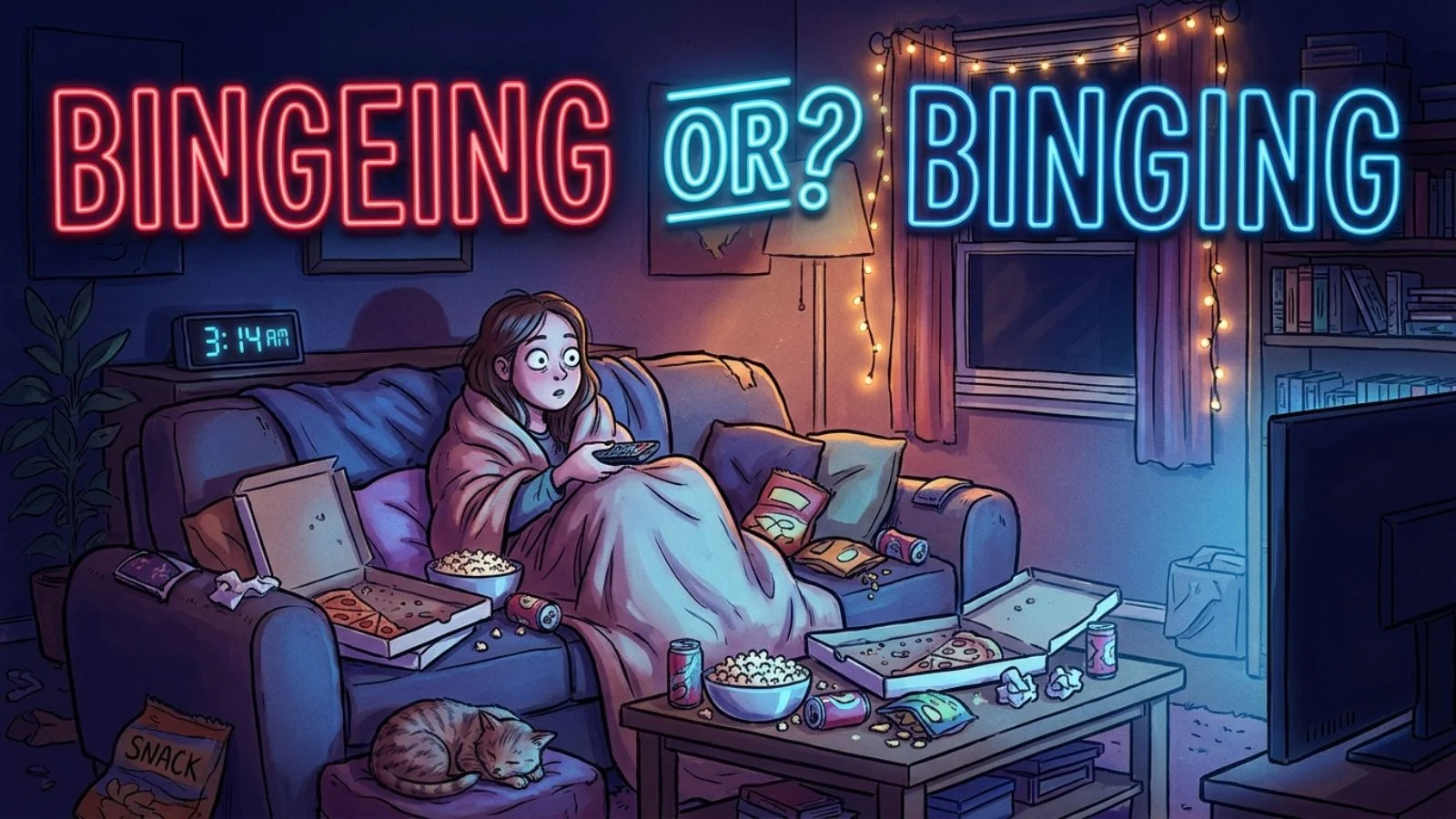
Have you ever wondered whether to write bingeing or binging? You are not alone both spellings appear in everyday English, especially when people talk about watching TV shows, eating large amounts of food, or spending hours doing one activity.
The confusion comes from the verb binge. When we add the ending -ing, should we keep the final letter e, or should we remove it? English spelling rules can make this question tricky because different verbs follow different patterns.
The good news is that both bingeing and binging are accepted spellings. However, one form is often preferred in careful writing.
Knowing the difference can help you write better emails, articles, school assignments, and social media posts.
Bingeing or Binging – Quick Answer
Both bingeing and binging are correct spellings of the present participle of the verb binge.
However, bingeing is often the safer choice in formal and professional writing. It keeps the final e from the original word and makes the connection to binge clear.
Here are some examples:
- Bingeing: I am bingeing my favorite TV series this weekend.
- Binging: I spent the whole night binging on old movies.
Both sentences are correct. The choice usually depends on personal preference, style, and the dictionary or style guide you follow.
Quick Comparison
| Spelling | Correct? | Best Use |
| Bingeing | Yes | Formal and general writing |
| Binging | Yes | Informal and everyday writing |
| Binge-ing | No, usually | Avoid this form |
| Bingeing on | Yes | Eating, watching, or doing something excessively |
| Binging on | Yes | Informal and everyday use |
Easy tip: When you are unsure, use bingeing. It is a clear and widely recognized spelling.
The Origin of Bingeing or Binging

The word binge has an interesting history. It first appeared in English during the 19th century. Early uses were linked to heavy drinking. Over time, its meaning expanded to include eating too much or doing something excessively.
The word is believed to come from a Lincolnshire dialect term meaning to soak a wooden container in water. This helped the wood swell and stop leaking. The meaning later developed into the idea of excessive drinking.
The verb binge eventually became common in everyday English. Today, people use it for many activities, including watching TV shows, eating snacks, shopping, and playing video games.
Why Do Both Spellings Exist?
The difference comes from how English handles verbs ending in the letter e.
Usually, when we add -ing to a verb ending in a silent e, we remove the final e.
For example:
- Bake → Baking
- Make → Making
- Write → Writing
- Dance → Dancing
However, some verbs allow more than one spelling. Binge is one of them.
- Binge → Bingeing
- Binge → Binging
Both forms are accepted. The spelling bingeing keeps the original e, while binging removes it.
This is an example of how English spelling does not always follow one simple rule.
British English vs American English Spelling
British and American English often use different spelling patterns. For example, British English uses colour, while American English uses color.
However, the difference between bingeing and binging is not a simple British-versus-American spelling rule.
Both forms are used in British and American English. Neither spelling belongs exclusively to one country.
Spelling Comparison Table
| Word | British English | American English |
| Bingeing | Correct | Correct |
| Binging | Correct | Correct |
| Binged | Correct | Correct |
| Binger | Correct | Correct |
| Binge-watch | Correct | Correct |
| Binge-watching | Correct | Correct |
Examples in British English
- I spent Sunday bingeing on my favorite television series.
- She was bingeing on chocolate after work.
- They enjoyed binge-watching a new drama.
Examples in American English
- I spent the weekend binging on Netflix.
- He is bingeing on snacks while watching a movie.
- We started binge-watching the latest season.
These examples show that both spellings work in both varieties of English.
Important tip: Do not assume that bingeing is British and binging is American. The choice is a spelling variation, not a national spelling difference.
Which Spelling Should You Use?
Choosing between bingeing and binging depends on your audience, writing style, and personal preference.
Both spellings are correct, but using one form consistently makes your writing look more professional.
1. For American Readers
American readers will understand both forms.
If you are writing a blog post, article, school assignment, or business document, bingeing is a clear choice.
Example:
- I spent the weekend bingeing on my favorite shows.
You can also use binging in casual conversations and social media posts.
2. For British Readers
British readers also recognize both spellings.
You can use either form in everyday writing. However, if your publication follows a particular dictionary or editorial style guide, follow its preferred spelling.
Example:
- She spent the evening bingeing on a popular television series.
3. For Canadian and Australian Readers
Both forms are understandable in Canadian and Australian English.
If you create content for these audiences, choose one spelling and use it throughout your article.
4. For Global Readers
If your content targets an international audience, choose bingeing.
It clearly connects to the original word binge and is a widely recognized form.
My recommendation: Use bingeing in formal articles, educational content, and professional writing. Use either spelling in casual writing, but stay consistent.
Common Mistakes with Bingeing or Binging
Writers sometimes make mistakes when using these two spellings. Most errors happen because people are unsure about the final e or how to use the word in a sentence.
Here are some common mistakes and their corrections.
Mistake 1: Thinking Binging Is Always Wrong
Some writers believe that binging is a spelling mistake.
Incorrect: Binging is never a correct English word.
Correct: Binging is an accepted spelling of the present participle of binge.
Mistake 2: Thinking Bingeing Is Always Wrong
Other writers believe that the final e must always be removed before adding -ing.
Incorrect: Bingeing is always wrong.
Correct: Both bingeing and binging are acceptable.
Mistake 3: Using the Wrong Verb Form
The words binge, binged, and bingeing have different uses.
Incorrect: I binged yesterday.
Correct: I binged yesterday.
Correct: I am bingeing today.
Mistake 4: Forgetting the Word On
The phrase binge on is commonly used when someone consumes or does something excessively.
Less natural: She is bingeing chocolate.
Better: She is bingeing on chocolate.
However, when talking about watching a show, both of these structures are common:
- I am bingeing on a new series.
- I am binge-watching a new series.
Mistake 5: Mixing Both Spellings
Using different spellings in the same article can make your writing look inconsistent.
Less consistent: I enjoy bingeing shows. My sister loves binging shows.
Better: I enjoy bingeing shows. My sister also loves bingeing shows.
Mistake 6: Adding an Unnecessary Hyphen
Some people write binge-ing because they are unsure about the spelling.
Incorrect: I am binge-ing a new show.
Correct: I am bingeing a new show.
Correct: I am bringing a new show.
Remember that a hyphen is not needed.
Bingeing or Binging in Everyday Examples
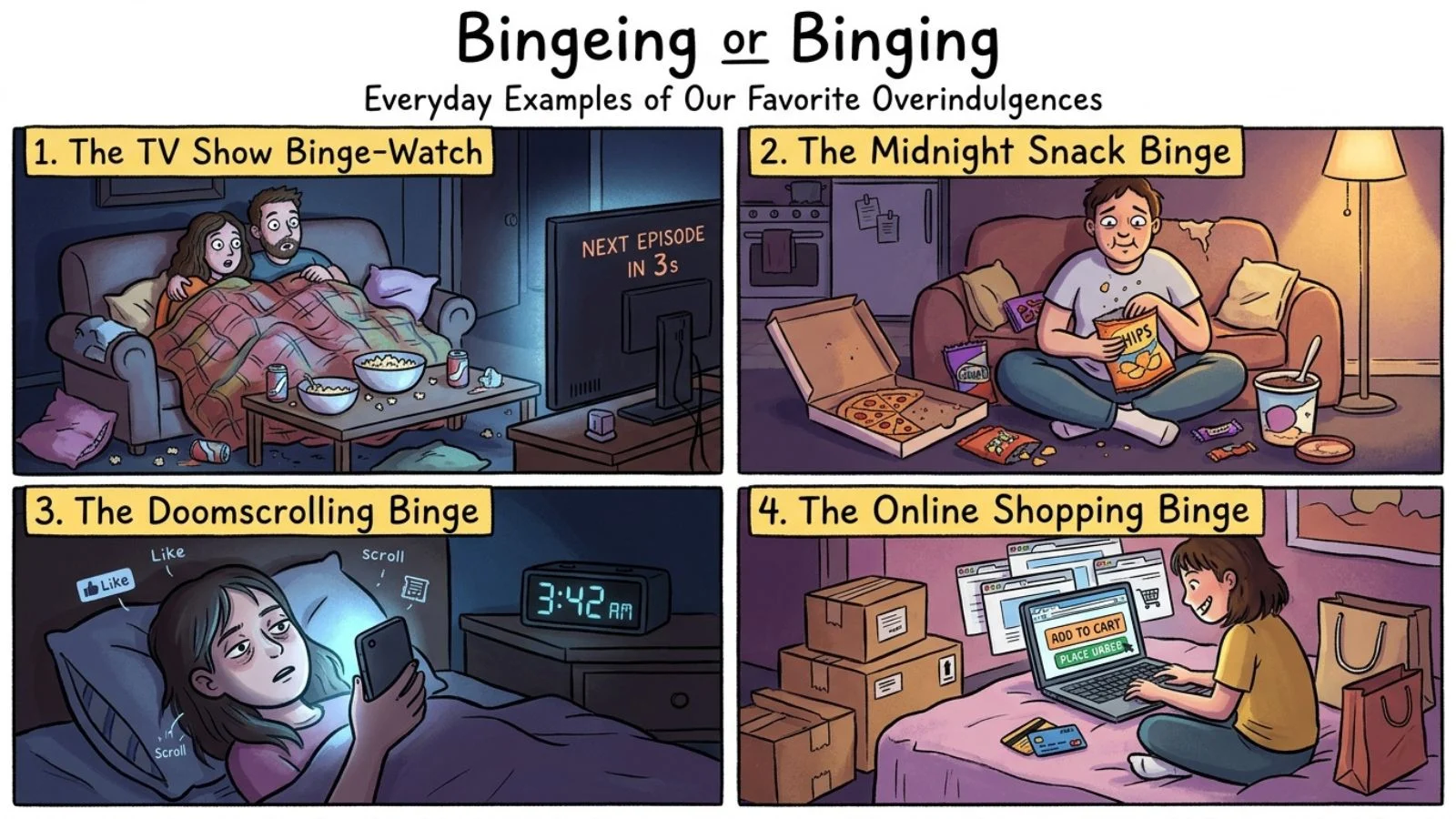
Both spellings are useful in everyday English. You may see them in emails, news articles, social media posts, and formal documents.
Let’s look at how to use them in different situations.
1. In Emails
When writing an email, choose a spelling that matches your usual writing style.
Example:
- I spent the weekend bingeing a new television series.
- Sorry for the late reply. I was binging at a show last night.
- We plan to spend our holiday binge-watching documentaries.
2. In News Articles
News writers often use the word to describe viewing habits, eating habits, or excessive activities.
Example:
- Bingeing on television shows has become a popular weekend activity.
- Experts are studying the effects of binge eating.
- Many viewers enjoy binging entire seasons of their favorite programs.
3. On Social Media
Social media users often prefer short and casual sentences.
Example:
- Weekend plans: bingeing my favorite show!
- Just finished binging an entire season.
- Nothing beats bingeing movies on a rainy day.
- I started one episode and ended up bingeing all night!
4. In Formal Writing
In formal writing, choose one accepted spelling and use it consistently.
Example:
- The report examines the effects of bingeing on digital media.
- Researchers explored patterns of binge eating among adults.
- The study discusses the relationship between excessive screen time and binge-watching.
5. In Everyday Conversations
People often use these words when talking with friends and family.
Example:
- What are you bingeing these days?
- I am binging on my favorite snacks.
- Have you finished bingeing that series?
- We spent the whole evening binge-watching movies.
More Bingeing vs Binging Examples
| Bingeing | Binging |
| She is bingeing on pizza. | She is binging on pizza. |
| We are bingeing a new series. | We are bringing a new series. |
| He enjoys bingeing movies. | He enjoys binging movies. |
| They were bingeing all night. | They were binging all night. |
All these examples use accepted spelling variations.
Bingeing or Binging Google Trends and Usage Data
People often search for bingeing or binging because they want to know which spelling is more popular and which one is correct.
Both spellings appear in online content, dictionaries, blogs, and everyday conversations.
However, popularity and correctness are two different things. A spelling can be used more often without making the other spelling incorrect.
Which Spelling Is More Popular?
Historical word-frequency comparisons reported by Grammarly and Grammarist show that bingeing gained popularity in published books from around 1980 onward.
However, some discussions of everyday usage report more frequent use of binging. These differences can occur because books, websites, news articles, and social media do not use language in exactly the same way.
Therefore, there is no reason to treat either spelling as incorrect simply because one appears more often in a particular source.
Does Usage Differ by Country?
Both spellings are used in the United States, United Kingdom, Canada, and Australia.
There is not enough verified, current country-by-country Google Trends data here to rank these countries or claim that one spelling dominates in a particular region.
How Can You Check Google Trends?
You can compare the two spellings using Google Trends.
Follow these steps:
- Visit Google Trends.
- Enter the search term bingeing.
- Add binging as a comparison.
- Select your preferred country or worldwide data.
- Choose a time range.
- Review the interest-over-time graph.
One important detail: Google explains that search-term comparisons may not capture spelling variations automatically. You should check the exact terms separately and avoid treating low or missing data as proof that a word is never used.
Frequently Asked Questions (FAQs)
1. Is bingeing or binging the correct spelling?
Both bingeing and binging are correct. They are accepted forms of the present participle of the verb binge. You can use either spelling.
2. Is bingeing more correct than binging?
No. Neither spelling is grammatically incorrect. However, bingeing is a useful choice for formal writing because it keeps the original spelling of binge.
3. Why does bingeing keep the letter E?
The spelling bingeing keeps the final e from the original verb. English has some verbs that allow this spelling variation when adding -ing. Both forms have become accepted through common usage.
4. Is binging acceptable in American English?
Yes. Binging is accepted in American English. It is also understood in British and other varieties of English.
5. Is bingeing a real English word?
Yes. Bingeing is a real English word. It is the present participle of binge and describes the act of doing something excessively for a period of time.
6. What is the past tense of binge?
The simple past tense of binge is binged.
Example:
- I binged on television last night.
- She binged on snacks during the weekend.
- They binged on their favorite movies.
7. Should I use bingeing or binging in formal writing?
Both are correct, but bingeing is a clear choice for formal writing. Always follow your organization’s style guide if it specifies a preferred spelling.
Conclusion
So, which spelling should you choose: bingeing or binging? The answer is simple: both are correct, and both are widely understood in modern English.
The main difference is how the words are formed. Bingeing keeps the final letter e from the original verb, while binging removes it before adding -ing. Both forms describe the same action and have the same meaning.
For professional writing, blog posts, school assignments, and formal articles, bingeing is a good choice. It is clear, familiar, and easy for readers to connect with the original word.
For casual conversations, emails, and social media, you can comfortably use either spelling.
Remember that British and American English do not have a strict rule separating these two forms. The most important thing is to stay consistent throughout your writing.

I am Ethan Whitmore is the founder and lead writer of Grammlii.com, passionate about exploring meanings, language, literature, and insightful ideas. Through well-researched and engaging content, he helps readers discover the deeper significance behind words, expressions, and everyday concepts.