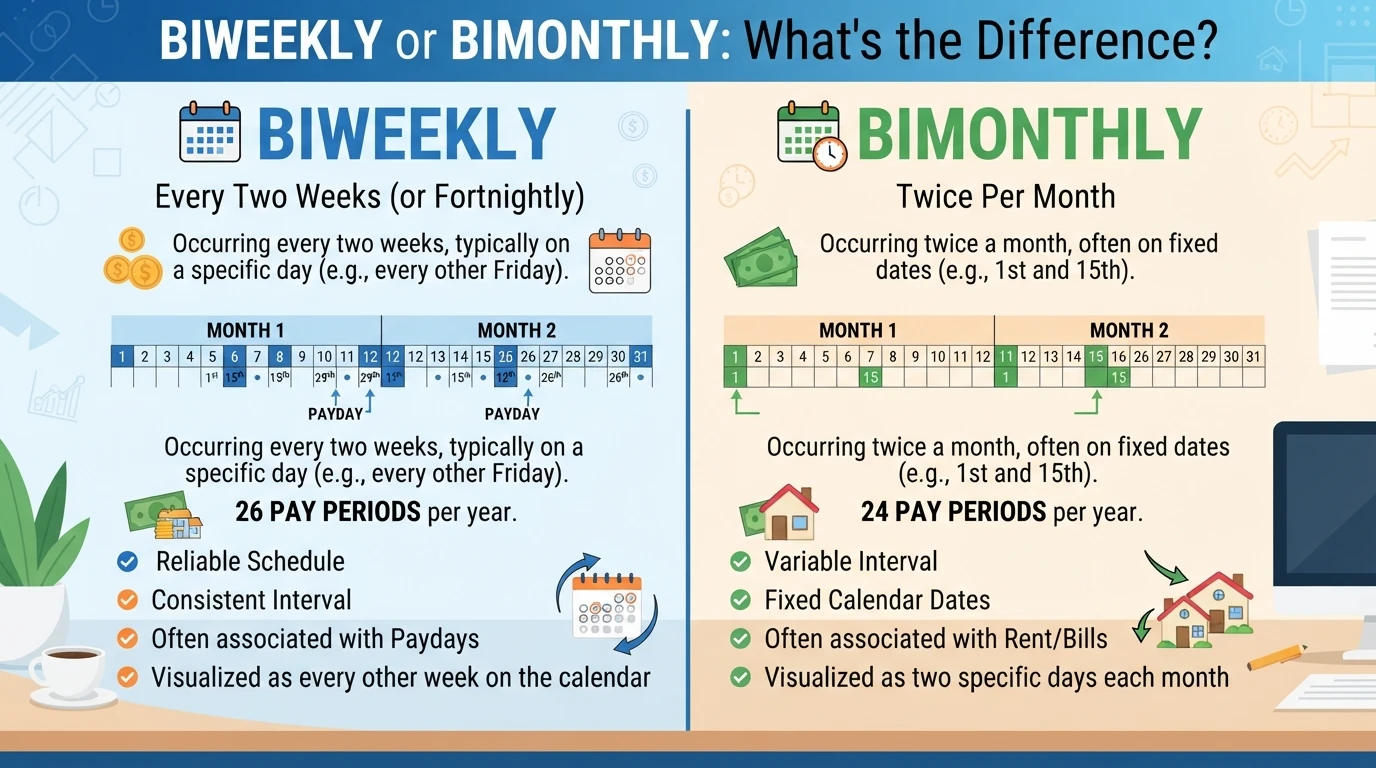
Biweekly or bimonthly is a common source of confusion because both terms can have more than one accepted meaning in English. Many people use them when discussing pay schedules, meetings, subscriptions, or recurring events, but their ambiguity often leads to misunderstandings. While biweekly typically means “every two weeks,” it can also be interpreted as “twice a week” in some contexts. Likewise, bimonthly may mean “every two months” or “twice a month,” depending on the speaker or organization. Understanding the difference between these terms is essential for clear communication in both personal and professional settings. In this guide, we’ll explain the meanings of biweekly and bimonthly, highlight their common uses, and share tips to avoid confusion.
If you’ve ever wondered whether to use biweekly or bimonthly, you’re not alone. These two scheduling terms often confuse because the prefix “bi-“ can mean two or every two. As a result, people may interpret these words differently, leading to missed meetings, incorrect payment schedules, or misunderstandings in workplace communication.
People search for biweekly or bimonthly because they want to know which term correctly describes a recurring event, such as a paycheck, newsletter, subscription, meeting, or publication. While the words seem similar, their meanings are not always clear without additional context.
The good news is that understanding the difference is simple once you know the standard definitions. This guide explains what biweekly and bimonthly mean, compares their usage, highlights common mistakes, provides real-world examples, and offers advice on when to use each term—or when to avoid them altogether.
Biweekly or Bimonthly – Quick Answer
The quick answer is:
- Biweekly usually means every two weeks (once every 14 days).
- Bimonthly usually means every two months, but it can also mean twice a month, making it potentially ambiguous.
Examples
- We have biweekly team meetings every other Friday.
- The magazine is published bimonthly, meaning once every two months.
Comparison Table
| Term | Most Common Meaning | Frequency |
| Biweekly | Every two weeks | About 26 times per year |
| Bimonthly | Every two months | 6 times per year |
The Origin of Biweekly or Bimonthly
Origin of Biweekly
The word biweekly combines the prefix bi- (“two” or “every two”) with weekly. In modern English, it most commonly means every two weeks.
Origin of Bimonthly
Bimonthly combines bi- with monthly. Because the prefix bi- has two accepted meanings, bimonthly can mean:
- Every two months
- Twice a month
This dual meaning is the main source of confusion.
Why the Confusion Exists
The prefix bi- has multiple accepted meanings in English, so context is important when using these words.
British English vs American English Usage
There is no major spelling difference between British and American English, but both varieties recognize that bimonthly can be ambiguous.
Comparison Table
| English Version | Biweekly | Bimonthly |
| American English | Every two weeks | Usually every two months, but it can also mean twice a month |
| British English | Every two weeks | The same ambiguity exists |
Key Point
To avoid confusion, many organizations use clearer phrases such as every two weeks or every two months.
Which Term Should You Use?
Choose the term based on the schedule you want to describe.
Use Biweekly If:
- An event happens every 14 days.
- Employees are paid every other week.
- Meetings occur every other week.
Use Bimonthly If:
- Something happens every two months.
- You clearly explain the schedule.
- The audience understands the intended meaning.
Better Alternatives
Instead of using ambiguous terms, consider writing:
- Every two weeks
- Twice a month
- Every two months
- Twice a week
Audience-Based Advice
| Audience | Best Practice |
| Businesses | Use exact schedules |
| Students | Clarify the frequency |
| Employees | Avoid ambiguous wording |
| Publishers | Specify the publication schedule |
| General Readers | Use plain language |
Common Mistakes with Biweekly or Bimonthly
Mistake 1: Assuming Bimonthly Always Means Twice a Month
It can also mean every two months.
Mistake 2: Confusing Biweekly with Twice a Week
Biweekly normally means every two weeks, not twice each week.
Mistake 3: Using Ambiguous Terms in Contracts
Legal and business documents should use precise wording.
Mistake 4: Forgetting the Audience
Different readers may interpret these terms differently.
Mistake 5: Not Clarifying Payment Schedules
Instead of “biweekly pay,” writing “paid every two weeks” removes confusion.
Biweekly or Bimonthly in Everyday Examples
Workplace Example
“Our staff meetings are biweekly, every other Monday.”
Payroll Example
“The company pays employees biweekly.”
Magazine Example
“The journal is published bimonthly, once every two months.”
School Example
“The club newsletter is sent every two weeks.”
Business Example
“The report is prepared every two months.”
Biweekly or Bimonthly – Google Trends & Usage Data
Interest in biweekly or bimonthly remains high because people often encounter these terms in work, education, publishing, and payroll.
Popular Search Queries
- Biweekly vs bimonthly
- Does biweekly mean twice a month?
- What does bimonthly mean?
- Every two weeks or biweekly
- Bimonthly meaning
Common Search Intent
Users want to know:
- Correct definitions
- Payment schedules
- Publication frequency
- Grammar usage
- Business communication
Popular Contexts
- Payroll
- Work schedules
- Magazines
- School calendars
- Subscription services
Biweekly vs Bimonthly Comparison Table
| Feature | Biweekly | Bimonthly |
| Standard Meaning | Every two weeks | Every two months |
| Can Be Ambiguous | Rarely | Yes |
| Common in Payroll | Yes | No |
| Common in Publishing | Sometimes | Yes |
| Best for Formal Writing | Yes, with context | Prefer clearer wording |
FAQs
Which is more frequent, biweekly or bimonthly?
Biweekly is generally more frequent because it means every two weeks, while bimonthly usually means every two months.
Does biweekly mean twice a month?
No. Biweekly most commonly means every two weeks.
What does bimonthly mean?
It usually means every two months, but some people also use it to mean twice a month.
Why is bimonthly confusing?
Because the prefix bi- allows two accepted interpretations.
Which term should businesses use?
Businesses should use clear phrases like every two weeks or every two months to avoid misunderstandings.
Is biweekly the same as every other week?
Yes. In most contexts, biweekly means every other week.
Should I avoid using bimonthly?
If there’s any chance of confusion, it’s better to write the exact schedule instead.
Conclusion:
When comparing biweekly or bimonthly, the main difference is how often something happens. Biweekly almost always means every two weeks, making it a relatively clear scheduling term. Bimonthly, however, can mean every two months or twice a month, depending on the context, which makes it more likely to be confused.
For business documents, contracts, employee handbooks, and formal communication, it’s often best to avoid ambiguous terms altogether. Writing every two weeks, twice a month, or every two months ensures everyone understands the schedule correctly.
Whenever you’re choosing between biweekly or bimonthly, remember that clarity is more important than brevity. A few extra words can prevent misunderstandings and help your audience know exactly what you mean.

I am Ethan Whitmore is the founder and lead writer of Grammlii.com, passionate about exploring meanings, language, literature, and insightful ideas. Through well-researched and engaging content, he helps readers discover the deeper significance behind words, expressions, and everyday concepts.