Have you ever wondered whether to write “each other” or “eachother”? You are not alone.
Many people make this spelling mistake when writing emails, school assignments, social media posts, or professional documents. Both forms look similar, but only one is correct in standard English.
The correct spelling is “each other”, written as two separate words. It is a common phrase used when two or more people or things share an action or feeling.
For example, “The two friends help each other” shows that both friends give and receive help.
So, why do some people write “eachother” as one word? The reason is simple. The phrase sounds like one word when spoken quickly. Also, many English expressions change over time, which can make spelling confusing.
Each Other or Eachother – Quick Answer
The correct spelling is “each other”, with a space between the two words.
“Eachother” is incorrect in standard English. You should always write “each other” in schoolwork, emails, articles, and professional documents.
Examples:
- Correct: They love each other.
- Incorrect: They love eachother.
- Correct: We should respect each other.
- Incorrect: We should respect eachother.
- Correct: The children helped each other.
- Incorrect: The children helped eachother.
What Does Each Other Mean?
“Each other” is a phrase used to show a shared action, feeling, or relationship between people or things.
It often means that two or more people do something to one another.
For example:
- The sisters support each other.
- We should listen to each other.
- The team members trust each other.
In each sentence, the action goes both ways.
The Origin of Each Other

The phrase “each other” has been part of English for many centuries. It comes from two separate words: “each” and “other.”
The word “each” refers to every person or thing in a group. The word “other” refers to another person or thing.
When these words work together, they describe a shared relationship or action.
For example, when two friends help each other, both friends give and receive help.
Why Are There Two Words?
English has many phrases made from two words that work together. “Each other” is one of them.
Over time, some English expressions become single words. However, “each other” has kept its two-word form in standard modern English.
People sometimes write “eachother” because the phrase sounds connected when spoken. However, pronunciation does not change its correct spelling.
Is Each Other a Compound Word?
No. In standard modern English, “each other” is an open compound expression. This means it contains two separate words that work together to express one meaning.
British English vs American English Spelling
There is no spelling difference between British English and American English when it comes to “each other.”
Both spelling systems use the same two-word form.
You should write “each other” whether you are writing for readers in the United States, the United Kingdom, Canada, Australia, or other English-speaking countries.
British English Examples
- Friends should care for each other.
- The students listened to each other.
- The two teams respected each other.
American English Examples
- My parents always support each other.
- The players encouraged each other.
- We should understand each other.
British English vs American English Comparison Table
| Feature | British English | American English |
| Correct spelling | Each other | Each other |
| Incorrect spelling | Eachother | Eachother |
| Number of words | Two | Two |
| Meaning | One another | One another |
| Formal writing | Each other | Each other |
| Informal writing | Each other | Each other |
The spelling remains the same in both forms of English. There is no need to change it based on your audience.
Which Spelling Should You Use?

You should always use “each other” in standard English.
Your choice does not depend on your country, writing style, or audience. The two-word spelling is correct in both formal and informal writing.
For American English
If you write for an American audience, use “each other.”
Example: The neighbors help each other during difficult times.
For British English
British writers also use “each other.”
Example: The children shared their toys with each other.
For Canadian and Australian English
The same spelling applies in Canada and Australia.
Example: Good friends should always trust each other.
For Global English
If you write for an international audience, use “each other.” It is easy to understand and follows standard English rules worldwide.
Professional tip: Always check the spelling of common phrases before publishing an article, sending an email, or submitting an assignment.
Common Mistakes with Each Other
Many people make small spelling mistakes when using “each other.” These errors are easy to fix once you understand the correct form.
Here are some common mistakes and their corrections.
1. Writing Eachother as One Word
Incorrect: They care about eachother.
Correct: They care about each other.
Always leave a space between “each” and “other.”
2. Using Each Other When the Meaning Is Not Clear
Incorrect: Each other student received a book.
Correct: Each student received a book.
“Each other” describes a shared relationship or action. It does not replace the word “each.”
3. Confusing Each Other with One Another
Both expressions can describe a shared action or relationship.
Examples:
- The friends support each other.
- The friends support one another.
Both sentences are correct.
4. Forgetting Each Other in a Sentence
Incorrect: We should respect and help.
Correct: We should respect and help each other.
The second sentence makes the shared action clear.
5. Using the Wrong Possessive Form
When something belongs to two or more people in a shared relationship, use “each other’s.”
Examples:
- Correct: They respect each other’s opinions.
- Incorrect: They respect each others opinions.
Remember that “each other’s” needs an apostrophe before the final s.
Each Other in Everyday Examples

“Each other” is a common phrase in daily English. You can use it in conversations, emails, news stories, social media posts, and professional writing.
Here are some examples to help you understand its use.
1. Each Other in Emails
Emails often use this phrase when discussing teamwork, support, and communication.
Examples:
- We should keep helping each other to complete this project.
- Thank you for supporting each other during the meeting.
- Our team members should respect each other’s ideas.
2. Each Other in News Writing
News articles use “each other” to describe relationships, cooperation, and shared actions.
Examples:
- The two leaders promised to support each other.
- The players congratulated each other after the match.
- Local communities helped each other after the storm.
3. Each Other on Social Media
People use this phrase in captions, comments, and everyday posts.
Examples:
- Best friends always understand each other.
- We make each other smile every day.
- Real friends never stop supporting each other.
4. Each Other in Formal Writing
In formal writing, “each other” is useful for explaining relationships and shared responsibilities.
Examples:
- Employees should communicate with each other clearly.
- Students must respect each other’s opinions.
- The two departments work closely with each other.
5. Each Other in Everyday Conversations
You can also use this phrase when speaking with friends and family.
Examples:
- We know each other very well.
- Why are you looking at each other?
- They always make each other laugh.
Each Other Google Trends & Usage Data
People search for “each other or eachother” because they want to know whether the phrase should be written as one word or two.
This is a common spelling question among English learners, students, bloggers, and professional writers.
Which Spelling Is More Popular?
“Each other” is the standard spelling used in books, websites, newspapers, academic writing, and everyday communication.
“Eachother” may appear in online searches, informal messages, or spelling mistakes. However, it is not accepted as the standard spelling.
Search Interest by Country
People in many English-speaking countries search for this spelling question, including:
- United States: Writers may search for the correct form when preparing emails and school assignments.
- United Kingdom: Students and professionals may check the phrase for correct British English usage.
- Canada: English learners often look for simple spelling and grammar explanations.
- Australia: Writers may search for the correct form when editing everyday and professional content.
- Pakistan: English learners and students may search for the difference between the two spellings.
Why Do People Search for This Keyword?
There are several reasons:
- Both forms sound similar when spoken.
- People may think the phrase is one compound word.
- English learners often confuse open and closed compound expressions.
- Writers want to avoid spelling mistakes in professional documents.
- Students want to improve their grammar and spelling skills.
Important note: These are general usage observations, not verified Google Trends rankings. Search popularity can change over time and should be checked directly in Google Trends for current country-level data.
Each Other vs Eachother: Comparison Table
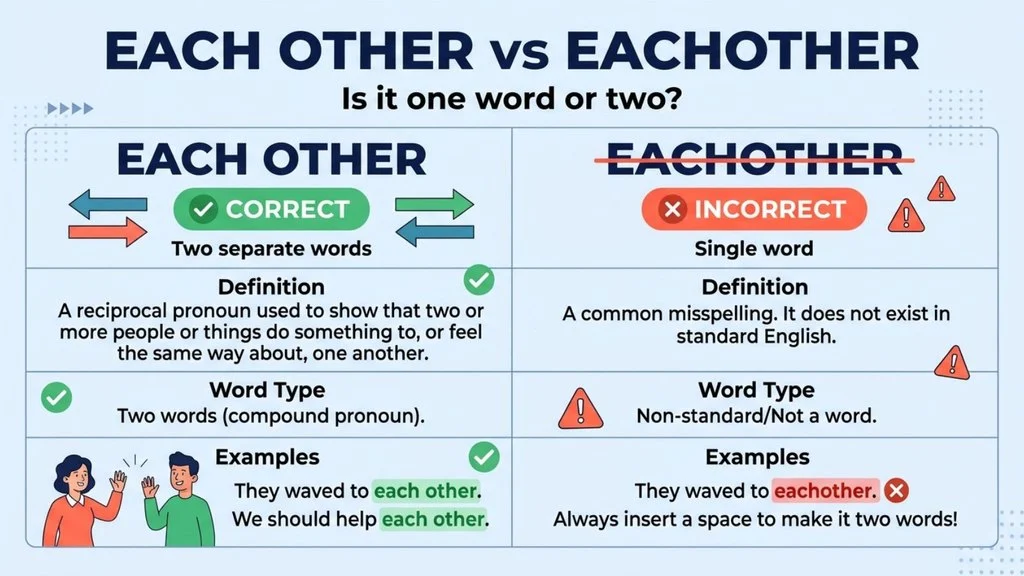
Here is a simple comparison of the two forms.
| Feature | Each Other | Eachother |
| Spelling | Correct | Incorrect |
| Word count | Two words | One word |
| Standard English | Yes | No |
| British English | Correct | Incorrect |
| American English | Correct | Incorrect |
| Formal writing | Accepted | Not accepted |
| Everyday writing | Accepted | Not accepted |
| Meaning | One another | No standard meaning |
Related Expressions
You may also see these expressions used in English:
| Expression | Correct Form | Example |
| Each other | Two words | We help each other. |
| One another | Two words | They trust one another. |
| Each other’s | Apostrophe included | We respect each other’s views. |
| One another’s | Apostrophe included | They shared one another’s ideas. |
Remember that “eachother” is not the correct standard spelling.
FAQs About Each Other or Eachother
1. Is Each Other One Word or Two?
“Each other” is always written as two separate words in standard English. Writing “eachother” as one word is incorrect.
Example: We should help each other.
2. Is Eachother Ever Correct?
No. “Eachother” is not accepted as a standard English spelling. Always write “each other” in formal and informal communication.
3. Is Each Other Correct in British English?
Yes. British English uses “each other” as two separate words. There is no British spelling variation.
4. Is Each Other Correct in American English?
Yes. American English also uses “each other.” The spelling and meaning are the same in both countries.
5. What Is the Difference Between Each Other and One Another?
Both expressions describe a shared action or relationship. They are often interchangeable.
Examples:
- The two friends help each other.
- The two friends help one another.
Both sentences are correct.
6. Can I Use Each Other in Formal Writing?
Yes. “Each other” is completely acceptable in formal writing. You can use it in business emails, reports, academic assignments, and professional articles.
7. What Is the Possessive Form of Each Other?
The possessive form is “each other’s.”
Example: The students respected each other’s opinions.
Use the apostrophe before the final s to show possession.
Conclusion:
Choosing between “each other” and “eachother” is simple once you know the correct English spelling.
The correct form is always “each other,” written as two separate words. The one-word spelling “eachother” is incorrect in standard English.
This rule applies to British English, American English, Canadian English, Australian English, and international English. You do not need to change the spelling based on your audience or writing style.
Remember that “each other” describes a shared action, feeling, or relationship between two or more people or things. For example, friends support each other, team members respect each other, and family members care for each other.
The easiest way to avoid this mistake is to remember one simple rule: Each other is always two words. Use this form every time, and your writing will stay clear, correct, and professional.

I am Ethan Whitmore is the founder and lead writer of Grammlii.com, passionate about exploring meanings, language, literature, and insightful ideas. Through well-researched and engaging content, he helps readers discover the deeper significance behind words, expressions, and everyday concepts.