Have you ever wondered whether the correct spelling is gray or grey? Both words describe the same color, but the spelling you should use depends on where you are writing.
If you use American English, you will usually see gray. In British English, grey is the more common choice.
The good news is that both spellings are correct. Neither one changes the meaning of the color. The main difference comes from regional English spelling rules.
In this guide, you will learn the meaning, history, and correct use of gray and grey. You will also see examples, spelling comparisons, common mistakes, and tips to help you choose the right spelling for your audience.
Gray or Grey Color – Quick Answer
Both gray and grey are correct spellings of the same color. The main difference is regional preference.
- Gray: The standard spelling in American English (US).
- Grey: The standard spelling in British English (UK).
Both words describe a color between black and white.
Examples:
- American English: She bought a beautiful gray dress.
- British English: She bought a beautiful grey dress.
- American English: The sky looks gray today.
- British English: The sky looks grey today.
Neither spelling is incorrect. You should simply choose the version that matches your audience.
| Spelling | Where It Is Common | Correct? |
| Gray | United States | Yes |
| Grey | United Kingdom | Yes |
| Gray | Canada | Yes |
| Grey | Canada | Yes |
| Grey | Australia | Yes |
| Gray | Australia | Yes |
Quick tip: Use gray for American readers and grey for British readers. If you are writing for a global audience, choose one spelling and use it consistently.
The Origin of Gray or Grey

The words gray and grey have a long history in the English language. Both come from an old Germanic word used to describe a color between black and white.
The word appeared in Old English as grǣg or grēg. Over time, different spellings developed in Middle English.
People used forms such as grei, grai, greye, and graye. Both spelling styles continued to appear in English writing.
As English developed in different regions, American and British writers began to favor different forms.
American English gradually adopted gray, while British English generally kept grey.
The difference became stronger through dictionaries, schools, publishers, and regional writing standards.
Today, both spellings remain correct. Their meanings are the same, and both are pronounced in the same way.
Interestingly, some English speakers once believed that gray described a darker color while grey described a lighter one. However, this difference never became a standard spelling rule.
The Oxford English Dictionary records both forms and explains their shared Germanic history.
British English vs American English Spelling
The main difference between British and American English is the preferred spelling.
American English usually uses gray, while British English usually uses grey.
This difference is similar to other common spelling pairs, such as color and colour, favorite and favourite, and center and centre.
1. American English: Gray
In the United States, gray is the standard spelling.
American dictionaries and writing guides generally prefer this version.
Examples:
- My father has gray hair.
- The walls are painted light gray.
- I bought a gray winter coat.
- The gray clouds covered the sky.
- She likes gray furniture.
If your readers are mainly from the United States, use gray throughout your content.
2. British English: Grey
In the United Kingdom, grey is the more common spelling.
British writers use it in everyday writing, books, newspapers, and formal documents.
Examples:
- My grandfather has grey hair.
- The walls are painted light grey.
- She bought a grey winter coat.
- The grey clouds covered the sky.
- He prefers grey furniture.
If your readers are mainly from the UK, use grey throughout your content.
3. Gray vs Grey Comparison Table
| Feature | American English | British English |
| Main spelling | Gray | Grey |
| Pronunciation | /ɡreɪ/ | /ɡreɪ/ |
| Meaning | Color between black and white | Color between black and white |
| Hair color | Gray hair | Grey hair |
| Light shade | Light gray | Light grey |
| Dark shade | Dark gray | Dark grey |
| Color adjective | Gray | Grey |
| Common derivative | Grayish | Greyish |
| Becoming gray | Graying | Greying |
| Past form | Grayed | Greyed |
Remember: The spelling changes, but the meaning and pronunciation stay the same.
Which Spelling Should You Use?

Choosing between gray and grey is simple when you know your audience.
You do not need to worry about choosing the only correct spelling because both forms are accepted. The important thing is to follow the spelling style used by your readers.
1. For American Readers
Use gray when writing for people in the United States.
This spelling is common in:
- American newspapers.
- School assignments.
- Business emails.
- American websites.
- Books and magazines.
Example: The house has beautiful gray walls.
2. For British Readers
Use grey when writing for people in the United Kingdom.
This spelling is common in:
- British newspapers.
- School books.
- Professional documents.
- UK websites.
- Everyday communication.
Example: The house has beautiful grey walls.
3. For Canadian Readers
Both gray and grey are used in Canada.
However, grey is often preferred in general Canadian writing. Your best choice is to follow the style guide of your school, company, or publication.
4. For Australian and Other Commonwealth Readers
Grey is generally the preferred spelling in Australia and many other Commonwealth English settings.
If you write for these readers, grey is usually the safer choice.
5. For Global Websites and Blogs
If your website targets readers from different countries, choose one spelling style and use it throughout your content.
For example:
- Use gray if your website mainly targets the United States.
- Use grey if your website mainly targets the United Kingdom, Australia, or similar markets.
For SEO, you can naturally mention both spellings in your article. This helps readers understand the difference without making your writing confusing.
Common Mistakes with Gray or Grey
Many people make small mistakes when using gray and grey. Most of these errors happen because writers do not understand regional spelling rules.
Here are some common mistakes and their corrections.
1. Thinking One Spelling Is Wrong
Incorrect idea: Grey is always wrong in American English.
Correct explanation: Grey is a valid spelling, even though American English usually prefers gray.
2. Mixing Both Spellings in One Article
Using both forms without a reason can make your writing look inconsistent.
Example of inconsistent writing:
- She bought a gray jacket.
- Her grey shoes look beautiful.
Better approach: Choose one spelling style and follow it throughout the article.
3. Thinking Gray and Grey Have Different Meanings
Some people believe gray is darker and grey is lighter.
This is not a standard English rule. Both words describe the same color.
4. Forgetting Regional Spelling Rules
Writers sometimes use American spelling in a British document or British spelling in an American assignment.
Better approach: Check your target audience before writing.
5. Using the Wrong Derivative
The spelling of related words usually follows the same regional pattern.
| American English | British English |
| Gray | Grey |
| Grayish | Greyish |
| Graying | Greying |
| Grayed | Greyed |
6. Changing the Spelling Without Checking the Style Guide
Some companies and publishers have their own writing rules.
Always follow the official style guide when preparing professional documents.
Gray or Grey in Everyday Examples
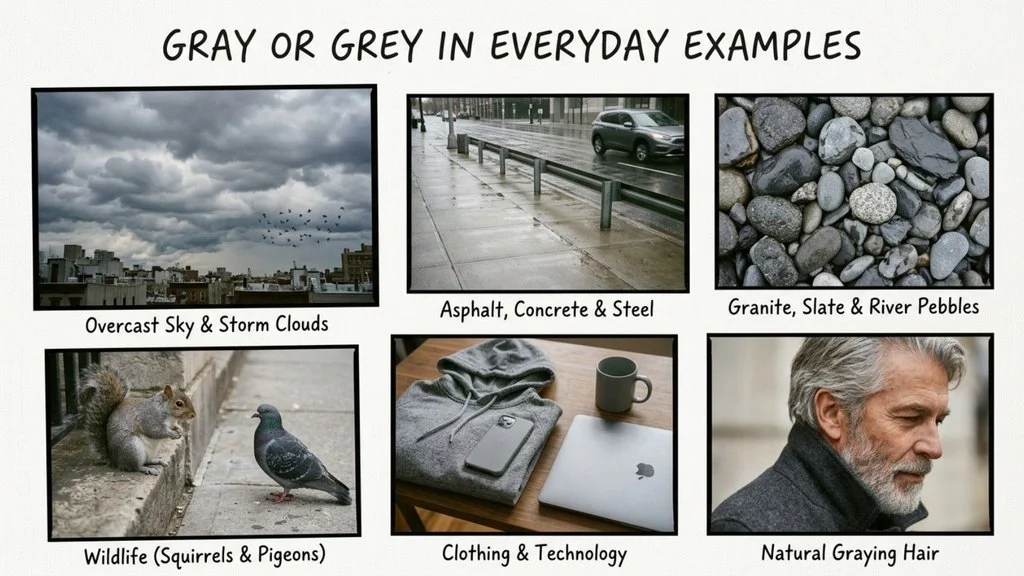
Both spellings appear in daily communication. You can use them in emails, news articles, social media posts, and formal writing.
Here are some simple examples.
1. Gray or Grey in Emails
American English:
Subject: Office Wall Color
Hello,
I think we should choose a light gray color for the office walls. It will make the room look clean and modern.
Best regards.
British English:
Subject: Office Wall Colour
Hello,
I think we should choose a light grey colour for the office walls. It will make the room look clean and modern.
Best regards.
2. Gray or Grey in News Writing
American English:
Dark gray clouds covered the city as heavy rain moved across the area.
British English:
Dark grey clouds covered the city as heavy rain moved across the area.
3. Gray or Grey on Social Media
American English:
- Loving my new gray hoodie!
- Gray skies, cozy days.
- Simple gray outfits never go out of style.
British English:
- Loving my new grey hoodie!
- Grey skies, cosy days.
- Simple grey outfits never go out of style.
4. Gray or Grey in Formal Writing
American English:
The report describes a gray material used in the construction project.
British English:
The report describes a grey material used in the construction project.
5. Gray or Grey in Academic Writing
American English:
The researchers used a gray background in the experiment.
British English:
The researchers used a grey background in the experiment.
The main rule is simple: use the spelling that matches the English variety required by your reader or institution.
Gray or Grey Google Trends & Usage Data
People search for both gray and grey because they want to know which spelling is correct.
The search interest is connected to regional English differences. American users are more likely to use gray, while British users are more likely to use grey.
However, search interest can change based on location, time, and the reason behind a search.
1. Gray in the United States
The spelling gray is widely used in American English.
People commonly use it when searching for:
- Gray paint colors.
- Gray hair styles.
- Gray clothing.
- Gray home decoration.
- Gray color combinations.
2. Grey in the United Kingdom
Grey is the common British spelling.
People may search for:
- Grey wall paint.
- Grey hair products.
- Grey clothing styles.
- Grey home designs.
- Grey color combinations.
3. Gray and Grey in Canada
Canadian English uses both spellings.
Grey is often preferred, but gray is also accepted. The choice may depend on the publication or writer.
4. Gray and Grey in Australia
Australian English generally follows British spelling preferences.
Therefore, grey is more common in Australian writing.
5. Understanding Google Trends Data
Google Trends can help writers compare search interest for different spelling variations.
It allows users to explore interest by country, region, and time period. Its scores are normalized from 0 to 100, so they show relative interest rather than exact search counts.
One important point: a simple comparison of the search terms gray and grey should not be treated as a complete measure of spelling preference. Search results can be affected by the meaning and context of each query.
For a better comparison, use the same time range, search category, and location settings.
Gray vs Grey: Quick Comparison of Word Variations
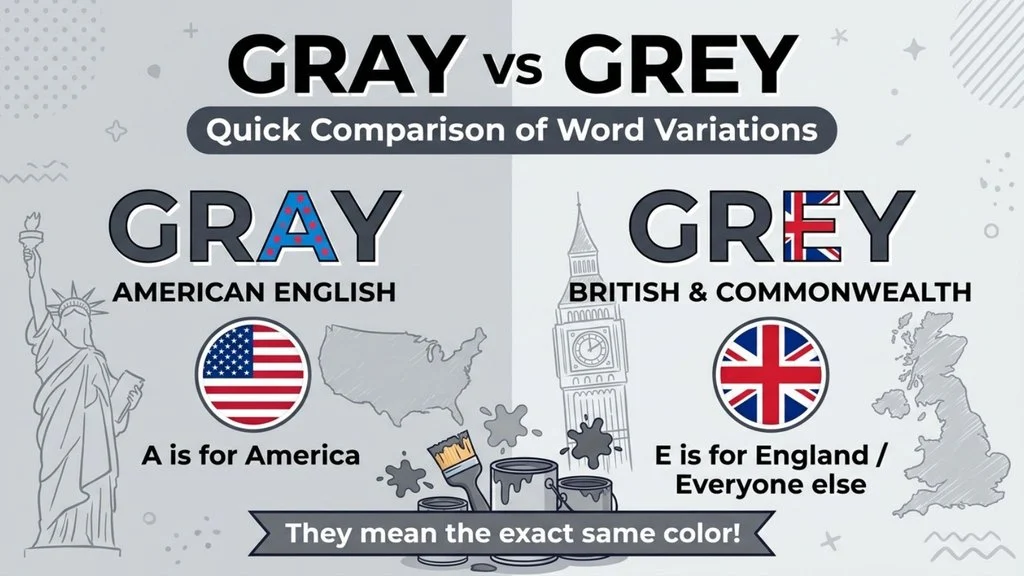
Here is a simple table showing the main spelling differences.
| Word Form | American English | British English |
| Basic spelling | Gray | Grey |
| Light shade | Light gray | Light grey |
| Dark shade | Dark gray | Dark grey |
| Hair color | Gray hair | Grey hair |
| Color paint | Gray paint | Grey paint |
| Slightly gray | Grayish | Greyish |
| Becoming gray | Graying | Greying |
| Turned gray | Grayed | Greyed |
| Gray area | Gray area | Grey area |
| Gray matter | Gray matter | Grey matter |
Important: Some proper names have fixed spellings. For example, Earl Grey tea is spelled with an e, including in American English.
FAQs About Gray or Grey Color
1. Is it gray or grey?
Both are correct. Gray is the preferred spelling in American English, while grey is generally preferred in British English.
2. Is gray American or British English?
Gray is mainly associated with American English. It is the standard spelling used in the United States.
3. Is grey British or American English?
Grey is mainly associated with British English. It is commonly used in the United Kingdom, Australia, and other Commonwealth countries.
4. Do gray and grey mean the same thing?
Yes. Both words describe the same color between black and white. There is no standard difference in meaning.
5. Is grey spelled with an E or an A?
Grey is spelled with an E. Gray is spelled with an A. Both forms are correct, but their regional use is different.
6. Which spelling should I use for SEO?
Choose the spelling that matches your target audience. Use gray for American readers and grey for British readers. You can include both naturally in your content to address spelling-related searches.
7. Is gray or grey correct in Canada?
Both spellings are accepted in Canada. Grey is often preferred, but you should follow your organization’s writing style.
8. Is gray darker than grey?
No. There is no official color rule that makes gray darker than grey. Both spellings refer to the same color.
Conclusion:
The difference between gray and grey is simple. Both are correct spellings of the same color, but their use depends on regional English preferences. American English generally uses gray, while British English usually uses grey.
If you write for American readers, choose gray. If your audience is mainly from the UK, Australia, or other Commonwealth countries, grey is usually the better choice. Canadian English accepts both forms.
Remember that neither spelling changes the meaning or pronunciation of the word. The most important thing is to keep your writing consistent. Avoid switching between gray and grey without a clear reason.
The final answer is easy: gray is American English, grey is British English, and both spellings are correct.

I am Ethan Whitmore is the founder and lead writer of Grammlii.com, passionate about exploring meanings, language, literature, and insightful ideas. Through well-researched and engaging content, he helps readers discover the deeper significance behind words, expressions, and everyday concepts.