Have you ever stopped while writing a text, email, or school paper to ask if “thru or through” is the correct spelling? You are not alone.
Both forms appear in daily life, on road signs, in messages, and in business writing. However, they do not have the same level of acceptance in formal English.
The word through is the standard spelling. It can mean from one side to the other, from start to finish, or by using something as a means.
For example, you might walk through a door, read through a book, or send a message through email.
The word thru is a shorter form of through. You may see it on road signs, restaurant menus, drive-thru windows, and informal messages.
It is easy to read and takes up less space. Still, it is not the best choice for most formal writing.
Thru or Through – Quick Answer
Through is the standard and preferred spelling in English. Thru is an informal, shortened version used mainly in signs, labels, and casual writing.
Here is a quick look at both words:
- Through: Use it in schoolwork, business emails, reports, essays, and formal documents.
- Thru: Use it in familiar expressions, such as drive-thru, or when a short form fits the context.
Examples:
- Correct: We walked through the park.
- Informal: We went to the drive-thru for lunch.
- Correct: I read through the report.
- Casual: I’ll be there thru the weekend. (Informal; through is preferred in standard writing.)
The main rule is simple: choose through when you are unsure. It is accepted in formal and informal English and works in almost every context.
The Origin of Thru or Through

The word through has a long history in the English language. It comes from Old English þurh, which meant moving from one side to another or passing across something. Over time, the spelling changed as the English language developed. The modern form through became the standard spelling.
Etymology, Origin & Meaning+1
The shorter spelling thru appeared around 1839. It was linked to efforts to make English spelling simpler. Some writers wanted words to be spelled in ways that better matched their sounds. The shorter form became more visible in American English, especially in signs and everyday use.
Etymology, Origin & Meaning+1
Here is a simple look at the history:
- Old English: þurh was an early form of the word.
- Middle English: The spelling developed into forms such as thurgh.
- Modern English: Through became the accepted standard spelling.
- Nineteenth century: Thru appeared as a shorter spelling.
- Modern usage: Thru is still used in some informal settings and familiar expressions.
The difference is mainly about spelling, not meaning. In most cases, thru and through refer to the same idea. However, through is the safer choice for formal and professional writing.
British English vs American English Spelling
Both British English and American English use through as the standard spelling. Unlike words such as colour and color, this is not a common British-versus-American spelling difference.
The shorter form thru is often associated with American signs, advertising, and informal writing. However, it is not the standard replacement for through in American English. British English also uses through in formal and everyday writing.
Compare these examples:
| Situation | Standard spelling | Informal or shortened form |
| Walking across a park | We walked through the park. | We walked thru the park. |
| Reading a document | Read through the report. | Read thru the report. |
| Restaurant service | Drive-through service | Drive-thru service |
| Sending a message | I sent it through email. | I sent it thru email. |
| Working during a period | I worked through the night. | I worked thru the night. |
| Completing a task | We went through every step. | We went thru every step. |
Notice that thru is understandable in many of these examples. However, the longer spelling is better for formal documents, academic work, and professional communication.
Is Thru More American Than British?
Yes, thru is more closely associated with American usage, especially in public signs and commercial language. For example, drive-thru is a familiar spelling in the United States.
Still, the spelling through is widely used in both countries. If you are writing for readers in the United States, the United Kingdom, Canada, Australia, or other English-speaking regions, you can safely use through in most situations.
Which Spelling Should You Use?

The right choice depends on your audience and the type of writing you are doing. In most cases, you should use through. It is clear, standard, and widely accepted.
Here is how to choose the correct spelling for different situations.
1. For American English
Use through in essays, reports, business emails, and formal documents.
Example: “Please read through the instructions before starting.”
You can use thru in informal messages or familiar commercial terms, such as drive-thru.
2. For British English
Use through in both formal and everyday writing.
Example: “We walked through the town centre.”
The same rule applies to most Commonwealth English settings, including Australia and New Zealand.
3. For School and Academic Writing
Always choose through unless you are quoting a source that uses thru or discussing spelling variations.
Example: “The researcher looked through the available evidence.”
Using the standard spelling helps keep your writing clear and professional.
4. For Business Emails and Reports
Use through when describing a process, sharing information, or explaining how something happened.
Example: “We received your application through our online system.”
This spelling is suitable for clients, managers, coworkers, and business partners.
5. For Signs, Labels, and Informal Messages
Thru may be suitable when space is limited or when it forms part of an established expression.
Examples include drive-thru, thruway, and short advertising messages. Remember that some terms have their own established spellings, so check the form used by the relevant brand or organization.
Best advice: If you are not sure which spelling to use, choose through. It works in almost every writing situation.
Common Mistakes with Thru or Through
Many people confuse thru and through because both forms are easy to understand. However, using the shorter form in the wrong setting can make your writing look less formal.
Here are some common mistakes and how to correct them.
Mistake 1: Using Thru in Formal Writing
Incorrect for standard formal writing: “Please look thru the attached report.”
Correct: “Please look through the attached report.”
Use through in business emails, academic papers, reports, and official letters.
Mistake 2: Thinking Thru Is Always Wrong
It is not always wrong. Thru is a recognized spelling variant of through, although its use is more limited. Dictionaries describe it as a less common spelling, chiefly associated with informal use.
Merriam-Webster+1
Examples:“The restaurant has a drive-thru window.”
This is a familiar and accepted spelling in that expression.
Mistake 3: Confusing Through with Threw
These words sound alike but have different meanings.
- Through: Moving from one side to another or from start to finish.
- Threw: The past tense of throw.
Examples:
- Correct: “She walked through the door.”
- Correct: “She threw the ball.”
Incorrect: “She threw the door to reach the garden.” (Unless she actually threw the door!)
Mistake 4: Using Thru in Every Sentence
Some writers use thru everywhere because it is shorter. This can make formal writing look inconsistent.
Incorrect: “We went thru the report and sent it thru email.”
Better: “We went through the report and sent it through email.”
Use the standard form unless the shorter spelling is needed for a particular purpose.
Mistake 5: Assuming British English Uses a Different Standard
Both British and American English use through as the standard form. You do not need to switch to thru when writing for an American audience.
Mistake 6: Changing Established Expressions
Some expressions have common spellings that you should learn as complete terms.
For example:
- Drive-through or drive-thru
- Through the door
- Through the night
- Follow through
- See it through
The spelling thru is common in drive-thru, but that does not mean it should replace through in every phrase.
Thru or Through in Everyday Examples
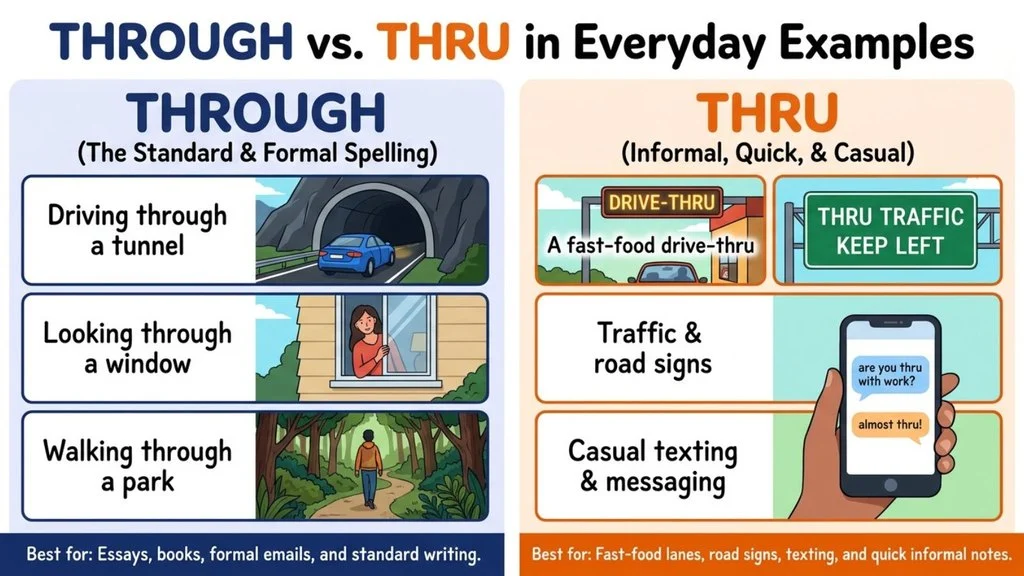
The best way to learn the difference is to see both spellings in real-life situations. The following examples show when to use each form.
1. In Emails
Professional emails usually require standard spelling.
Correct:
“Please read through the attached document and share your feedback.”
“Thank you for sending the details through email.”
Informal message:
“I’ll look thru the notes later.”
The informal version may be understood, but the standard spelling is a better choice for work.
2. In News Articles
News writing usually uses through because it follows standard spelling conventions.
Examples:
- “The storm moved through the region overnight.”
- “The team advanced through the final round.”
- “The company reached customers through its website.”
Using thru in a news article may look unusual unless it appears in a direct quote, a proper name, or an established label.
3. On Social Media
Social media posts often use shorter words, abbreviations, and casual spelling.
Examples:
- “Made it thru a busy week!”
- “We walked through the old city today.”
- “Just trying to get through Monday.”
Both forms may appear online. Use thru if you want an informal tone, but use through if you want standard spelling.
4. In Academic Writing
Academic writing should use through.
Examples:
- “The results were collected through interviews.”
- “The students worked through the exercises.”
- “The study examines changes through the years.”
Avoid thru in essays, research papers, assignments, and formal reports unless you are quoting the original wording.
5. In Business Communication
Business writing should be clear and consistent.
Examples:
- “We received your request through our website.”
- “Please review the contract through the final section.”
- “The payment was processed through the bank.”
The word through is suitable for customer emails, internal reports, proposals, and presentations.
6. In Signs and Advertising
This is where thru is especially familiar.
Examples:
- Drive-thru available
- Drive-thru pickup
- Order at the drive-thru
- Open late for drive-thru service
Shorter words can be useful on signs because they save space. Still, drive-through is also a recognized form.
Thru or Through Google Trends and Usage Data
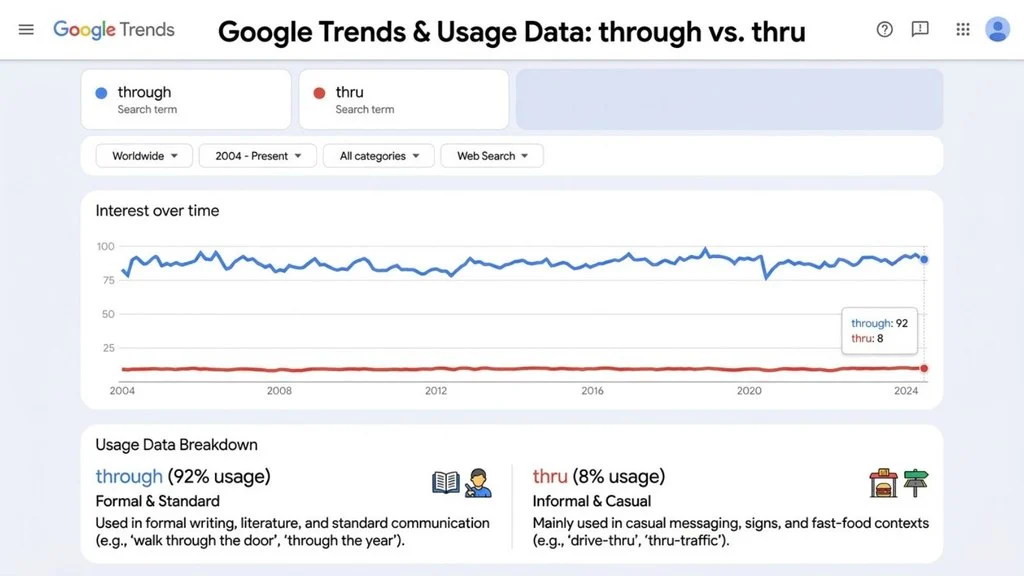
People often search for thru or through because they want to know which spelling is correct. They may also want to check whether one form is more common in American or British English.
However, it is important to separate general spelling guidance from measured search data.
Which Spelling Is More Common?
In standard written English, through is the preferred spelling. It is used across formal, academic, professional, and everyday contexts.
The shorter form thru is associated more strongly with American informal usage, especially in signs, commercial terms, and casual messages. This is a general usage distinction, not a live measurement of how many people use each form.
What About Google Trends?
Google Trends can help you explore interest in spelling questions by country and over time. Its results use a normalized index from 0 to 100, rather than showing exact search counts.
Google News Initiative+1
You can explore search interest using Google Trends. For a useful comparison, try these search phrases:
- Thru or through
- Through meaning
- How to spell through
- Drive-thru spelling
- Through vs. thru
One important limitation is that Google Trends does not always treat spelling variations as the same search term. Its help documentation specifically notes that misspellings and spelling variations may need separate comparisons.
Trends Help+1
Therefore, do not assume that a higher search-interest score means a word is more common in everyday writing. Search interest measures relative attention, not total word usage.
Usage by Country and Context
| Country or region | Preferred standard spelling | Where thru may appear |
| United States | Through | Drive-thru signs and informal messages |
| United Kingdom | Through | Informal writing or American-style commercial terms |
| Canada | Through | Signs, advertising, and casual communication |
| Australia | Through | Informal messages and commercial contexts |
| New Zealand | Through | Informal writing and some signs |
| International English | Through | Short labels and informal communication |
This table summarizes general spelling conventions, not a live ranking of usage by country. For professional writing intended for a global audience, through remains the most reliable choice.
Comparison Table: Thru vs Through and Related Words
The following table explains the difference between the two spellings and several related words that are often confused with them.
| Word or phrase | Meaning | Example |
| Through | From one side to another | We walked through the tunnel. |
| Thru | Informal spelling of through | Use the drive-thru window. |
| Drive-through | A service you use without leaving your vehicle | We ordered food at the drive-through. |
| Drive-thru | Shorter spelling of drive-through | The drive-thru closes at midnight. |
| Threw | Past tense of throw | He threw the ball. |
| Thorough | Complete and careful | She did a thorough review. |
| Throughout | In every part or during the whole period | It rained throughout the day. |
| Breakthrough | A major advance or discovery | The team made a scientific breakthrough. |
Remember that through, thru, and threw are not interchangeable in every sentence. Pay attention to both meaning and context.
Frequently Asked Questions (FAQs)
1. Is Thru or Through Correct?
Through is the standard spelling and the best choice for most situations. Thru is a recognized, less common variant used mainly in informal writing and familiar expressions such as drive-thru.
2. Is Thru a Real Word?
Yes. Thru is a recognized spelling variant of through. It is not simply a random spelling error. However, its use is more limited, so through is usually better for formal writing.
Merriam-Webster+1
3. Is Thru American or British English?
Thru is more closely associated with American English, particularly in signs, advertising, and informal communication. Both American and British English use through as the standard spelling.
4. Should I Use Thru or Through in an Email?
Use through in professional emails, client messages, and formal communication.
Example: “Please send the documents through our online portal.”
You can use thru in a casual text to a friend, but it is best to avoid it in professional writing.
5. Why Do People Write Drive-Thru Instead of Drive-Through?
Drive-thru is a common shortened spelling used on signs and in advertising. It is easy to read and saves space. Drive-through is also a recognized spelling.
6. Does Thru Mean the Same Thing as Through?
In most situations, yes. Thru is a shortened spelling of through. However, through is the standard form, so it is the better choice in formal writing and most general communication.
7. How Do I Remember the Correct Spelling?
Use this simple rule: When in doubt, write through.
Remember that thru is a shorter variant, while through works in almost every context. Also, do not confuse through with threw, which is the past tense of throw.
Conclusion:
Choosing between thru and through is simple once you understand their uses. Both spellings exist, but they do not have the same role in standard English.
Through is the preferred spelling for formal writing, school assignments, business emails, news articles, and everyday communication. It is accepted in both American and British English.
The shorter form thru is mostly used in informal settings, signs, advertising, and familiar expressions such as drive-thru.
It can be useful when space is limited or when a casual tone is appropriate. However, it is not the best choice for essays, reports, or professional documents.
Remember that the main difference is spelling, not meaning. Both forms can express the same idea in suitable contexts, but through is the safer option when you are unsure.
If you want your writing to look clear, correct, and professional, choose through as your default.

I am Ethan Whitmore is the founder and lead writer of Grammlii.com, passionate about exploring meanings, language, literature, and insightful ideas. Through well-researched and engaging content, he helps readers discover the deeper significance behind words, expressions, and everyday concepts.