Have you ever written acknowledgement and wondered if you should remove the extra “e”? You are not alone.
Many people search for acknowledgement or acknowledgment because both spellings look correct, and both appear in books, emails, school work, and professional documents.
The good news is that both spellings are correct. The main difference is where they are used. Acknowledgment is the standard spelling in American English, while acknowledgement is more common in British English and many other English-speaking countries.
Choosing the right spelling can help your writing look clear and professional. It is especially useful when writing job applications, business emails, academic papers, or formal letters.
Using the wrong regional spelling is not usually a grammar mistake, but it may make your writing less consistent.
In this guide, you will learn the meaning, origin, spelling rules, and correct use of both words. You will also see simple examples, common mistakes, and tips to help you choose the right spelling for your audience.
Acknowledgement or Acknowledgment – Quick Answer
Both acknowledgement and acknowledgment are correct spellings of the same noun. They mean the act of accepting, recognizing, or showing that something is true or has been received.
The difference is regional:
- Acknowledgment: Preferred in American English (US).
- Acknowledgement: Preferred in British English (UK) and commonly used in other varieties of English.
Examples:
- US English: Thank you for your acknowledgment of my request.
- UK English: Thank you for your acknowledgement of my request.
Both sentences are correct. The meaning does not change.
Remember this simple rule: Use acknowledgment for American readers and acknowledgement for British readers. Most importantly, choose one spelling and use it consistently throughout your writing.
The Origin of Acknowledgement or Acknowledgment
The word acknowledgment comes from the verb acknowledge, which means to accept, recognize, or show that something is known.
The verb has roots in Middle English. It developed from earlier English forms connected with recognizing or admitting something.
The ending -ment turns the verb into a noun. It describes the act, result, or process of acknowledging something.
The spelling difference developed through different English spelling conventions. British English often keeps a final silent “e” before certain suffixes. American English often removes it to make the word shorter.
This explains the two forms:
- Acknowledge + ment = Acknowledgement
- Acknowledg + ment = Acknowledgment
Both forms have the same meaning. The difference is mainly based on regional spelling preferences.
British English vs American English Spelling
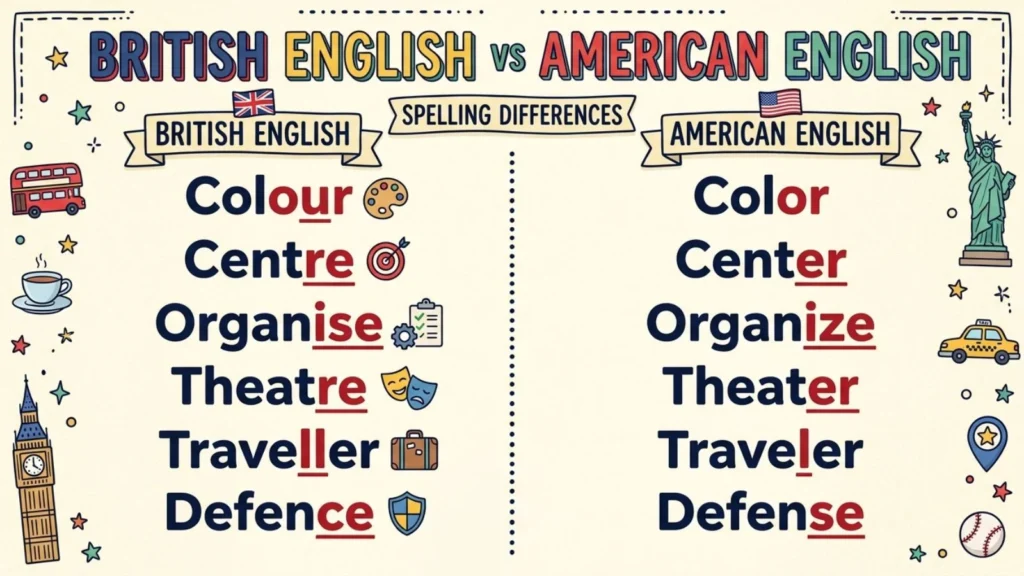
British and American English use different spelling rules for some words. One common difference is the final silent “e” before endings such as -ment.
British English often keeps the “e” in words such as acknowledgement. American English usually removes it and writes acknowledgment.
Here is a simple comparison:
| British English | American English |
| Acknowledgement | Acknowledgment |
| Judgement | Judgment |
| Ageing | Aging |
| Likeable | Likable |
| Routeing | Routing |
There is one important detail: both acknowledgement and acknowledgment are accepted in major English dictionaries. The shorter form is preferred in American English, while the longer form is preferred in British English.
UOC+2
Examples in British English:
- Your acknowledgement is greatly appreciated.
- She received an acknowledgement from the company.
- The book includes a page of acknowledgements.
Examples in American English:
- Your acknowledgment is greatly appreciated.
- She received an acknowledgment from the company.
- The book includes a page of acknowledgments.
The meaning stays the same in every example.
Which Spelling Should You Use?
The correct spelling depends on your readers, location, and writing style. Both forms are correct, but choosing the preferred regional spelling makes your writing look more natural.
Here is how to choose.
1. Use Acknowledgment for American Readers
If you are writing for people in the United States, use acknowledgment. It is the standard American spelling.
Examples:
“Thank you for your acknowledgment of our proposal.”
This spelling is suitable for American business emails, reports, academic papers, and formal letters.
2. Use Acknowledgement for British Readers
If your audience is in the United Kingdom, use acknowledgement. It follows the common British spelling style.
Examples:
“Thank you for your acknowledgement of our proposal.”
This form is also common in British academic and professional writing.
3. Use the Preferred Local Form in Commonwealth Countries
Countries such as Australia and New Zealand commonly follow British spelling conventions.
For these audiences, acknowledgement is generally a suitable choice.
4. Choose One Spelling for Global Writing
If you write for an international audience, either form can work.
However, consistency is important. Do not switch between the two spellings in the same article, report, or document.
Professional tip: Check your organization’s style guide before preparing formal documents. Some companies and universities have their own spelling preferences.
Common Mistakes with Acknowledgement or Acknowledgment
Many writers understand the meaning but still make small spelling and usage mistakes.
Here are some common errors and their corrections.
1. Using Both Spellings in One Document
Incorrect:
“We received your acknowledgment. Thank you for the acknowledgement.”
Correct:
“We received your acknowledgment. Thank you for the acknowledgment.”
Choose one spelling and use it throughout the document.
2. Thinking One Spelling Is Always Wrong
Incorrect idea:
“Acknowledgement is always wrong in American English.”
Correct:
“Both spellings are accepted, but acknowledgment is the preferred American form.”
Do not treat a regional spelling difference as a serious grammar error.
3. Confusing the Noun with the Verb
Acknowledgment and acknowledgement are nouns. Acknowledge is the verb.
Examples:
- Noun: We received your acknowledgment.
- Verb: We acknowledge your support.
4. Forgetting the Correct Ending
Incorrect:
- Acknowledgementt
- Acknowledgemant
- Aknowledgment
Correct:
- Acknowledgement
- Acknowledgment
Check the spelling before submitting important documents.
5. Using the Word Without a Clear Meaning
An acknowledgment should show recognition, acceptance, or thanks.
Incorrect:
“I acknowledgment the email.”
Correct:
“I acknowledge the email.”
Use acknowledge when you need a verb.
Acknowledgement or Acknowledgment in Everyday Examples

Both spellings appear in everyday communication. The best choice depends on your audience and the type of writing.
Here are some simple examples.
1. In Emails
Emails often use the word when confirming that a message or document has arrived.
British English:
“Thank you for your acknowledgement. I will review the documents today.”
American English:
“Thank you for your acknowledgment. I will review the documents today.”
2. In News Articles
News writers use the word when someone accepts a fact or recognizes an important issue.
Examples:
- The statement was an acknowledgement of the problem.
- The announcement was an acknowledgment of the team’s hard work.
Both sentences are correct.
3. On Social Media
People use the word when talking about recognition, appreciation, or support.
Examples:
- Everyone deserves a little acknowledgement.
- A simple acknowledgment can make someone feel valued.
- Thank you for your support and acknowledgement!
4. In Academic Writing
Students and researchers often use the plural form in a section that thanks people who helped with their work.
British English:
“Acknowledgements”
American English:
“Acknowledgments”
Examples:
“The author would like to express sincere thanks to the teachers and researchers who supported this study.”
5. In Formal Business Writing
Businesses use acknowledgments to confirm that they have received letters, applications, payments, or other documents.
Examples:
- We confirm the acknowledgement of your application.
- Please send an acknowledgment of receipt.
- Your acknowledgment of the agreement is required.
These examples show that the word has several useful meanings in professional communication.
Acknowledgement or Acknowledgment Google Trends & Usage Data
People search for both spellings because they want to know which version is correct. The difference is especially important for students, bloggers, business writers, and people working with international audiences.
However, there is an important point about Google Trends: it measures relative search interest, not exact search numbers. Its scores are normalized from 0 to 100, so they should not be treated as monthly search volumes.
Trends Help+1
Regional spelling patterns
The following table shows the common spelling preferences across English-speaking regions.
| Country or Region | Common Preference |
| United States | Acknowledgment |
| United Kingdom | Acknowledgement |
| Canada | Acknowledgment is common |
| Australia | Acknowledgement |
| New Zealand | Acknowledgement |
| India | Acknowledgement is common |
| Pakistan | Both forms are understood |
| South Africa | Acknowledgement is common |
These are general language conventions, not live Google Trends rankings.
Why Do People Search for Both Words?
There are several reasons:
- Students want to use the correct spelling in assignments.
- Writers want to follow British or American English rules.
- Job applicants want professional-looking documents.
- Bloggers want to use the right keyword.
- Office workers want to write clear business emails.
How to Check Google Trends
You can compare both spellings by following these steps:
- Visit Google Trends.
- Enter “acknowledgement” as your first search term.
- Add “acknowledgment” as your second search term.
- Select your preferred country or region.
- Choose a time range, such as the past 12 months.
- Compare interest over time and regional interest.
For a useful SEO analysis, check both spellings separately in your target countries. Google also recommends examining regional interest and related searches when planning content.
Trends Help+1
Acknowledgement vs Acknowledgment Comparison Table
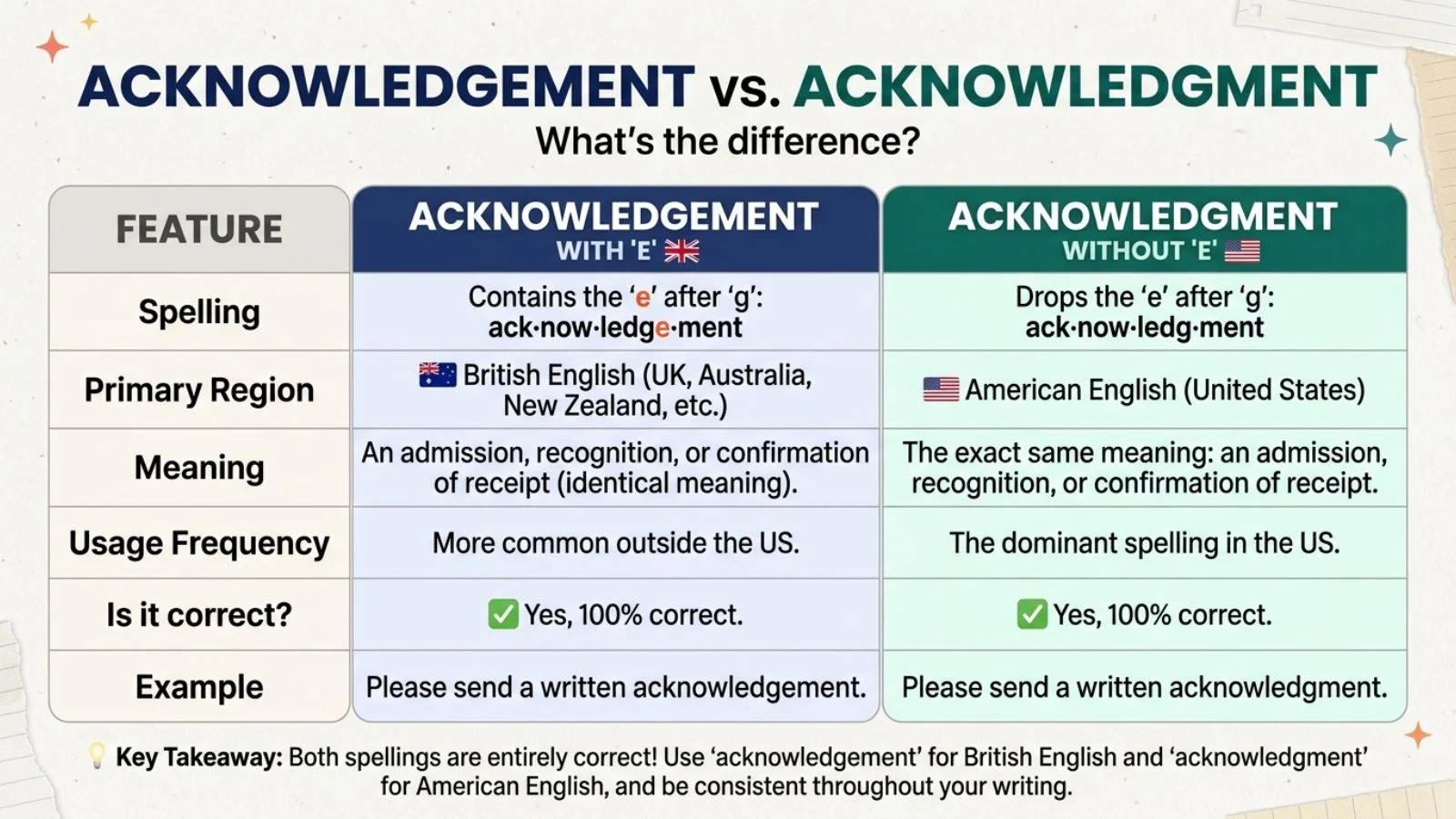
Here is a quick side-by-side comparison to help you remember the difference.
| Feature | Acknowledgement | Acknowledgment |
| Spelling | With an extra e | Without an extra e |
| Preferred region | British English | American English |
| Meaning | Recognition or thanks | Recognition or thanks |
| Word type | Noun | Noun |
| Pronunciation | Same | Same |
| Formal writing | Correct | Correct |
| Plural | Acknowledgements | Acknowledgments |
| Grammar | Correct | Correct |
Quick reminder: The extra “e” changes the spelling, not the meaning or pronunciation.
FAQs
1. Is acknowledgement or acknowledgment correct?
Both spellings are correct. Acknowledgement is preferred in British English, while acknowledgment is preferred in American English.
2. What is the difference between acknowledgement and acknowledgment?
The only difference is the letter “e” before the ending “-ment.” Both words have the same meaning and pronunciation.
3. Is acknowledgement British or American English?
Acknowledgement is the preferred British English spelling. It is also used in several other countries that follow British spelling conventions.
4. Is acknowledgment American English?
Yes. Acknowledgment is the standard preferred spelling in American English. It is commonly used in US emails, reports, books, and academic writing.
5. How do you spell acknowledgement in the UK?
In the UK, the usual spelling is acknowledgement, with an extra “e” after the letter “g.”
6. How do you spell acknowledgment in the US?
In the US, the usual spelling is acknowledgment, without the extra “e.”
7. What is the plural of acknowledgement or acknowledgment?
The plural of acknowledgement is acknowledgements. The plural of acknowledgment is acknowledgments.
Both forms are correct.
8. Is acknowledgement a formal word?
Yes. It is a formal noun used in business emails, academic papers, reports, letters, and books. It can describe recognition, thanks, or confirmation that something has been received.
9. What is the verb form of acknowledgment?
The verb form is acknowledge.
Example: “We acknowledge your contribution to the project.”
10. Which spelling should I use for SEO content?
Use the spelling that matches your target audience. Choose acknowledgment for US-focused content and acknowledgement for UK-focused content. You can mention the alternative spelling naturally to help readers find your article.
Conclusion:
The choice between acknowledgement and acknowledgment is simple once you understand the difference between British and American English.
Both spellings are correct, and both have the same meaning. The only difference is the extra letter “e.”
If you write for an American audience, choose acknowledgment. If you write for British readers or audiences that follow British spelling, choose acknowledgement.
Both forms work well in emails, academic papers, business reports, books, and everyday communication.
Remember that consistency is more important than choosing one spelling over the other. Avoid switching between the two forms in the same document.
If you are writing for a company, school, or publication, check its preferred style guide before submitting your work.

I am Ethan Whitmore is the founder and lead writer of Grammlii.com, passionate about exploring meanings, language, literature, and insightful ideas. Through well-researched and engaging content, he helps readers discover the deeper significance behind words, expressions, and everyday concepts.