Chemistry can be confusing, especially when you need to decide whether a molecule is polar or nonpolar.
One common question students ask is: Is HCN polar or nonpolar? Understanding molecular polarity helps explain how molecules behave, how they interact with other substances, and why some compounds dissolve in certain liquids.
Hydrogen cyanide (HCN) is a simple molecule with three atoms: hydrogen, carbon, and nitrogen.
However, its molecular structure makes it an interesting example of chemical polarity. Students often confuse bond polarity with molecular polarity.
A molecule can contain polar bonds, but its overall shape determines whether the entire molecule is polar or nonpolar.
In this article, we will explain whether HCN is polar or nonpolar, explore its molecular structure, and discuss the role of electronegativity and dipole moments.
You will also find simple examples, common mistakes, comparison tables, and answers to frequently asked questions.
By the end, you will understand why HCN is classified as a polar molecule.
HCN Polar or Nonpolar – Quick Answer
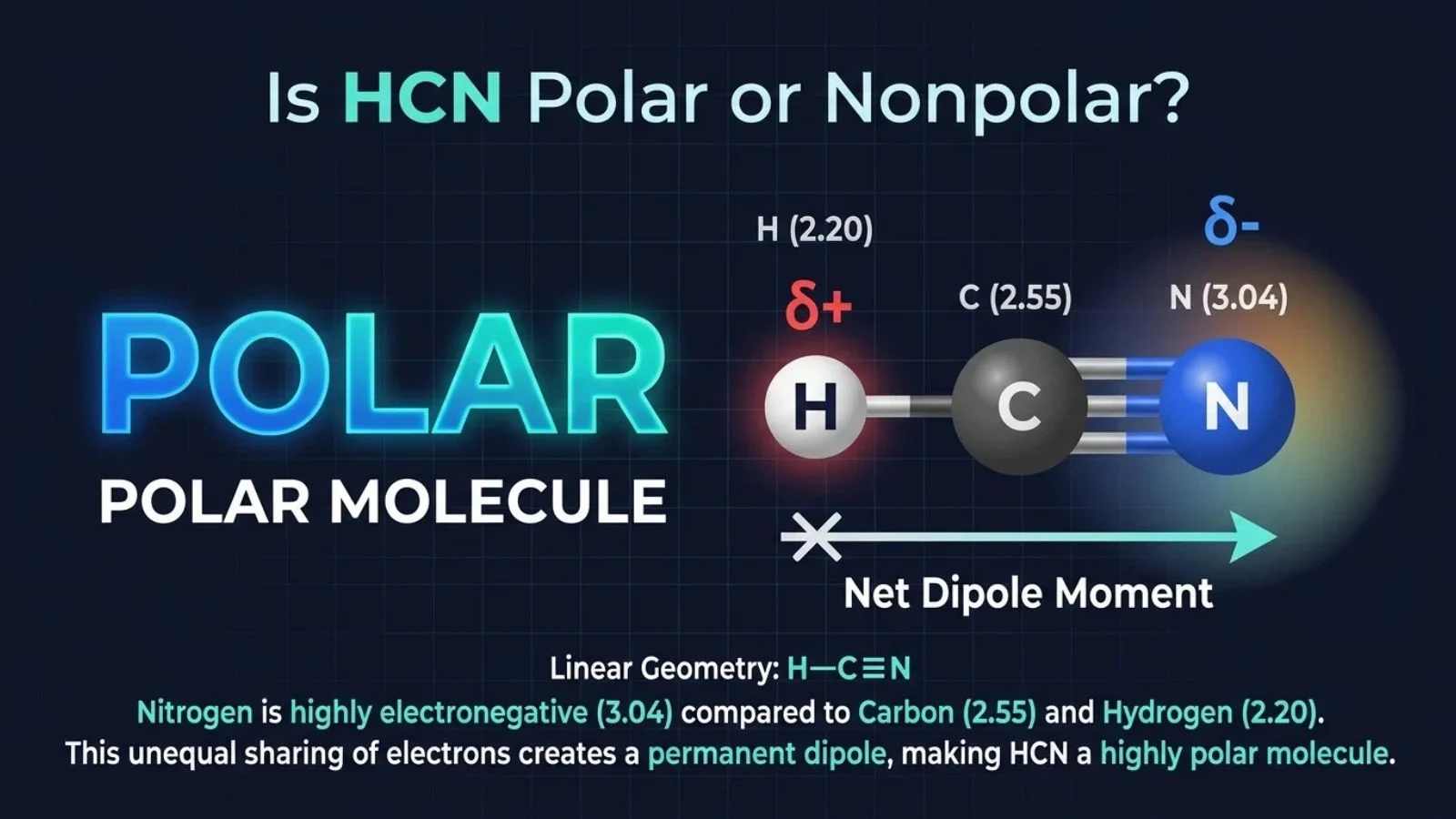
HCN is a polar molecule.
HCN stands for hydrogen cyanide. It has a linear molecular shape, but its two ends have different electronegativities.
Here is why HCN is polar:
- Hydrogen is less electronegative than carbon.
- Nitrogen is more electronegative than carbon.
- The molecule has an uneven distribution of electrical charge.
- Its bond dipoles do not cancel each other.
The nitrogen end becomes partially negative, while the hydrogen end becomes partially positive.
Quick fact: HCN has a linear shape with a bond angle of 180 degrees, but it is still polar because its ends are different.
The Origin of HCN
HCN is the chemical formula for hydrogen cyanide. It contains three atoms:
- One hydrogen atom (H).
- One carbon atom (C).
- One nitrogen atom (N).
Hydrogen cyanide is also known as prussic acid when dissolved in water.
The molecule contains a hydrogen-carbon single bond and a carbon-nitrogen triple bond.
Its structure is:
H–C≡N
The carbon atom is in the center. Hydrogen is on one side, and nitrogen is on the other.
The term polarity comes from the idea of having two different electrical ends. In chemistry, a polar molecule has an uneven distribution of electrical charge.
HCN has this uneven charge distribution because nitrogen attracts electrons more strongly than hydrogen and carbon.
British English vs American English Spelling

The chemical formula HCN does not change between British and American English.
Both countries use the same chemical symbols, molecular formulas, and scientific naming systems.
However, some related scientific words have different spellings.
| British English | American English |
| Polarisation | Polarization |
| Analyse | Analyze |
| Behaviour | Behavior |
| Colour | Color |
| Centre | Center |
| Molecule | Molecule |
| Hydrogen cyanide | Hydrogen cyanide |
The words in the table show common spelling differences. The chemical formula HCN remains the same everywhere.
Does HCN Have Different Spellings?
No. HCN is a chemical formula, not an ordinary English word.
It always represents one hydrogen atom, one carbon atom, and one nitrogen atom.
You should not change its spelling based on the country or language you use.
Which Spelling Should You Use?
The best choice depends on your audience and the type of writing.
For American Students
Use American English spelling in school assignments and science articles.
For example:
- Polarization
- Analyze
- Behavior
For British Students
Use British English spelling when writing for UK schools, universities, and scientific publications that follow British conventions.
For example:
- Polarisation
- Analyse
- Behaviour
For Global Readers
If you are writing for an international audience, use simple scientific language.
Always write the chemical formula as HCN. This formula is understood worldwide.
Professional advice: Never change chemical symbols to match British or American spelling rules.
Common Mistakes with HCN Polar or Nonpolar
Students often make mistakes when identifying the polarity of HCN.
Here are some common errors and their corrections.
Mistake 1: Thinking Linear Molecules Are Always Nonpolar
This is incorrect.
Some linear molecules are nonpolar, while others are polar.
For example, carbon dioxide (CO2) is nonpolar because its bond dipoles cancel. HCN is polar because its ends are different.
Mistake 2: Ignoring Electronegativity
Electronegativity explains how strongly an atom attracts shared electrons.
Nitrogen attracts electrons more strongly than carbon and hydrogen. This creates an uneven charge distribution in HCN.
Mistake 3: Confusing Bond Polarity with Molecular Polarity
Bond polarity and molecular polarity are not the same.
A molecule may contain polar bonds, but its overall shape determines whether the bond dipoles cancel.
In HCN, they do not cancel.
Mistake 4: Thinking HCN Has a Bent Shape
HCN is linear, not bent.
Its bond angle is 180 degrees.
Mistake 5: Assuming All Three Atoms Share Electrons Equally
The electrons are not shared equally because the atoms have different electronegativities.
Nitrogen pulls the shared electrons more strongly.
HCN in Everyday Examples
Understanding HCN polarity can help students learn how molecules behave in chemistry.
Here are examples of how this topic appears in different types of writing.
1. In Emails
A student may write:
“Can you explain why HCN is polar even though it has a linear molecular shape?”
This is a common question in chemistry classes.
2. In Science News
A science article may explain:
“Hydrogen cyanide is a polar molecule because its electrical charge is distributed unevenly.”
This helps readers understand its molecular properties.
3. On Social Media
A student may post:
“Quick chemistry fact: HCN is linear, but it is still polar!”
This is a simple way to remember the concept.
4. In Formal Writing
A chemistry assignment may include:
“Hydrogen cyanide (HCN) is a polar molecule due to its unequal electron distribution and non-canceling bond dipole moments.”
This is a suitable scientific explanation.
HCN Polar or Nonpolar Google Trends & Usage Data
The keyword “HCN polar or nonpolar” is mainly searched by students, chemistry learners, and people preparing for science exams.
It is a question-based educational keyword. People usually search for it when studying molecular geometry, electronegativity, and chemical bonding.
Why Do People Search for This Keyword?
There are several reasons:
- Students need quick answers for homework.
- Chemistry learners want to understand molecular polarity.
- Teachers use HCN as an example of a polar linear molecule.
- Exam candidates study molecular shapes and dipole moments.
- Online learners compare HCN with other molecules.
Search Interest by Country
Chemistry questions about molecular polarity can attract international searches.
Potential audiences include:
| Country | Common Search Context |
| United States | Chemistry homework and exams |
| United Kingdom | School and university chemistry |
| India | Chemistry lessons and competitive exams |
| Pakistan | Science education and exam preparation |
| Canada | Molecular geometry and bonding |
| Australia | Chemistry assignments and revision |
These are potential audience groups, not verified search-volume rankings.
Does the Keyword Have Different Meanings by Country?
No. HCN has the same chemical structure and polarity everywhere.
The scientific answer does not change between countries.
Google Trends can help compare search interest over time, but it does not provide exact search volumes. No verified trend figures are presented here.
HCN Molecular Structure and Polarity Explained
To understand why HCN is polar, you need to look at its molecular structure.
1. Molecular Geometry
HCN has a linear molecular shape.
Its atoms are arranged in a straight line:
H–C≡N
The bond angle is 180 degrees.
2. Electronegativity
Electronegativity measures how strongly an atom attracts shared electrons.
Approximate Pauling electronegativity values are:
| Atom | Electronegativity |
| Hydrogen | 2.20 |
| Carbon | 2.55 |
| Nitrogen | 3.04 |
Nitrogen has the highest electronegativity of the three atoms.
Therefore, the electrons are pulled more strongly toward the nitrogen end.
3. Dipole Moment
A dipole moment measures the separation of positive and negative electrical charges.
HCN has a permanent dipole moment of approximately 2.98 Debye.
This confirms that HCN is polar.
4. Why Do the Dipoles Not Cancel?
HCN has two different ends.
The hydrogen end is relatively positive, while the nitrogen end is relatively negative.
Although the molecule is linear, the bond dipoles point in a way that produces a net dipole toward nitrogen.
This is why HCN is polar.
Comparison Table: HCN Polar or Nonpolar and Similar Molecules
| Molecule | Molecular Shape | Polarity |
| HCN | Linear | Polar |
| CO2 | Linear | Nonpolar |
| H2O | Bent | Polar |
| BF3 | Trigonal planar | Nonpolar |
| NH3 | Trigonal pyramidal | Polar |
| CH4 | Tetrahedral | Nonpolar |
| HCl | Linear | Polar |
This table shows that molecular shape and electronegativity both matter when identifying polarity.
Frequently Asked Questions
1. Is HCN polar or nonpolar?
HCN is polar. Its electrons are distributed unevenly, creating a permanent dipole moment.
2. Why is HCN polar if it is linear?
HCN is linear, but its two ends are different. The bond dipoles do not cancel, so the molecule has a net dipole moment.
3. What is the molecular shape of HCN?
HCN has a linear molecular shape with a bond angle of 180 degrees.
4. What is the electronegativity of nitrogen in HCN?
Nitrogen has an approximate Pauling electronegativity value of 3.04. It attracts shared electrons more strongly than carbon and hydrogen.
5. Does HCN have a dipole moment?
Yes. HCN has a permanent dipole moment of approximately 2.98 Debye.
6. Is HCN more polar than CO2?
Yes. HCN is polar, while CO2 is nonpolar. The dipole moments in CO2 cancel because of its symmetrical structure.
7. What is the correct structure of HCN?
The correct structure is H–C≡N. Hydrogen forms a single bond with carbon, while carbon forms a triple bond with nitrogen.
Conclusion
HCN is a polar molecule, even though it has a linear molecular shape. Its structure is H–C≡N, with hydrogen on one end, carbon in the center, and nitrogen on the other. The main reason for its polarity is the unequal distribution of electrons.
Nitrogen attracts shared electrons more strongly than carbon and hydrogen. This creates a partially negative nitrogen end and a relatively positive hydrogen end. As a result, the bond dipoles do not cancel, and HCN has a permanent dipole moment.
If you are studying in the United States, the United Kingdom, Pakistan, or another country, the scientific answer remains the same.
HCN is polar everywhere. Understanding this example will also help you identify the polarity of other molecules and prepare for chemistry exams with greater confidence.

I am Ethan Whitmore is the founder and lead writer of Grammlii.com, passionate about exploring meanings, language, literature, and insightful ideas. Through well-researched and engaging content, he helps readers discover the deeper significance behind words, expressions, and everyday concepts.