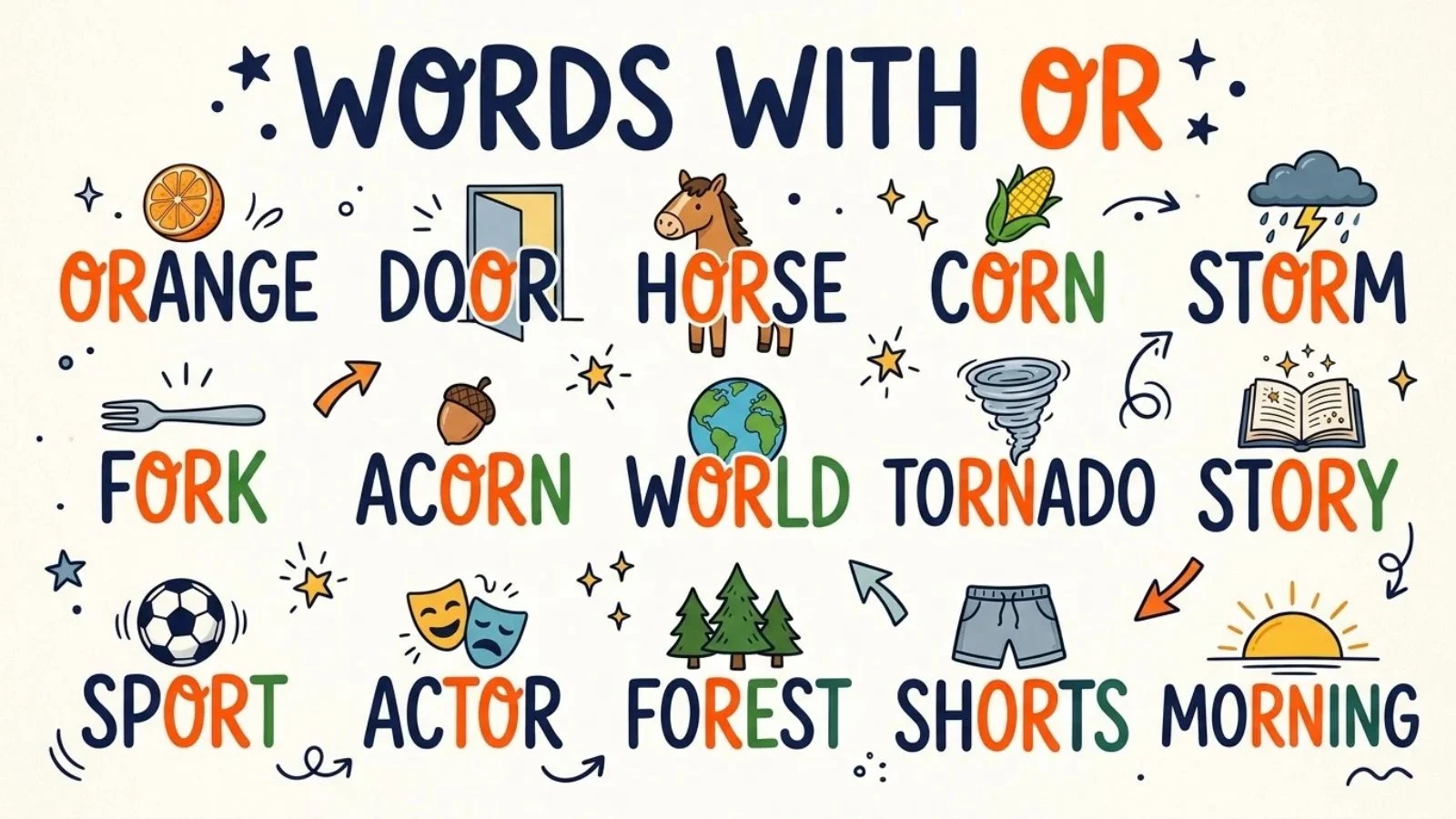
Words with “or” are common in English. You can find these two letters in words like orange, horse, short, world, and doctor. Learning these words can help you improve your spelling, reading, writing, and vocabulary.
Many people search for words with “or” because they want to help children learn English, solve word puzzles, improve spelling, or find examples for schoolwork. Some also want to know where “or” appears in a word and how it changes the sound.
The good news is that learning these words is easy. You only need to understand a few simple patterns and practise them with examples. In this guide, you will find short and long words, words that start or end with “or,” spelling differences, and useful everyday examples.
We will also look at British and American English, common spelling mistakes, and how to choose the right words for your audience. By the end, you will have a useful list of words with “or” and know how to use them correctly.
Words With Or – Quick Answer
Words with “or” are English words that contain the letters O and R together in this order. These letters can appear at the beginning, middle, or end of a word.
Here are some easy examples:
- At the beginning: Orange, order, orbit, organ, original.
- In the middle: Horse, short, world, storm, morning.
- At the end: Doctor, actor, visitor, editor, sailor.
100+ Words With Or
Here is a useful list of common words containing “or.”
| Word | Word | Word |
| Orange | Horse | Short |
| World | Storm | Doctor |
| Order | Sport | Morning |
| Story | Work | More |
| Form | Fork | Born |
| North | South | Forty |
| Force | Store | Score |
| Floor | Door | Poor |
| Before | Afterward | Normal |
| Report | Record | Forest |
| Forget | Forgive | Foreign |
| Formal | Former | Worker |
| Author | Actor | Visitor |
| Editor | Sailor | Mirror |
| Corner | Border | Horror |
| Moral | Major | Minor |
| Honor | Color | Labor |
| Harbor | Flavor | Favor |
| Support | Important | Morning |
| Wonderful | Wonderful | Ordinary |
| Organization | Information | Education |
| Performance | Opportunity | Transportation |
| Corporation | Comfortable | Extraordinary |
| Historical | Horizontal | Original |
| Forward | Forever | Forecast |
| Courage | Curious | Correct |
| Control | Compare | Explore |
| Doctorate | Professor | Director |
Note: Some words have different meanings and uses, but all contain the letters “or” together.
The Origin of Words With Or
The letters “or” do not have one single origin in English. They appear in words that came from different languages, including Latin, French, Germanic languages, and Old English.
Over time, English adopted many words with this letter combination. Some kept their original spelling, while others changed as the language developed.
For example:
- Orange: Came into English through French, with roots in older European and Asian languages.
- Doctor: Comes from the Latin word doctor, meaning teacher.
- Order: Came through Old French from the Latin ordo, meaning arrangement or rank.
- Horse: Comes from Old English hors.
- World: Comes from Old English weorold.
The letters “or” can also make different sounds. In horse, they sound different from the “or” in orange for many English speakers.
This is why spelling and pronunciation do not always follow one simple rule.
British English vs American English Spelling
British and American English both use many words containing “or.” However, some words have different spellings depending on the country.
One common difference is the use of -or in American English and -our in British English.
For example:
- American English: Color
- British English: Colour
Both spellings are correct. The main difference is the writing style used in each country.
British vs American Spelling Comparison Table
| American English | British English |
| Color | Colour |
| Honor | Honour |
| Labor | Labour |
| Favor | Favour |
| Neighbor | Neighbour |
| Humor | Humour |
| Behavior | Behaviour |
| Flavor | Flavour |
| Harbor | Harbour |
| Rumor | Rumour |
| Splendor | Splendour |
| Valor | Valour |
| Odor | Odour |
| Savior | Saviour |
| Endeavor | Endeavour |
These differences mainly come from spelling traditions. American English spelling reforms helped remove the silent U from many words, while British English kept the older forms.
However, not every word ending in “or” changes to “our.”
For example:
- Doctor is the same in both forms.
- Actors are the same in both forms.
- Professor is the same in both forms.
- Author is the same in both forms.
The difference mainly applies to certain word endings, not every word containing “or.”
UOC+1
Which Spelling Should You Use?
The correct spelling depends on your readers and the type of English you want to use.
Here is some simple advice.
1. Use American English for US Readers
If your readers live in the United States, use American spellings.
Examples:
- Color
- Honor
- Favorite
- Behavior
- Neighbor
These spellings are common in American books, websites, newspapers, and schools.
2. Use British English for UK Readers
If your readers live in the United Kingdom, use British spellings.
Examples:
- Colour
- Honour
- Favourite
- Behaviour
- Neighbour
These spellings are also common in Australia, New Zealand, and other countries that follow British spelling traditions.
3. Use One Style for Global Content
If you write for people around the world, choose one spelling style and use it throughout your article.
For example, do not write color in one paragraph and colour in another unless you are comparing the two forms.
Consistency makes your writing easier to read and more professional.
Common Mistakes with Words With Or
Many English learners make small mistakes when writing words with “or.” Some mistakes happen because letters have similar sounds. Others happen because British and American spelling rules are different.
Here are common mistakes and their corrections.
| Incorrect or confused form | Correct form | Explanation |
| Colour | Colour / Color | Depends on English style |
| Honer | Honor / Honour | Depends on English style |
| Neighbor | Neighbor / Neighbour | Depends on English style |
| Behaviour | Behavior / Behaviour | Depends on English style |
| Docter | Doctor | Correct spelling is doctor |
| Horse | Horse | Correct spelling is horse |
| World | World | Letters are in the wrong order |
| Orange | Orange | Letters are in the wrong order |
| Foreword | Forward | Correct spelling is forward |
| Tomorrow | Tomorrow | One M and two Rs |
Mistake 1: Mixing British and American Spellings
Some writers use American spelling in one sentence and British spelling in the next.
Wrong style:
I like the color of my neighbour’s house.
Better American style:
I like the color of my neighbor’s house.
Better British style:
I like the colour of my neighbour’s house.
Mistake 2: Confusing Spelling and Pronunciation
The letters “or” do not always sound the same.
For example, horse, work, and orange have different vowel sounds in many English accents.
Do not assume that every word with “or” follows the same pronunciation rule.
Mistake 3: Putting Letters in the Wrong Order
Words like world and orange can be difficult for new learners.
Write each word slowly and check the letter order before using it.
Words With Or in Everyday Examples
Words containing “or” appear in daily conversations, emails, news reports, social media posts, and formal documents.
Learning how to use them can make your English writing clearer.
1. In Emails
You can use these words in professional and personal emails.
Examples:
- Please send the report before tomorrow.
- Thank you for your support.
- I would like to confirm the order.
- Your work was important to the project.
- We appreciate your cooperation.
2. In News
News writers often use words with “or” to explain events, people, and important information.
Examples:
- The government announced a new order.
- The storm caused problems in the northern region.
- The report showed important results.
- The local doctor helped several people.
- The organization shared its latest information.
3. On Social Media
These words are also useful in everyday online conversations.
Examples:
- More stories are coming soon!
- Work hard and stay focused.
- Follow your dreams and explore the world.
- Orange is my favorite color.
- Share your favorite movie with us.
4. In Formal Writing
Formal writing uses words with “or” in reports, essays, research, and business documents.
Examples:
- The director approved the final report.
- The organization supports local education.
- The performance was excellent.
- The research explored an important topic.
- The professor explained the theory.
Words With Or Google Trends & Usage Data
People search for words with “or” for different reasons. Some want short words for spelling practice, while others need longer words for word games, school activities, and vocabulary lessons.
Google Trends can help writers understand when and where people search for a topic. However, it does not provide an exact worldwide count of searches. Its interest scores are relative and depend on the selected country and time range.
Search Interest by Country
The following table describes useful audiences and possible search contexts. It is not a measured Google Trends ranking.
| Country | Common spelling style | Possible search context |
| United States | American English | Word games and spelling |
| United Kingdom | British English | School vocabulary |
| Canada | Mixed British and American forms | English learning |
| Australia | British English | Reading and spelling |
| New Zealand | British English | Vocabulary practice |
| Pakistan | Often British-influenced English | Schoolwork and English learning |
| India | Often British-influenced English | Grammar and vocabulary |
Why Do People Search for Words With Or?
There are several common reasons:
- School activities: Students need word examples for homework and spelling lessons.
- Word games: Players search for words containing specific letters.
- English learning: Beginners want to improve reading and vocabulary.
- Writing: Writers need correct spellings for articles and documents.
- Teaching: Teachers use word lists to help children learn letter patterns.
How to Check Google Trends
You can check the actual search interest yourself.
- Open Google Trends.
- Enter the keyword “Words With Or.”
- Select your preferred country.
- Choose a time range.
- Compare the results with related searches, such as “words containing or” and “five letter words with or.”
This can help you understand which related searches attract more interest. Remember that a higher Trends score means greater relative interest, not a specific number of searches.
Words With Or: Variations and Word Patterns
The letters “or” can appear in different positions. Understanding these patterns makes it easier to find and remember new words.
Comparison Table of Word Variations
| Word pattern | Examples |
| Starts with OR | Orange, order, orbit, organ |
| Contains OR in the middle | Horse, short, world, storm |
| Ends with OR | Actor, doctor, editor, visitor |
| Four-letter words | Form, fork, more, work |
| Five-letter words | Horse, short, world, story |
| Six-letter words | Doctor, forest, normal, report |
| Seven-letter words | Morning, forward, support |
| Eight-letter words | Original, ordinary, historic |
| Long words | Organization, transportation, information |
Short Words With Or
- For
- Nor
- Ore
- Orb
- Orc
- Tor
Five-Letter Words With Or
- Horse
- Short
- World
- Story
- North
- Force
- Store
- Sport
- Order
- Color
Six-Letter Words With Or
- Doctor
- Forest
- Normal
- Formal
- Report
- Record
- Worker
- Border
- Horror
- Author
Long Words With Or
- Organization
- Information
- Transportation
- Extraordinary
- Performance
- Corporation
- Opportunity
- Historical
- Comfortable
- Horizontal
These lists are useful for spelling practice, classroom activities, vocabulary building, and word puzzles.
FAQs About Words With Or
1. What Are Words With Or?
Words with “or” are English words that contain the letters O and R together in that order. Examples include orange, horse, short, world, and doctor.
2. What Are Some Common Words With Or?
Some common examples are:
- Orange
- Horse
- World
- Short
- Work
- More
- Story
- Doctor
- Order
- Morning
3. What Are Three-Letter Words With Or?
Some three-letter examples are for, nor, ore, orb, and orc. These words can help with spelling practice and word games.
4. What Are Five-Letter Words With Or?
Examples include horse, short, world, story, north, force, store, sport, and order.
5. Do British and American English Spell Or Words Differently?
Yes. Some words use different spellings. American English uses color, honor, and labor. British English uses colour, honour, and labour. However, many other words have the same spelling in both styles.
6. Are All Words With Or Pronounced the Same Way?
No. The sound changes from word to word and between accents. For example, horse, work, and orange have different vowel sounds for many speakers.
7. Why Should Children Learn Words With Or?
Learning these words helps children improve spelling, reading, pronunciation, and vocabulary. Simple word lists also make English lessons more interesting and easier to understand.
Conclusion
Words with “or” are an important part of everyday English. You can find them in simple words like for, more, and work, as well as longer words like organization, information, and transportation. Learning these words can help you improve your spelling, reading, and writing skills.
Remember that “or” can appear at the beginning, middle, or end of a word. Its sound can also change depending on the word and the speaker’s accent.
British and American English have some spelling differences, such as colour and color, but many words remain the same.
If you are learning English, start with short and common words. Then practise longer words through reading, writing, and daily conversations.
If you are writing for a particular audience, choose the correct spelling style and use it consistently.

I am Ethan Whitmore is the founder and lead writer of Grammlii.com, passionate about exploring meanings, language, literature, and insightful ideas. Through well-researched and engaging content, he helps readers discover the deeper significance behind words, expressions, and everyday concepts.