Have you ever stopped while writing a sentence and wondered whether to use snuck or sneaked? You are not alone.
Both words are common in English, and both can describe moving quietly, secretly, or without being noticed. But which one is correct? Does American English use one spelling while British English prefers the other?
The good news is that both snuck and sneaked are correct. They are past-tense forms of the verb sneak. The main difference is how people use them in different places and writing styles.
Snuck is very common in American English, while sneaked has a long history and is often preferred in formal writing and some British English contexts.
This guide will help you understand the difference between snuck and sneaked. You will learn their meanings, origins, grammar rules, and common uses.
You will also see simple examples, spelling comparisons, and answers to common questions.
If you are writing a school essay, a work email, a blog post, or a social media caption, this guide will help you choose the right word with confidence.
Snuck or Sneaked – Quick Answer
Both snuck and sneaked are correct past-tense forms of the verb sneak. They mean to move quietly or secretly to avoid being seen or heard.
- Snuck: She snuck into the room.
- Sneaked: She sneaked into the room.
Both sentences are correct and have the same basic meaning.
The main difference is usage. Snuck is especially common in American English and everyday speech. Sneaked is also widely used and may sound more formal to some readers.
Here is a quick comparison:
| Word | Meaning | Example |
| Snuck | Moved secretly | He snuck out of the house. |
| Sneaked | Moved secretly | He sneaked out of the house. |
| Sneak | Present-tense verb | They sneak past the guard. |
| Sneaking | Action happening now | She is sneaking downstairs. |
Quick tip: Use snuck in casual American English. Use sneaked if it fits your preferred style or your publication’s style guide. You can use either form in most everyday situations.
The Origin of Snuck and Sneaked
The word sneak has been used in English for centuries. It refers to moving in a quiet or secret way, often to avoid being seen or heard.
The older past-tense form is sneaked. It follows a common English grammar rule: add -ed to a regular verb to show that an action happened in the past.
For example:
- Present: I sneak into the room.
- Past: I sneaked into the room.
- Past participle: I have sneaked into the room.
The word snuck appeared much later, in North American English during the late 19th century. It developed as an irregular past-tense form. Its exact origin is uncertain, but it became widely used over time. Today, it is a standard form of the verb sneak.
Merriam-Webster+1
Why Did Snuck Become Popular?
English has many irregular verbs. For example, go becomes went, take becomes took, and speak becomes spoken.
The word snuck may sound similar to these irregular forms. However, it does not follow a clear, regular pattern with other verbs. It simply became a common alternative to sneaking.
Over time, more speakers began using snuck in daily conversations, books, newspapers, and other forms of writing.
Today, both forms are accepted in standard English. Some people still prefer to sneak in formal writing, while others use snuck without concern.
Merriam-Webster+1
British English vs American English Spelling

The difference between snuck and sneaked is mainly about usage, not spelling rules.
American English often uses snuck, especially in everyday speech. British English has traditionally favored sneaking more often, although snuck is also understood and used.
Here is a simple comparison:
| Feature | American English | British English |
| Common past tense | Snuck or sneaked | Sneaked is traditionally preferred |
| Formal writing | Sneaked is a safe choice | Sneaked is a safe choice |
| Casual conversation | Snuck is very common | Both forms may occur |
| Meaning of snuck | Moved secretly | Moved secretly |
| Meaning of sneaked | Moved secretly | Moved secretly |
| Correct form | Both are correct | Both are correct |
Dictionary entries recognize both forms, while usage research shows that snuck is more frequent in American English than in British English.
English meaning – Cambridge Dictionary+2
Examples in American English
American speakers often use snuck in casual conversations and everyday writing.
- I snuck a cookie before dinner.
- She snuck out of the house early.
- We snuck into the cinema after the lights went down.
- He snuck a quick look at the answer.
These sentences sound natural to many American English speakers.
Examples in British English
In British English, sneaking is a traditional and widely accepted choice.
- I sneaked a biscuit before dinner.
- She sneaked out of the house early.
- We sneaked into the cinema after the lights went down.
- He sneaked a quick look at the answer.
These examples are also correct in American English. The difference is one of preference, not meaning.
Which Form Is Better for Formal Writing?
If you are writing a research paper, business report, school assignment, or formal article, sneaking is a reliable choice. It follows the regular past-tense rule and is widely accepted across English varieties.
However, snuck is not automatically wrong or unprofessional. It appears in respected publications and is recognized by major dictionaries. The best choice depends on your audience, tone, and any style guide you need to follow.
Merriam-Webster+1
Which Spelling Should You Use?
Choosing between snuck and sneaked is easy when you consider your readers and the type of writing you are doing.
1. For American Readers
Use snuck if you want a natural, conversational tone. It is common in American English and works well in stories, blog posts, messages, and everyday writing.
Example: I snuck out to buy a snack.
You can also sneak. Both forms are correct.
2. For British Readers
Use sneaked if you want to follow the more traditional British preference.
Example: He sneaked into the garden without making a sound.
This choice is suitable for schoolwork, professional writing, and formal documents.
3. For Australian, Canadian, and Other English Readers
Both forms are generally understandable. Regional preferences may vary, so consider your audience and the style of the publication.
If you are unsure, sneaked is a practical choice for international readers because it follows the regular past-tense pattern.
4. For SEO Articles and Blog Posts
If your article targets an American audience, you can use snuck in examples and headings where it sounds natural. If your audience is mainly British, sneaking may be the better primary choice.
You can mention both forms in your article to answer readers’ questions and cover common search variations.
5. For School and Academic Writing
Follow your teacher’s or institution’s guidelines. If there are no specific rules, sneaking is a safe option.
Remember, the goal is not to treat one word as right and the other as wrong. Both are correct, but one may fit your audience or writing style better.
Common Mistakes with Snuck or Sneaked
Many writers confuse these words because one follows the regular past-tense rule and the other does not. Here are common mistakes to avoid.
Mistake 1: Thinking Snuck Is Always Wrong
Incorrect claim: Snuck is not a real English word.
Correction: Snuck is a recognized past-tense and past-participle form of sneak. It is especially common in American English.
Merriam-Webster+1
Example: She snuck out before the meeting ended.
Mistake 2: Thinking Sneaked Is Outdated
Incorrect claim: Sneaked is old-fashioned and should never be used.
Correction: Sneaked remains correct and widely used. It is especially useful when a writer wants a traditional or formal tone.
Example: He sneaked into the office to collect his bag.
Mistake 3: Using Snuck With the Wrong Verb Form
Incorrect: She has snuck into the room.
Correct: She has snuck into the room.
You should not add -ed to snuck. The word is already a past-tense and past-participle form.
You can also say: She has sneaked into the room.
Mistake 4: Mixing Verb Tenses
Incorrect: Yesterday, he sneaked into the kitchen.
Correct: Yesterday, he snuck into the kitchen.
Also correct: Yesterday, he sneaked into the kitchen.
Use sneak for the present tense and snuck or sneaked for the past tense.
Mistake 5: Changing the Meaning
Both words describe a secret or quiet action. Neither word automatically means that someone committed a crime or did something harmful.
Example: I snuck a gift into her bag.
This sentence can describe a kind surprise rather than a bad action.
Mistake 6: Assuming British and American English Have Different Meanings
The meanings do not change between these varieties of English. The main difference is how often speakers choose each form.
Example:
- American English: He snuck away.
- British English: He sneaked away.
Both sentences mean that he left quietly or secretly.
Snuck or Sneaked in Everyday Examples
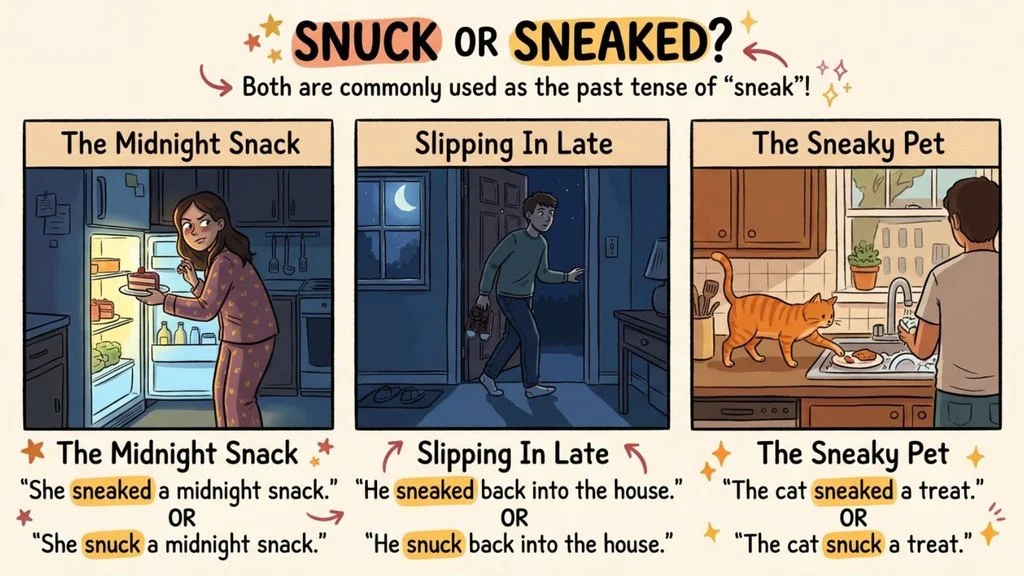
The best way to learn the difference is to see both words in real-life situations. Here are examples from casual conversations, emails, news-style writing, social media, and formal documents.
1. In Everyday Conversation
People often use these words when describing small, secret actions.
- I snuck an extra piece of cake.
- She sneaked out while everyone was talking.
- He snuck into the kitchen for a glass of water.
- They sneaked past the sleeping dog.
Both forms work in these examples.
2. In Emails
For a friendly or informal email, either word can work.
Example:
Hi Sam,
I snuck out for a short break before the next meeting. I am back at my desk now and ready to continue.
Best,
Alex
For a more formal email, you could write:
Dear Sam,
I briefly stepped out before the next meeting began. I have now returned and am ready to continue.
Kind regards,
Alex
The second version avoids the informal feel of snuck and sneaked altogether.
3. In News-Style Writing
A news report may use either form, depending on its publication style.
Example:
- The visitor snuck into the building before security arrived.
- The visitor sneaked into the building before security arrived.
Both are grammatically correct. In serious reporting, a writer might choose a more precise phrase, such as entering the building without permission, if the facts support that wording.
4. On Social Media
Casual posts often use snuck because it sounds natural and direct.
Example:
- I snuck a snack into the cinema.
- My cat snuck into my room at 3 a.m.
- She sneaked a peek at the birthday cake.
- We snuck away for a quiet weekend.
These examples show how both words fit everyday online writing.
5. In School Essays
For a school essay, either form may be accepted, but sneaking is a practical choice if your teacher prefers traditional grammar.
Example:
The child sneaked downstairs after everyone had gone to bed.
You could also write:
The child moved quietly downstairs after everyone had gone to bed.
The second version may be better if you want a more neutral or formal tone.
6. In Formal Reports
In professional writing, clarity matters more than choosing one form over the other.
Instead of writing:
The employee snuck into the restricted area.
You could write:
The employee entered the restricted area without being noticed.
Use this kind of wording only when it accurately describes what happened. Do not use snuck or sneaked to imply wrongdoing without evidence.
7. In Stories and Fiction
Both words are useful in creative writing.
- The thief snuck through the open window.
- The little girl sneaked downstairs to see her presents.
- A smile snuck across his face.
- A strange feeling sneaked into her thoughts.
The last two examples use the words figuratively. They describe something that appears slowly or unexpectedly.
Snuck or Sneaked Google Trends and Usage Data

People search for snuck or sneaked because they want to know which form is correct, which one sounds natural, and whether the choice changes between American and British English.
Which Word Is More Popular?
In general, snuck is more common in American English, while sneaked has a stronger traditional preference in British English. Research on English usage supports this regional difference.
Cambridge Core+1
| Region | Common usage | Practical advice |
| United States | Snuck is very common | Use either form |
| United Kingdom | Sneaked has a traditional preference | Prefer sneaked for a traditional style |
| Canada | Snuck is well established | Use either form |
| Australia | Both forms are understood | Follow local style preferences |
| Global English | Both forms are understood | Choose one based on audience |
These are general usage patterns, not exact rankings for every country.
What Does Google Trends Tell Us?
Google Trends can help writers explore how often people search for snuck and sneaked in different countries and over different periods.
However, search interest is not the same as word usage. Someone searching for snuck or sneaked may be looking for a grammar explanation rather than using either word in daily life.
For accurate comparisons, set the Google Trends search location, date range, and search type. Compare the terms separately and examine regional interest over the same period.
You can explore the comparison directly through Google Trends.
No verified live search-interest figures are provided here, so it would be misleading to claim an exact search percentage or a current country ranking.
Why Does This Matter for SEO?
If you write grammar articles, understanding both forms can help you answer different search queries.
Consider these related keywords:
- Snuck or sneaked
- Is snuck a word?
- Is sneaking correct?
- Snuck meaning
- Sneaked meaning
- Snuck vs. sneaked in American English
- British English past tense of sneak
A useful SEO article should answer the main question early, explain regional preferences, and provide clear examples. This helps readers find the information they need without confusing a difference in preference with a grammar error.
Comparison Table: Snuck vs. Sneaked and Related Forms
The following table summarizes the main forms of the verb sneak.
| Word or phrase | Grammar or use | Example |
| Sneak | Present tense | I sneak out early. |
| Sneaks | Present tense, third-person singular | She sneaks into the room. |
| Sneaking | Present participle | He is sneaking outside. |
| Sneaked | Regular past tense | They sneaked past the gate. |
| Snuck | Irregular past tense | They snuck past the gate. |
| Has sneaked | Present perfect | She has sneaked out before. |
| Has snuck | Present perfect | She has snuck out before. |
| Had sneaked | Past perfect | He had sneaked away earlier. |
| Had snuck | Past perfect | He had snuck away earlier. |
Notice that both sneaked and snuck can be used with helping verbs such as has, have, and had.
Frequently Asked Questions (FAQs)
1. Is snuck or sneaked correct?
Both are correct. Snuck is especially common in American English, while sneaked is the regular past-tense form and is often preferred in traditional formal writing.
2. Is snuck proper English?
Yes. Snuck is accepted in standard English and is listed in major dictionaries. Although some people prefer to sneak, snuck is not automatically incorrect.
Merriam-Webster+1
3. Is sneaking more correct than snuck?
No. Neither form is universally more correct. Sneaked follows the regular past-tense rule, but snuck is also accepted. Your audience and writing style can guide your choice.
4. Do Americans say snuck or sneaked?
Americans use both forms, but snuck is especially common in everyday American English. Sneaked remains correct and is also used in American writing.
5. Do British people say snuck or sneaked?
Both forms occur in British English, but sneaked has traditionally been more common. It is a sensible choice if you are writing for a British audience and want a traditional style.
6. Can I say “I have snuck”?
Yes. I have snuck is grammatically correct.
Example: I snuck into the kitchen before everyone woke up.
You can also say, I have sneaked into the kitchen before everyone woke up.
7. What is the past participle of sneak?
Both snuck and sneaked can serve as the past participle.
Example:
- She has sneaked into the room.
- She has snuck into the room.
Both sentences are correct.
8. Which word should I use in formal writing?
Sneaked is a safe choice for formal writing because it follows the regular past-tense pattern and is widely accepted. However, snuck is also standard English. Follow your organization’s style guide if one exists.
Conclusion:
The choice between snuck and sneaked is easier than it may first appear. Both words are correct past-tense forms of sneak, and both describe moving quietly, secretly, or without being noticed.
The main difference is regional preference and writing style. Snuck is especially common in American English and everyday conversation.
Sneaked follows the regular past-tense rule and remains a popular choice in British English and more traditional writing.
You do not need to avoid snuck just because it is an irregular form. It is recognized in standard English and appears in many kinds of writing. Likewise, you do not need to avoid sneaking because another person prefers to sneak.

I am Ethan Whitmore is the founder and lead writer of Grammlii.com, passionate about exploring meanings, language, literature, and insightful ideas. Through well-researched and engaging content, he helps readers discover the deeper significance behind words, expressions, and everyday concepts.