Have you ever stopped while writing and wondered whether to use farther or further? You are not alone.
These two words look and sound alike. Both can talk about distance. But they do not always mean the same thing.
The difference between farther and further is a common problem in English writing. Many people use them in emails, schoolwork, business documents, and daily conversations.
Some use them as if they have the same meaning. Others are unsure which word is correct.
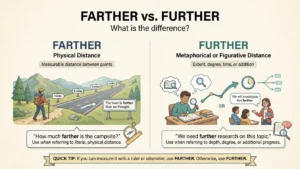
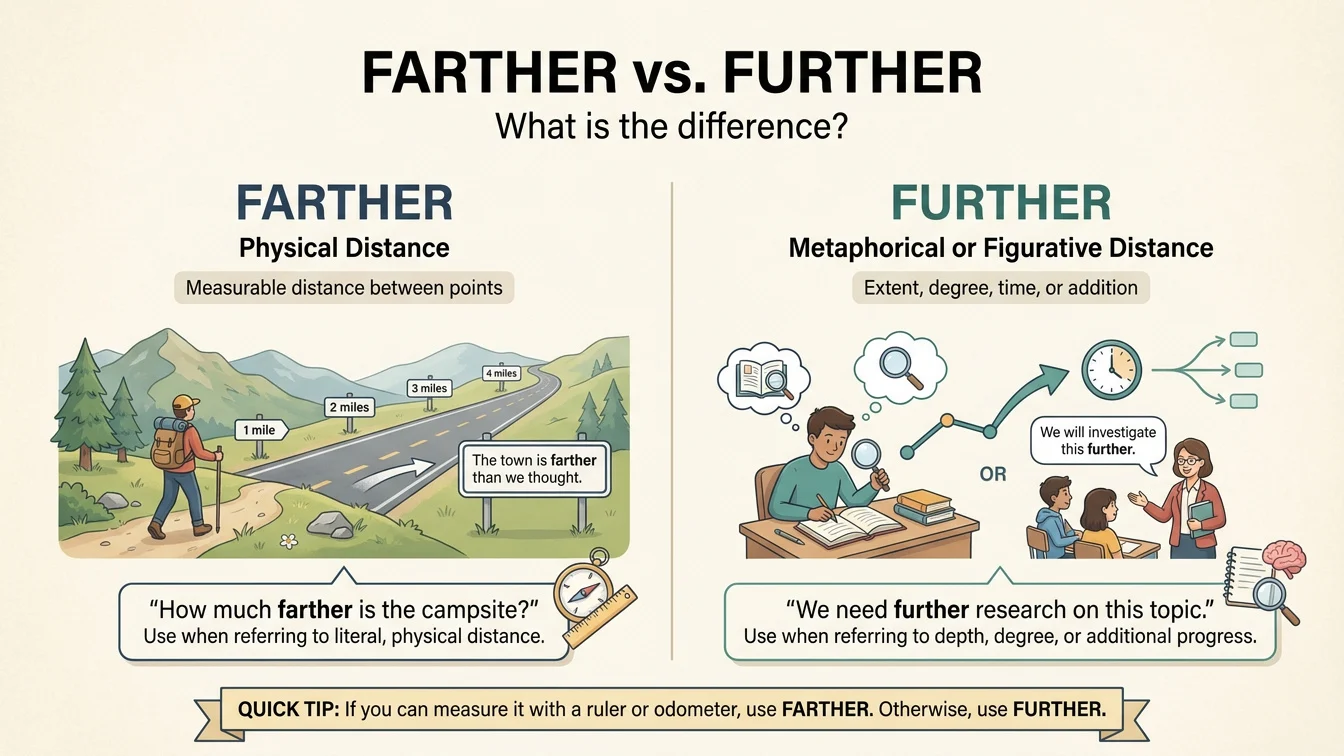
The good news is that the rule is simple. Farther usually refers to physical distance. Further often refers to extra progress, more information, or a greater degree. In some cases, both words can be used.
Farther or Further – Quick Answer
The main difference between farther and further is their meaning.
- Farther means a greater physical distance. It usually refers to something you can measure or travel.
- Further means more, extra, or to a greater degree. It often refers to ideas, progress, time, or information.
Here are some simple examples:
Farther:
- My school is farther from home than yours.
- We walked farther than we planned.
- The shop is farther down the road.
Further:
- I need further information about the course.
- We must discuss this issue further.
- She wants to further her education.
A simple way to remember the difference is to connect farther with physical distance and further with additional things or progress.
However, English has some overlap. Further can also refer to physical distance, especially in British English and in everyday speech.
The Origin of Farther or Further
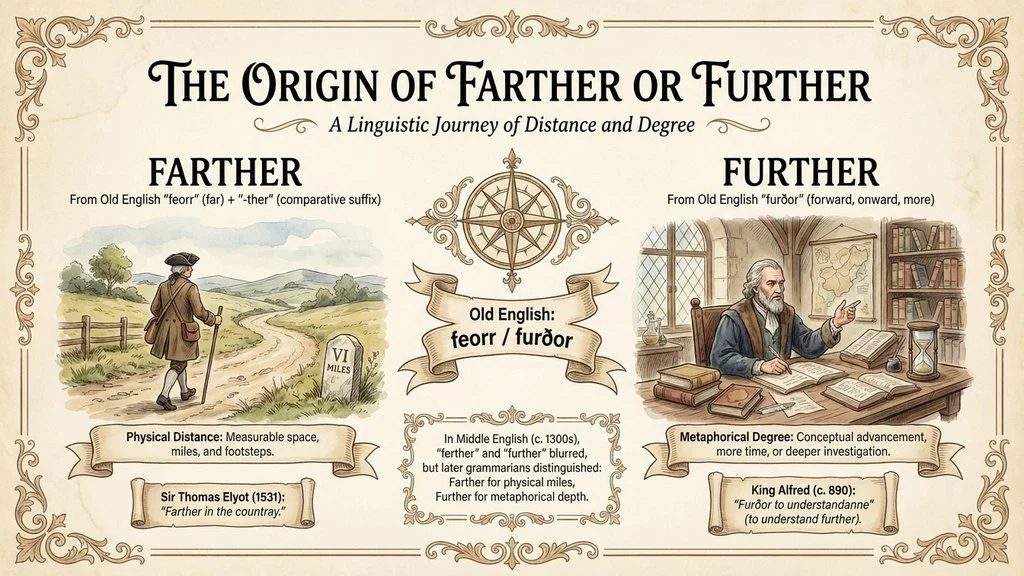
The words farther and further have a shared history. Both come from the Old English word feor, which meant far or distant.
Over time, English developed different forms to compare distance and degree.
Farther developed from the word far. It became a common way to describe a greater physical distance.
Further developed from an older form related to forth. Its meaning grew to include additional progress, more information, and a greater amount.
The two words became closely related. This is why people sometimes use them in similar ways.
Today, many modern style guides suggest using farther for physical distance and further for figurative distance or additional information. Still, some dictionaries accept both words when talking about physical distance.
The key point is that the words have different common uses, even though their meanings sometimes overlap.
British English vs American English Spelling
The good news is that there is no major spelling difference between British and American English.
Both countries use the same spelling:
- Farther
- Further
The main difference is often about usage and writing style, not spelling.
American English Usage
American English often makes a clear distinction between the two words.
- Farther is used for physical distance.
- Further is used for additional information, progress, or degree.
Examples:
- The airport is farther away than I thought.
- Please contact us for further details.
- We need to go further with this project.
British English Usage
British English also uses both words. However, further is often used more widely, including in some situations involving physical distance.
Examples:
- The village is farther down the road.
- The next station is further along the line.
- For further information, contact our office.
Both forms are understood in the UK and the US.
British English vs American English Comparison Table
| Word or usage | American English | British English |
| Physical distance | Farther | Farther or further |
| Extra information | Further | Further |
| More progress | Further | Further |
| Greater degree | Further | Further |
| Spelling | Farther / Further | Farther / Further |
The main lesson is simple: spelling stays the same in both varieties of English. The distinction between physical distance and figurative meaning is a useful guide in both.
Which Spelling Should You Use?
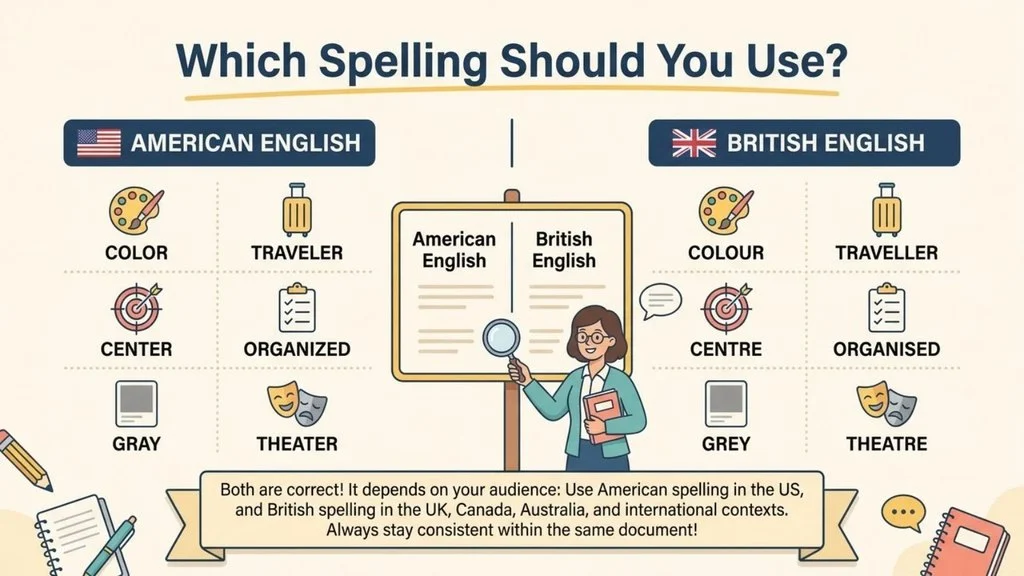
Choosing between farther and further depends on what you want to say and who will read your writing.
Both words are correct in British and American English. However, choosing the right one can make your writing clearer and more professional.
1. For American English Readers
If your audience is in the United States, follow the traditional distinction:
- Use farther for physical distance.
- Use further for extra information, progress, or degree.
Examples:
- We drove farther than we expected.
- Please send further details about the offer.
- I want to take my studies further.
This approach is common in American writing.
2. For British English Readers
British English often uses further more widely, including when talking about physical distance.
Examples:
- The hotel is further down the street.
- We need further information.
- She wants to further her career.
You can also use farther for physical distance. Both words are understood.
3. For Australian, Canadian, and Other English Readers
English speakers in countries such as Australia and Canada understand both words.
For clear writing, follow these simple rules:
- Use farther for measurable physical distance.
- Use further for additional information.
- Use further when discussing progress or development.
4. For Global and Professional Writing
If you write for an international audience, the traditional rule is a safe choice.
For example:
- The next town is 20 miles farther away.
- For further information, visit our website.
- We will discuss this matter further.
These choices are clear, natural, and suitable for professional writing.
Common Mistakes with Farther or Further
Many English learners and native speakers mix up these words. The good news is that a few simple rules can help you avoid common mistakes.
Here are some errors to watch for.
Mistake 1: Using Farther for Extra Information
Incorrect: Please contact us for further information.
Correct: Please contact us for further information.
Why? Further means additional or extra. It is the correct choice in this sentence.
Mistake 2: Using Further When Farther Is Clearer
Less precise: We walked further than the other group.
Clearer: We walked farther than the other group.
Why? Farther makes the physical distance clear. Further is also accepted for distance, but farther is a useful choice.
Mistake 3: Writing Further More
Incorrect: We need further more details.
Correct: We need further details.
Why? Further already means more or additional. Adding more creates an unnecessary repetition.
Mistake 4: Confusing Farther and Further in Formal Emails
Incorrect: I am writing to request further details about your service.
Correct: I am writing to request further details about your service.
Why? Further is the standard choice when asking for additional details.
Mistake 5: Forgetting the Difference Between Farther and Further
Some writers use both words without thinking about their meaning.
A simple trick can help:
- Farther = physical distance.
- Further = additional information or progress.
Remember that further can also describe physical distance, so the rule is a helpful guide rather than an absolute rule.
Farther or Further in Everyday Examples
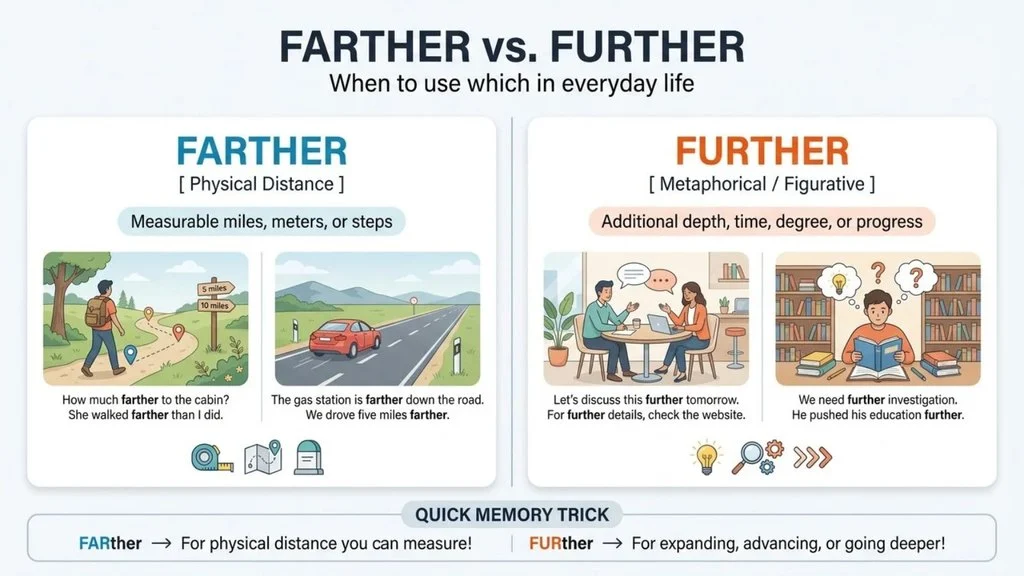
You can find these words in everyday conversations, business emails, news reports, social media posts, and formal documents.
Let’s look at how to use them in different situations.
1. In Emails
Professional emails often use further when asking for more information or discussing the next steps.
Examples:
- Please provide further details about the meeting.
- I would like to discuss this matter further.
- We will contact you if we need further assistance.
- Further to our last email, please find the updated document.
These examples sound natural and professional.
2. In News and Articles
News writers use both words to describe distance and developments.
Examples:
- The storm moved farther inland during the night.
- Officials are investigating the matter further.
- The team traveled farther than expected.
- Further updates will be shared tomorrow.
Farther describes physical movement, while further introduces additional information or investigation.
3. On Social Media
People use both words in casual posts and comments.
Examples:
- I walked farther than I planned today!
- Time to take my skills further.
- Looking forward to going even farther next year.
- I need further motivation to finish this project!
Both words can make your message sound natural when used correctly.
4. In Academic Writing
Students and researchers often use further when discussing ideas, evidence, or research.
Examples:
- Further research is needed to understand the results.
- This study takes the discussion further.
- The researchers examined the issue further.
- The university is located farther from the city center.
Use further when discussing ideas and research. Use farther when a clear physical distance is involved.
5. In Business and Formal Writing
In business writing, further is common when discussing extra steps, details, or decisions.
Examples:
- We require further approval before proceeding.
- Please contact our team for further assistance.
- The company plans to expand further.
- The new office is farther from the main building.
These examples show how both words work in professional situations.
Farther or Further Google Trends & Usage Data
People search for farther or further because they want to understand the difference between these words. The question is common among students, teachers, bloggers, editors, and people learning English.
Google Trends can help writers understand search interest in different countries and over time.
However, Google Trends does not provide a fixed worldwide search-volume count. Its scores are relative and depend on the selected country, time range, and search settings.
Trends Help+1
1. Search Interest in Different Countries
English usage differs across countries.
Here is a general guide to regional language preferences:
| Country or region | Common usage pattern |
| United States | Farther is common for physical distance |
| United Kingdom | Further is widely used |
| Canada | Both words are understood |
| Australia | Further is widely used |
| New Zealand | Both words are understood |
| Other English-speaking regions | Both forms are understood |
These are general language patterns, not live Google Trends rankings.
Oxford notes that farther and farthest are more common in North American English, while further and furthest are more common in British English.
Oxford Learner’s Dictionaries+1
2. Why Do People Search for These Words?
There are several reasons:
- Similar meanings: Both words can describe distance.
- Writing confusion: People want to know which word sounds correct.
- School assignments: Students need clear grammar rules.
- Professional writing: Workers want to avoid mistakes in emails and reports.
- English learning: Language learners want simple examples.
3. How to Check Google Trends
You can compare the search interest for both terms using Google Trends.
Follow these steps:
- Visit Google Trends.
- Enter “farther” in the search box.
- Add “further” as a comparison term.
- Select Worldwide or a specific country.
- Choose a time range, such as the past 12 months.
- Check the interest-over-time graph and regional results.
Google Trends uses a normalized score from 0 to 100. A score of 100 represents the highest relative interest in the selected comparison, not the total number of searches.
Trends Help+1
For SEO writers, this information can help identify regional interests and understand how people search for confusing English words.
Farther vs Further Comparison Table
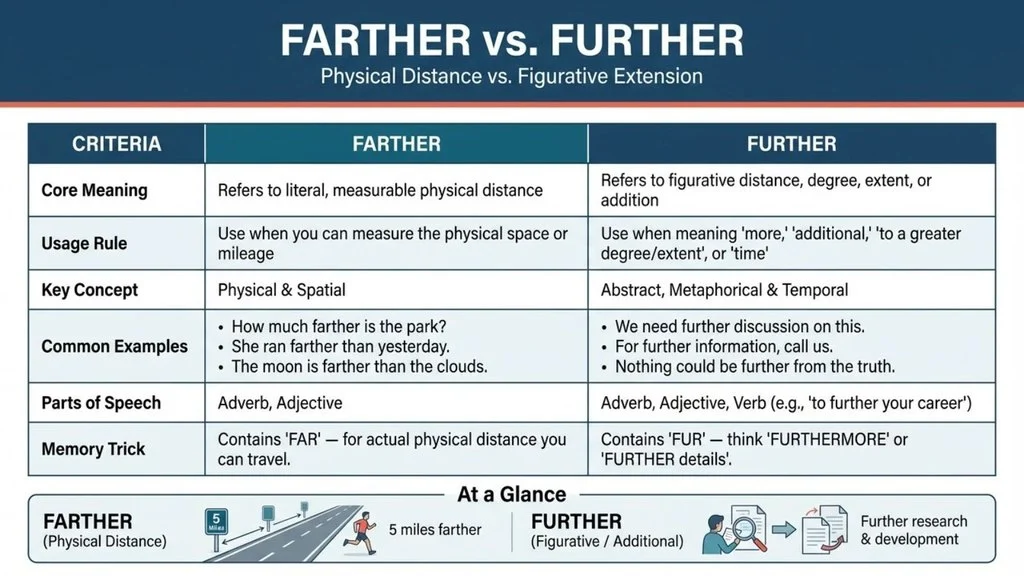
Here is a simple side-by-side comparison to help you remember the difference.
| Feature | Farther | Further |
| Main meaning | Greater physical distance | More or additional |
| Physical distance | Yes | Yes |
| Extra information | Generally avoid | Yes |
| Progress | Less common | Yes |
| Formal writing | Correct | Correct |
| American English | Common for distance | Common for extra meaning |
| British English | Correct | More widely used |
| Comparative form | Farther | Further |
| Superlative form | Farthest | Furthest |
| Example | Walk farther | Further details |
Quick tip: If you can measure the distance, farther is usually a good choice. If you mean extra information or progress, choose further.
Frequently Asked Questions (FAQs)
1. What is the main difference between farther and further?
Farther usually refers to physical distance. Further usually means more, extra, or additional progress. For example, “We walked farther” and “I need further information.”
2. Is farther or further correct in American English?
Both are correct in American English. Farther is traditionally used for physical distance, while further is used for additional information, progress, and degree.
3. Is farther or further correct in British English?
Both words are correct in British English. However, further is more common and can also describe physical distance.
4. Can farther and further be used interchangeably?
Sometimes, yes. Both can describe physical distance. However, further is preferred when you mean additional information, extra details, or progress.
5. Is it further information or further information?
The correct phrase is further information. Further means additional or extra, making it the right choice.
6. What are the comparative and superlative forms of far?
The comparative forms are farther and further apart. The superlative forms are farthest and furthest.
Examples:
- My house is farther away.
- This is the furthest point on the map.
- We need to look further into the problem.
7. Is it grammatically correct?
No. Further already means more or additional. The phrase “further more” is usually unnecessary. Use “further details” or “more details” instead.
Conclusion:
Understanding the difference between farther and further does not have to be difficult. Both words are correct, but they have different common uses.
Farther usually describes physical distance, such as walking farther, driving farther, or traveling farther from home. Further usually refers to additional information, progress, or a greater degree.
For everyday writing, remember this simple rule: use farther when talking about measurable distance and further when you mean more or extra.
For example, “The school is farther away” and “Please provide further information.”

I am Ethan Whitmore is the founder and lead writer of Grammlii.com, passionate about exploring meanings, language, literature, and insightful ideas. Through well-researched and engaging content, he helps readers discover the deeper significance behind words, expressions, and everyday concepts.