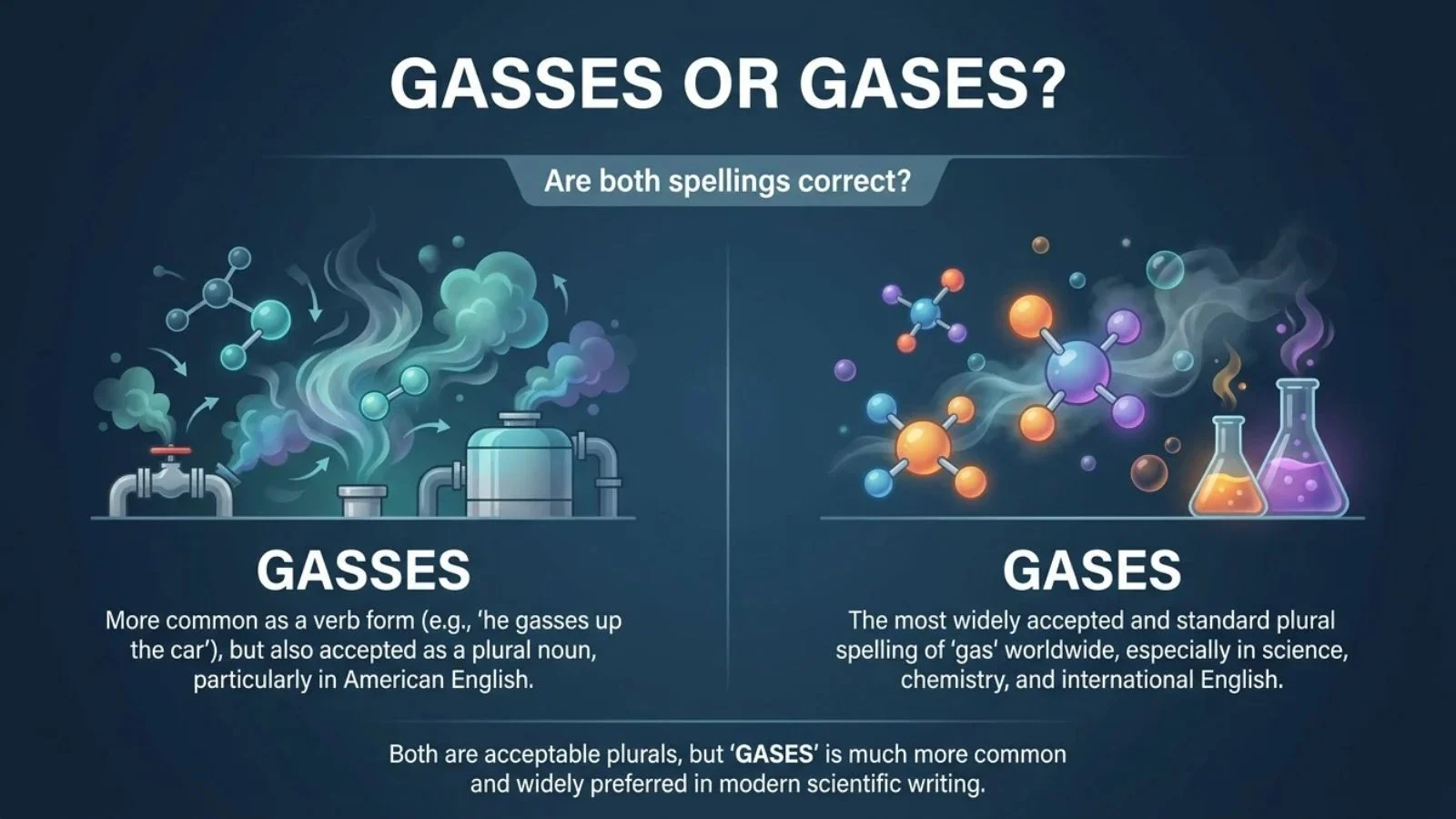
Have you ever wondered whether to write Gasses or Gases? Both words look correct, and both are used in English.
However, they have different meanings. Choosing the wrong one can change the meaning of your sentence. This is why many students, writers, and English learners search for the correct spelling.
The word gases is the plural form of gas. It means more than one type or amount of gas. The word gasses is the third-person singular form of the verb gas.
It can also mean to expose someone or something to gas. For example, “Air contains different gases” is correct, while “The smell gasses me out” uses a verb form.
In this guide, you will learn the difference between Gasses or Gases, their meanings, origins, and spelling rules.
You will also see examples from everyday English, British and American usage, and common mistakes. By the end, you will know which spelling to use with confidence.
Gasses or Gases – Quick Answer
Gases is the correct plural form of the noun gas. It refers to two or more gases or different types of gas.
Gasses is the third-person singular form of the verb gas. It can also be the plural form of the noun gass, but this use is very rare.
Here are some simple examples:
- Correct: The air contains several gases.
- Correct: Carbon dioxide and oxygen are gases.
- Correct: The strong smell gasses me.
- Incorrect: The air contains several gasses.
The easiest way to remember the difference is:
- Gases: Use it when talking about more than one gas.
- Gasses: Use it when using gas as a verb with he, she, or it.
In everyday writing, you will need gases much more often when discussing science, air, and chemistry.
The Origin of Gasses or Gases

The word gas has an interesting history. It was introduced into scientific language in the 17th century by Flemish chemist Jan Baptist van Helmont.
He used the word to describe a substance that could spread through the air. The word may have been inspired by the Greek word chaos, which means a vast or empty space.
Over time, gas became a common word in science and daily English.
The plural form became gases. This follows a common English spelling rule. When a word ends in -s, we often add -es to make it plural.
For example:
- Gas → Gases
- Bus → Buses
- Class → Classes
- Glass → Glasses
The spelling gasses comes from a different use of the word. It is formed by adding -es to the verb gas for he, she, or it.
For example:
- I gas the room.
- He gasses the room.
- She gasses the area.
This is why both spellings exist, but they do not mean the same thing.
British English vs American English Spelling
British and American English use the same spelling for gases and gasses.
There is no major spelling difference between these two English varieties. The difference depends on the word’s role in a sentence, not the country where you write.
Both British and American writers use gases as the plural of gas. They also use gasses as a verb form.
Here is a simple comparison:
| Word | British English | American English |
| Gas | Gas | Gas |
| Plural noun | Gases | Gases |
| Verb form | Gasses | Gasses |
| Past tense | Gassed | Gassed |
| Present participle | Gassing | Gassing |
British English Examples
- Many gases exist in the atmosphere.
- Some gases are harmful to human health.
- The machine gasses the room during the test.
American English Examples
- Scientists study different gases.
- Greenhouse gases affect the climate.
- The chemical smell gasses him.
As you can see, both English styles follow the same spelling rules.
Which Spelling Should You Use?

Choosing between gasses and gases depends on what you want to say. Your audience does not change the spelling.
Here is a simple guide:
For American English
Use gases when talking about different types of gas.
Example: Scientists study gases in the atmosphere.
Use gasses when the word is a verb.
Example: The chemical smell gasses him.
For British English
Follow the same rule. British English uses gases as a plural noun and gasses as a verb.
Example: The laboratory tests different gases.
For Global English
If you write for an international audience, use the correct spelling based on the meaning.
- Use gases in science articles.
- Use gases in school assignments about chemistry.
- Use gasses when describing an action involving gas.
Professional advice: If you are writing about oxygen, carbon dioxide, nitrogen, or other substances, choose gases. This is the standard plural spelling.
Common Mistakes with Gasses or Gases
Many people mix up these two words because they look and sound similar. However, their meanings are different.
Here are some common mistakes to avoid.
1. Using Gasses as a Plural Noun
Incorrect: The atmosphere contains many gasses.
Correct: The atmosphere contains many gases.
Why? Gases is the standard plural form of the noun gas.
2. Using Gases as a Verb
Incorrect: The chemical smell gases him.
Correct: The chemical smell gasses him.
Why? The verb gas becomes gasses when used with he, she, or it.
3. Mixing Up Gassed and Gasses
Incorrect: The room was gassed yesterday.
Correct: The room was gassed yesterday.
Why? Gassed is the past tense and past participle of the verb gas.
4. Forgetting the Double S
Incorrect: He gases the area.
Correct: He gasses the area.
Why? The verb form uses a double S before -es.
5. Using the Wrong Form in Science Writing
Incorrect: Oxygen and nitrogen are two common gasses.
Correct: Oxygen and nitrogen are two common gases.
Why? Science writing uses gases when referring to more than one gas.
Gasses or Gases in Everyday Examples
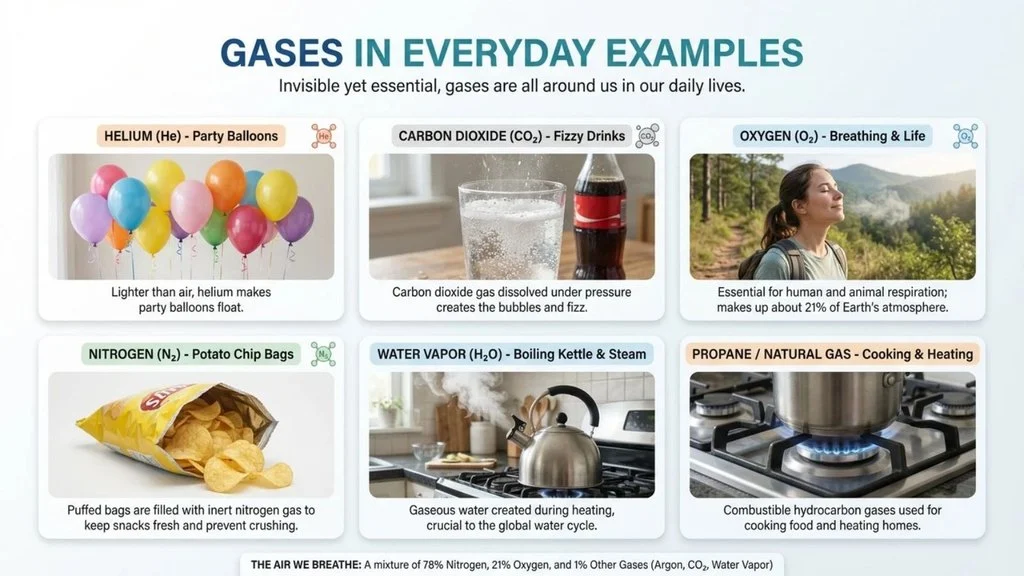
Both words can appear in daily communication. The key is to understand their grammatical roles.
1. In Emails
When writing a professional email, use gases for the plural noun.
Example:
“Dear Team,
The report includes information about harmful gases found in the environment. Please review the results before our next meeting.”
2. In News Articles
News writers often use gases when discussing pollution, climate change, and science.
Example:
“Scientists have warned that greenhouse gases continue to affect global temperatures.”
3. On Social Media
People use gases in educational posts and science discussions.
Example:
“Did you know that oxygen and nitrogen are two major gases in Earth’s atmosphere?”
The verb form may also appear in casual posts.
Example:
“That strange smell gasses me out!”
4. In Formal Writing
Use gases in academic papers, research reports, and scientific documents.
Example:
“Carbon dioxide and methane are important greenhouse gases.”
Use gasses when the sentence needs the verb form.
Example:
“The equipment gasses the chamber before the experiment.”
5. In Everyday Conversations
Here are a few more examples:
- Some gases have no smell.
- Natural gas is used for cooking.
- The chemical smell gasses me.
- Scientists study gases in space.
- The machine gasses the container.
These examples show how context helps you choose the correct spelling.
Gasses or Gases Google Trends & Usage Data
People search for both gasses and gases because the words look almost the same. However, they have different grammatical uses.
The word gases is much more common in general science and educational writing. It appears in topics such as chemistry, air pollution, climate change, and the atmosphere.
The word gasses appears less often as a verb. It is mainly used when describing an action involving gas.
Usage by Country
| Country | Common Usage | Example |
| United States | Gases | Greenhouse gases |
| United Kingdom | Gases | Harmful gases |
| Canada | Gases | Different gases |
| Australia | Gases | Industrial gases |
| New Zealand | Gases | Atmospheric gases |
Which Word Is More Popular?
Gases is generally more common because people use it as the standard plural form of gas.
You may find gasses in dictionaries, grammar resources, and writing examples, but its use as a verb is less frequent.
Google Trends can help compare search interest in different countries and over time. However, search interest does not always show how often a word appears in everyday writing.
For the most accurate choice, focus on meaning and grammar rather than popularity.
Gasses vs Gases: Side-by-Side Comparison
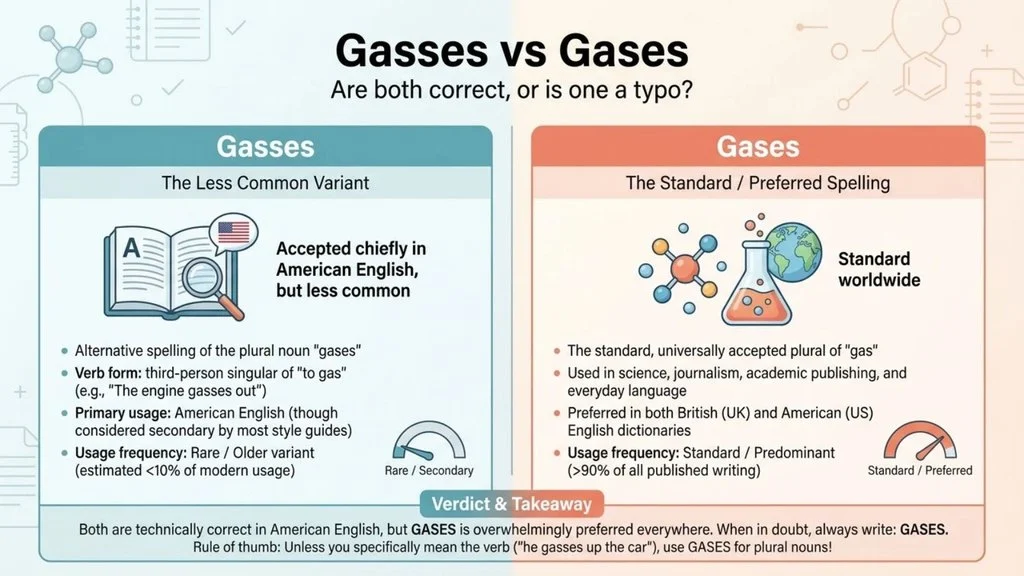
Here is a quick table to help you remember the difference.
| Feature | Gasses | Gases |
| Main use | Verb form | Plural noun |
| Base word | Gas | Gas |
| Meaning | Exposes or fills with gas | More than one gas |
| Grammar | Verb | Noun |
| Example | He gasses the room. | Air contains gases. |
| Common use | Less common | Very common |
| Science writing | Action | Different gas types |
Easy memory trick: If you are talking about two or more types of gas, use gases. If you are describing an action, use gasses.
Frequently Asked Questions (FAQs)
1. Is Gasses or Gases the Correct Spelling?
Both spellings are correct, but they have different meanings. Gases is the plural form of the noun gas. Gasses is the third-person singular form of the verb gas.
2. What Is the Plural of Gas?
The correct plural of gas is gases.
Example: Oxygen and nitrogen are gases found in the atmosphere.
3. Why Is Gasses Spelled With Two S’s?
The word gasses comes from the verb gas. English doubles the final consonant before adding -es in this verb form.
Example: He gasses the room.
4. Is Gasses a Real Word?
Yes, gasses is a real English word. It is mainly used as the third-person singular form of the verb gas.
Example: The chemical smell gasses him.
5. Do British People Write Gases or Gasses?
British English uses both words. Gases is the plural noun, while gasses is the verb form. The spelling rules are the same in American English.
6. Which Word Is Correct in Science Writing?
Gases is usually correct in science writing when referring to more than one gas.
Example: Greenhouse gases contribute to climate change.
7. Is It Greenhouse Gasses or Greenhouse Gases?
The correct phrase is greenhouse gases. It refers to gases such as carbon dioxide and methane that trap heat in Earth’s atmosphere.
Conclusion
Understanding the difference between Gasses or Gases is simple once you know how each word works. Both spellings are correct, but you cannot use them in the same way.
Gases is the plural form of the noun gas. It is the right choice when talking about oxygen, nitrogen, carbon dioxide, and other types of gas.
On the other hand, gasses is the third-person singular form of the verb gas. It describes an action involving gas. For example, “He gasses the room” uses the verb form correctly.
Remember that British and American English follow the same spelling rules for these words. There is no need to change the spelling based on your audience or location.

I am Oliver Bennett is the founder and writer behind Grammlii.com, where he shares insightful content on language, meanings, expressions, and effective communication. Passionate about making knowledge simple and accessible, he helps readers explore words, ideas, and their deeper significance.