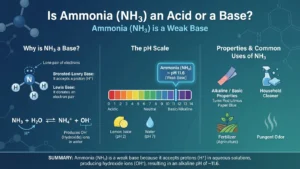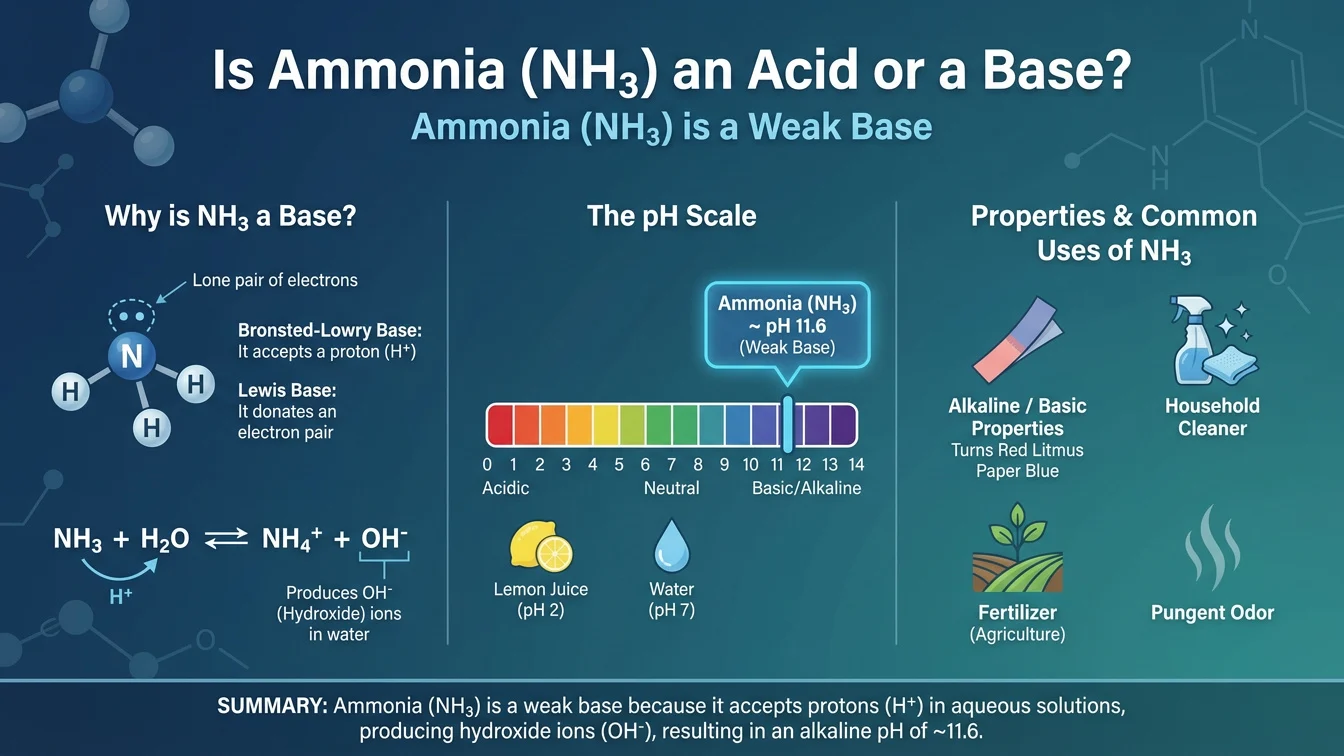
Have you ever wondered whether NH3 is an acid or a base? This is a common question in chemistry, especially for students learning about acids, bases, and chemical reactions. The answer is simple: NH3 (ammonia) is a weak base, not an acid.
But why does ammonia act as a base? How does it react with water? And what makes it different from strong bases such as sodium hydroxide (NaOH)?
Understanding these ideas can help you solve chemistry problems, prepare for exams, and understand everyday chemical reactions. NH3 has a special structure that allows it to accept hydrogen ions (H+).
When it reacts with water, it forms ammonium ions (NH4+) and hydroxide ions (OH-). This reaction explains why ammonia solutions are basic.
NH3 Acid or Base – Quick Answer
NH3 (ammonia) is a weak base. It accepts a hydrogen ion (H+) from water and forms ammonium ions (NH4+).
When ammonia dissolves in water, the following reaction takes place:
NH3 + H2O ⇌ NH4+ + OH-
Here is what happens:
- NH3 accepts a hydrogen ion (H+).
- H2O donates a hydrogen ion.
- NH4+ is formed.
- OH- ions are released into the solution.
The hydroxide ions make the solution basic.
Why Is NH3 a Weak Base?
Ammonia is a weak base because it does not react completely with water. Only some NH3 molecules accept hydrogen ions.
At 25°C, its base ionization constant (Kb) is about 1.8 × 10^-5.
This means ammonia produces fewer hydroxide ions than a strong base such as NaOH at the same concentration.
Quick comparison:
| Chemical | Acid or Base? | Strength |
| NH3 | Base | Weak |
| NaOH | Base | Strong |
| HCl | Acid | Strong |
| CH3COOH | Acid | Weak |
Therefore, NH3 is a weak base because it accepts H+ ions and produces OH- ions in water.
The Origin of NH3 Acid or Base
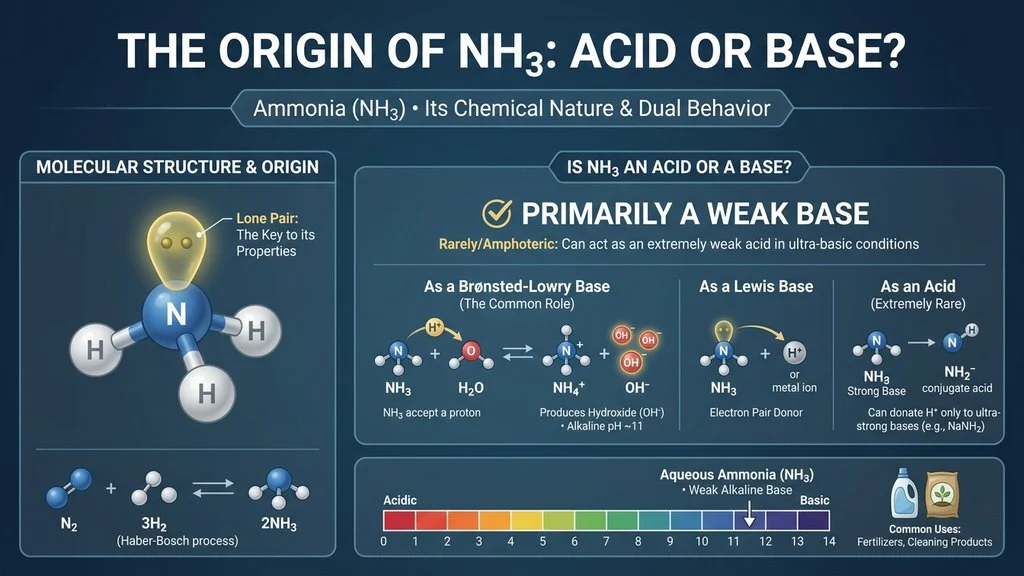
The keyword “NH3 acid or base” comes from basic chemistry. It combines the chemical formula NH3 with the two main types of substances found in acid-base chemistry.
Let’s understand its meaning.
What Does NH3 Mean?
NH3 is the chemical formula for ammonia.
It contains:
- One nitrogen (N) atom.
- Three hydrogen (H) atoms.
Ammonia is a colorless gas with a strong, sharp smell. It is widely used in fertilizers, cleaning products, and industrial processes.
Why Is It Called Ammonia?
The name ammonia comes from historical references to sal ammoniac, a substance associated with the ancient Egyptian temple of Amun.
The modern name became established through the development of chemistry.
Why Does NH3 Act as a Base?
Nitrogen has one lone pair of electrons in an ammonia molecule.
This lone pair allows NH3 to accept a hydrogen ion (H+).
According to the Brønsted-Lowry theory, a base is a substance that accepts a proton.
According to the Lewis theory, a base donates an electron pair.
NH3 fits both definitions. This is why chemists classify ammonia as a base.
British English vs American English Spelling
The chemical formula NH3 has the same spelling in British English and American English.
Unlike ordinary English words, chemical formulas follow international scientific rules. Their symbols do not change between countries.
However, some chemistry terms may have different spellings in British and American English.
British vs American Chemistry Terms
| British English | American English |
| Ammonia | Ammonia |
| Chemical formula | Chemical formula |
| Colourless gas | Colorless gas |
| Ionisation | Ionization |
| Neutralisation | Neutralization |
| Analyse | Analyze |
| Sulphur | Sulfur |
Does NH3 Change Between British and American English?
No. NH3 always represents ammonia.
The number 3 is written as a subscript in standard chemical notation. It shows that one ammonia molecule contains three hydrogen atoms.
For example:
- British English: NH3 is a weak base.
- American English: NH3 is a weak base.
Both sentences are correct.
The main differences appear in the spelling of some chemistry-related words, not in chemical formulas.
Which Spelling Should You Use?

The chemical formula NH3 does not change based on your location. However, your choice of English spelling should match your audience.
For American Students
Use American English spelling in school assignments, science reports, and educational articles written for US readers.
Examples:
- Ionization
- Neutralization
- Colorless
For British Students
Use British English spelling when writing for schools, universities, and readers in the United Kingdom.
Examples:
- Ionisation
- Neutralisation
- Colourless
For Global Readers
If your article targets an international audience, choose one spelling style and use it throughout the content.
Keep chemical formulas such as NH3, H2O, and NH4+ unchanged.
Professional advice: Always follow the spelling guidelines of your school, university, scientific journal, or intended publication.
Common Mistakes with NH3 Acid or Base
Students often make mistakes when learning about ammonia and its chemical properties.
Here are some common errors and their corrections.
1. Thinking NH3 Is an Acid
Incorrect: NH3 is an acid because it contains hydrogen.
Correct: NH3 is a weak base because it accepts hydrogen ions.
Having hydrogen atoms does not automatically make a substance an acid.
2. Calling NH3 a Strong Base
Incorrect: NH3 is a strong base.
Correct: NH3 is a weak base because it only partly reacts with water.
3. Confusing NH3 with NH4+
NH3 and NH4+ are different chemical species.
- NH3 is ammonia and acts as a base.
- NH4+ is the ammonium ion and can act as an acid.
NH3 becomes NH4+ when it accepts a hydrogen ion.
4. Forgetting the Hydroxide Ions
When ammonia reacts with water, it produces OH- ions.
These ions make the solution basic.
Always remember this reaction:
NH3 + H2O ⇌ NH4+ + OH-
5. Confusing Weak Bases with Dilute Bases
A weak base and a dilute base do not mean the same thing.
- Weak base: Only partly ionizes or reacts with water.
- Dilute base: Contains a low concentration of the base.
Ammonia is a weak base, even when its solution is concentrated.
NH3 in Everyday Examples
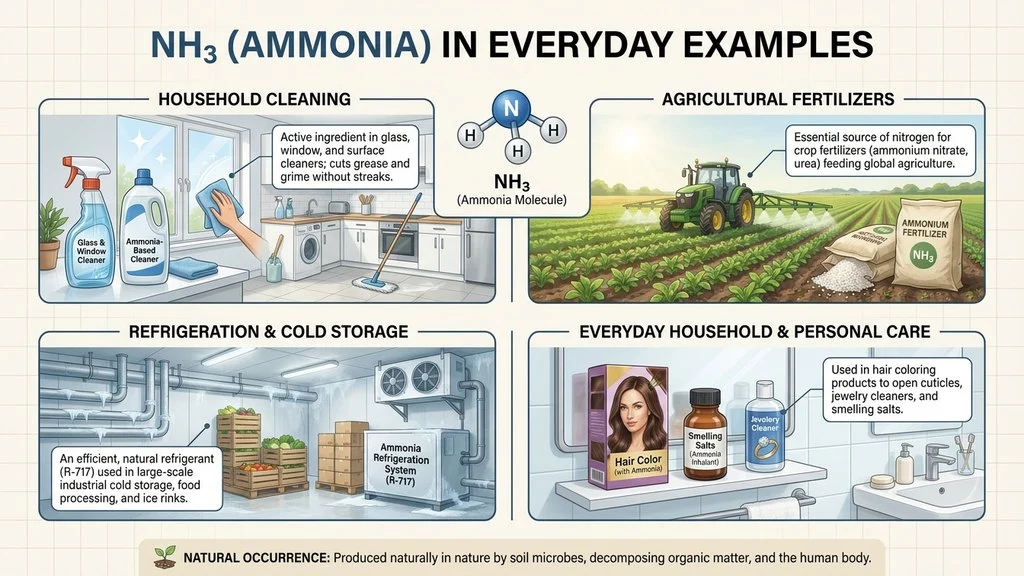
Ammonia is not just a chemistry topic. It has many uses in everyday life and industry.
Understanding its basic properties helps explain why it is useful in different products and processes.
1. NH3 in Cleaning Products
Ammonia is used in some household cleaning products.
Its basic nature helps it remove certain types of dirt and grease.
However, ammonia cleaners should never be mixed with bleach because dangerous gases can form.
2. NH3 in Fertilizers
Ammonia is important in agriculture.
It is used to make nitrogen-based fertilizers that help plants grow.
Nitrogen is an essential nutrient for healthy plant development.
3. NH3 in Industrial Processes
Many industries use ammonia to produce chemicals, fertilizers, and other materials.
Its ability to take part in chemical reactions makes it useful in manufacturing.
4. NH3 in Emails and Educational Writing
Students may write:
“Could you please explain why NH3 is considered a weak base?”
Teachers may write:
“Remember that ammonia accepts a proton from water to form ammonium ions.”
5. NH3 in News and Science Articles
Ammonia is often discussed in articles about agriculture, energy, industrial production, and environmental science.
For example:
“Ammonia plays an important role in the production of nitrogen fertilizers.”
6. NH3 in Formal Scientific Writing
In scientific reports, you may see:
“Ammonia (NH3) acts as a weak Brønsted-Lowry base by accepting a proton from water.”
This is a clear and scientifically correct way to describe its chemical behavior.
NH3 Acid or Base Google Trends & Usage Data
People search for “NH3 acid or base” because they want a quick and clear answer about ammonia’s chemical properties.
The keyword is especially relevant to students studying chemistry.
Why Do People Search for This Keyword?
Common reasons include:
- Preparing for chemistry exams.
- Completing school assignments.
- Learning about acids and bases.
- Understanding the properties of ammonia.
- Solving chemical equation questions.
- Learning the difference between NH3 and NH4+.
Which Countries May Search for This Keyword?
This chemistry topic can interest students and teachers around the world.
Countries with large English-language educational audiences include:
| Country | Common Search Intent |
| United States | School chemistry and exams |
| United Kingdom | Chemistry lessons and homework |
| India | Competitive exams and science studies |
| Canada | Chemistry education |
| Australia | School and university chemistry |
| Pakistan | Chemistry assignments and exam preparation |
These are potential audience segments, not verified search rankings.
What About Google Trends?
Google Trends can help compare interest in searches such as:
- NH3 acid or base
- Is ammonia a base?
- NH3 properties
- Ammonia chemical formula
- NH3 reaction with water
Search interest can change by country, season, and educational demand.
No exact search-volume figures or country rankings are claimed here. You can use Google Trends to check current interest and compare these search terms over a selected time period.
NH3 Acid or Base Comparison Table
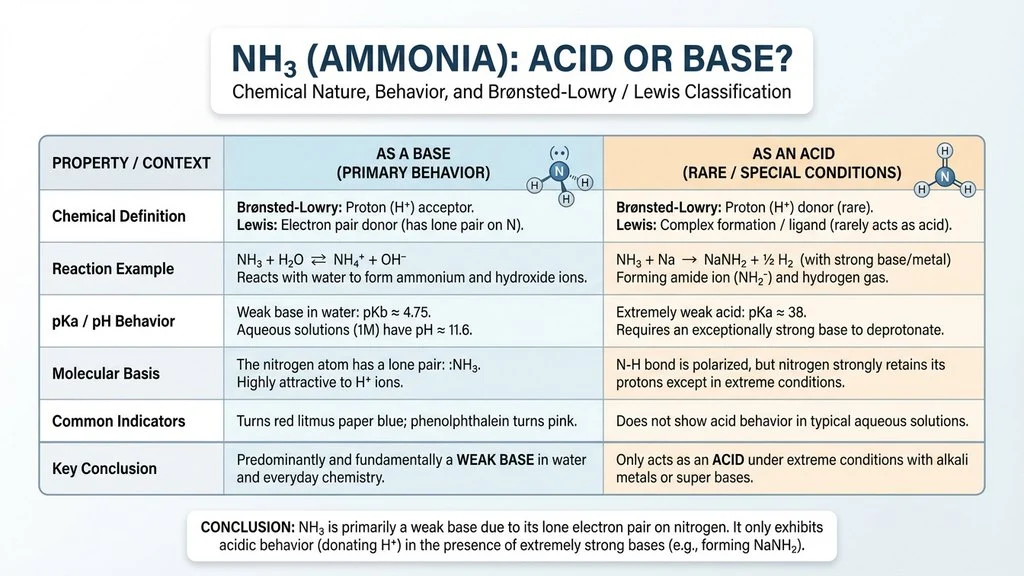
The following table makes it easy to understand how ammonia compares with other common acids and bases.
| Chemical Formula | Chemical Name | Classification |
| NH3 | Ammonia | Weak base |
| NH4+ | Ammonium ion | Weak acid |
| NaOH | Sodium hydroxide | Strong base |
| KOH | Potassium hydroxide | Strong base |
| HCl | Hydrochloric acid | Strong acid |
| H2SO4 | Sulfuric acid | Strong acid |
| CH3COOH | Acetic acid | Weak acid |
| H2O | Water | Amphoteric |
What Is the Difference Between NH3 and NH4+?
NH3 is ammonia. It accepts a proton and becomes NH4+.
NH4+ is the ammonium ion. It can donate a proton and become NH3.
This means NH3 acts as a base, while NH4+ can act as a weak acid.
This difference is very important when solving acid-base chemistry problems.
Frequently Asked Questions (FAQs)
1. Is NH3 an Acid or a Base?
NH3 is a weak base. It accepts hydrogen ions (H+) and forms ammonium ions (NH4+). When it reacts with water, it also produces hydroxide ions (OH-).
2. Why Is NH3 a Weak Base?
NH3 is a weak base because it only partly reacts with water. It does not produce hydroxide ions completely like strong bases such as sodium hydroxide.
3. Is NH3 a Strong or Weak Base?
NH3 is a weak base. Its base ionization constant (Kb) is approximately 1.8 × 10^-5 at 25°C.
4. What Happens When NH3 Reacts with Water?
When NH3 reacts with water, it accepts a hydrogen ion and forms ammonium and hydroxide ions.
The chemical equation is:
NH3 + H2O ⇌ NH4+ + OH-
5. Is NH4+ an Acid or a Base?
NH4+ (ammonium ion) acts as a weak acid. It can donate a hydrogen ion to another substance and form NH3.
6. Why Does NH3 Have Basic Properties?
NH3 has one lone pair of electrons on its nitrogen atom. This electron pair allows ammonia to accept a hydrogen ion, giving it basic properties.
7. What Is the pH of NH3 in Water?
An aqueous ammonia solution usually has a pH above 7 because it produces hydroxide ions.
The exact pH depends on the concentration and temperature of the solution. Pure ammonia gas does not have a pH by itself; pH applies to aqueous solutions.
Conclusion
Understanding if NH3 is an acid or a base is an important part of learning chemistry. The simple answer is that NH3 (ammonia) is a weak base because it accepts hydrogen ions from other substances.
When it reacts with water, it forms ammonium ions (NH4+) and hydroxide ions (OH-), which make the solution basic.
The nitrogen atom in ammonia has a lone pair of electrons. This allows NH3 to accept a proton and behave as a Brønsted-Lowry base. It also acts as a Lewis base because it can donate an electron pair.
Remember that NH3 is different from NH4+. Ammonia acts as a weak base, while the ammonium ion can act as a weak acid. Also, NH3 is not a strong base, and its chemical formula stays the same in British and American English.

I am Oliver Bennett is the founder and writer behind Grammlii.com, where he shares insightful content on language, meanings, expressions, and effective communication. Passionate about making knowledge simple and accessible, he helps readers explore words, ideas, and their deeper significance.