Have you ever stopped while writing an email and wondered whether to use paid or payed? You are not alone.
Many people mix up these two words because they look and sound almost the same. However, only one is correct in most everyday situations.
The confusion often comes from the English verb pay. Most verbs use an -ed ending to show the past. For example, we write walked, talked, and worked.
So, it may seem logical to write payed as well. But English has some unusual spelling rules, and pay is one of them.
Knowing the difference between paid and payed can help you write better emails, school assignments, business messages, and social media posts. It can also help you avoid spelling mistakes in professional writing.
Paid or Payed – Quick Answer
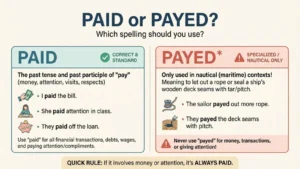
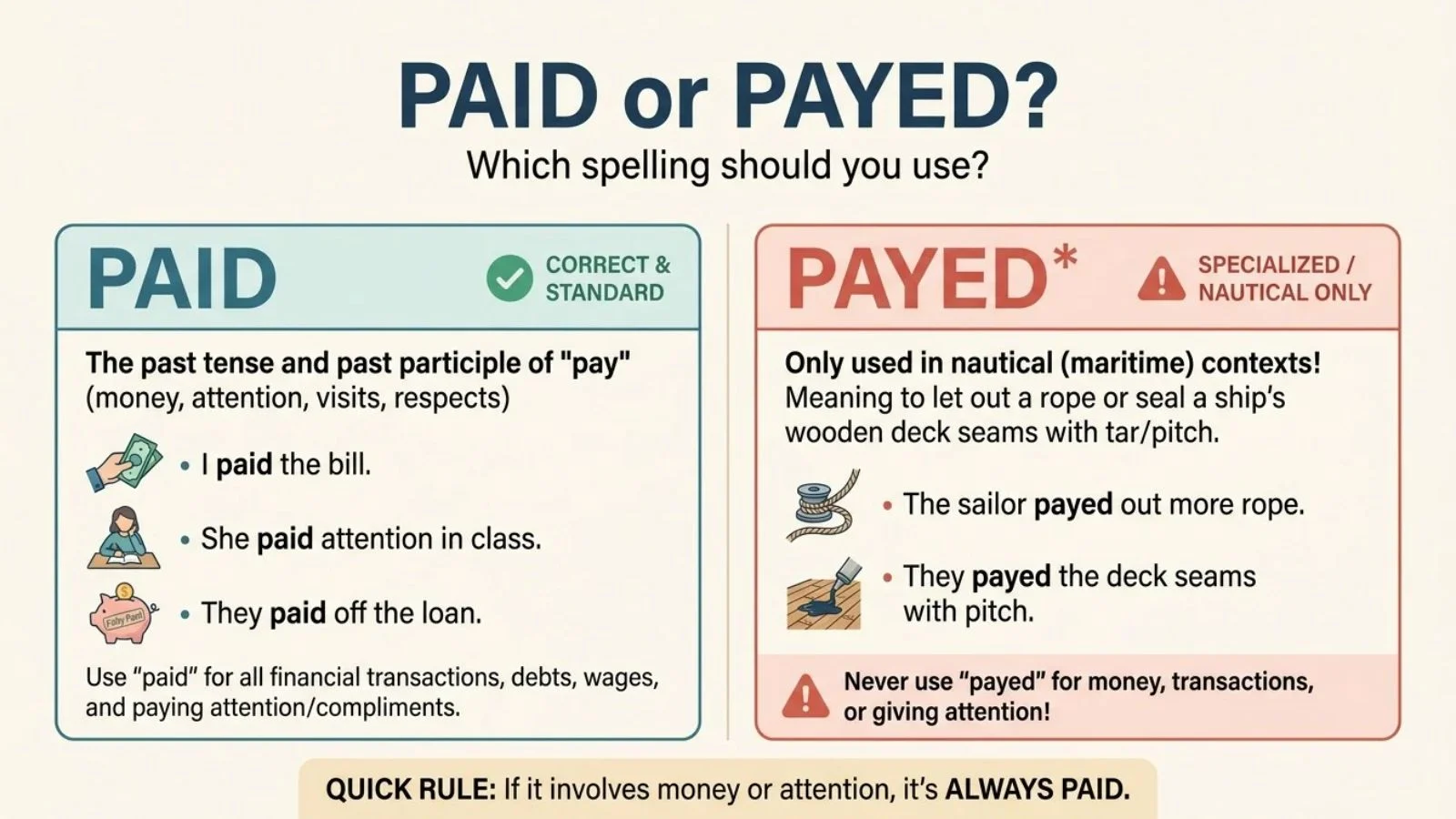
Paid is the correct past tense and past participle of the verb pay in almost all everyday situations.
Use paid when talking about money, bills, salaries, debts, or services.
Examples:
- I paid my electricity bill yesterday.
- She paid for her new phone.
- The company paid all its workers.
- We have already paid the full amount.
Payed is a rare word. It is mainly used as a nautical term related to letting out rope or cable, or covering a surface with tar or pitch.
For everyday writing, remember this simple rule:
- Paid: Correct for money and payments.
- Payed: Rare technical word with special meanings.
If you are talking about paying money, always choose paid.
The Origin of Paid or Payed
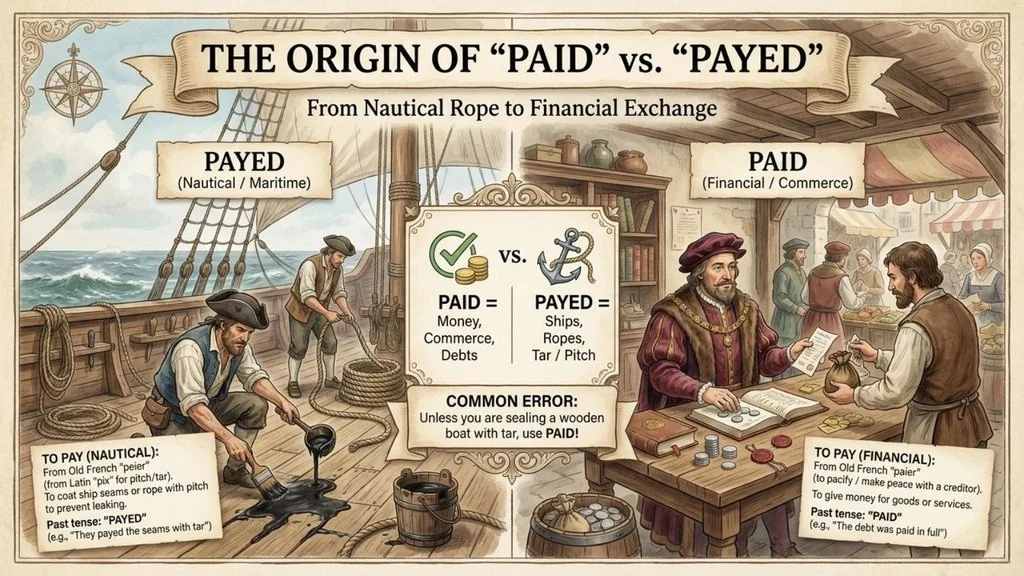
The words paid and payed come from the verb pay. Their spelling differences developed because English has changed over many years.
The verb pay has roots in Old French and Latin. It came from the Old French word paier, which was linked to the Latin word pacare. The original meaning was connected to settling or satisfying a debt.
Over time, the word became pay in English.
Why Is Paid the Correct Spelling?
Most regular English verbs form their past tense by adding -ed.
For example:
| Present tense | Past tense |
| Walk | Walked |
| Talk | Talked |
| Work | Worked |
| Clean | Cleaned |
| Pay | Paid |
The verb pay is irregular in this sense. Its past form changes from pay to paid.
This is why we write:
- I pay my bills every month.
- I paid my bills yesterday.
- I have paid my bills already.
Where Does Payed Come From?
Payed has a separate history in specialized English.
It is sometimes used in nautical language. For example, sailors may use it when describing the action of letting out rope or cable.
It can also describe covering a surface with tar or pitch.
These meanings are not related to ordinary money payments.
British English vs American English Spelling
One common question is whether British and American English use different spellings of paid and payed.
The answer is simple: both varieties use paid when talking about money.
Unlike words such as colour and color, this spelling does not change between British and American English.
Paid or Payed in American English
American English uses paid as the standard past tense of pay.
Examples:
- I paid my rent last week.
- He paid for dinner.
- The workers were paid on Friday.
- She has paid the entire bill.
You should use paid in American emails, reports, schoolwork, and business documents.
Paid or Payed in British English
British English also uses paid for money.
Examples:
- I paid for the train ticket.
- She paid her monthly bills.
- The staff were paid on time.
- We have paid the deposit.
There is no spelling difference between British and American English for this word.
British English vs American English Comparison Table
| Meaning | American English | British English |
| Past tense of pay | Paid | Paid |
| Paid a bill | Paid a bill | Paid a bill |
| Paid a salary | Paid a salary | Paid a salary |
| Paid for food | Paid for food | Paid for food |
| Nautical term | Payed | Payed |
Both countries follow the same basic spelling rule.
Which Spelling Should You Use?
Choosing between paid and payed depends on the meaning of your sentence, not the country where your readers live.
Here is some simple advice for different audiences.
For American Readers
Use paid when writing about money, bills, salaries, purchases, or services.
Examples:
“I paid the internet bill this morning.”
This is the standard spelling in American English.
For British and Commonwealth Readers
Use paid for the same situations.
Examples:
“The customer paid for the service yesterday.”
British, Australian, Canadian, and other Commonwealth readers will expect this spelling.
For Global Readers
If you write for an international audience, choose paid whenever you mean a money payment.
It is understood and accepted around the world.
For Professional Writing
Always use paid in:
- Business emails
- Financial reports
- Job applications
- School assignments
- Invoices and receipts
- News articles
- Website content
Use payed only when discussing its special nautical or technical meaning.
Common Mistakes with Paid or Payed
Many writers make mistakes with these words because they follow the usual -ed rule.
Here are some common errors and their corrections.
1. Writing Payed for Money
Incorrect: I payed my rent yesterday.
Correct: I paid my rent yesterday.
Why? The correct past tense of pay is paid when talking about money.
2. Using Payed in Business Emails
Incorrect: Your invoice has been payed.
Correct: Your invoice has been paid.
Why? Business writing should use the standard past participle paid.
3. Writing Payed Instead of Paid on Social Media
Incorrect: I finally payed off my debt!
Correct: I finally paid off my debt!
Why? Paying off a debt always takes the spelling paid.
4. Confusing Paid and Pay
Incorrect: I have pay the bill.
Correct: I have paid the bill.
Why? After have, use the past participle paid.
5. Using Paid in Every Special Technical Context
Incorrect: The sailor payed out the rope. (when using the specialized nautical spelling)
Correct: The sailor payed out the rope.
Why? In this special nautical sense, payed can be correct.
Paid or Payed in Everyday Examples
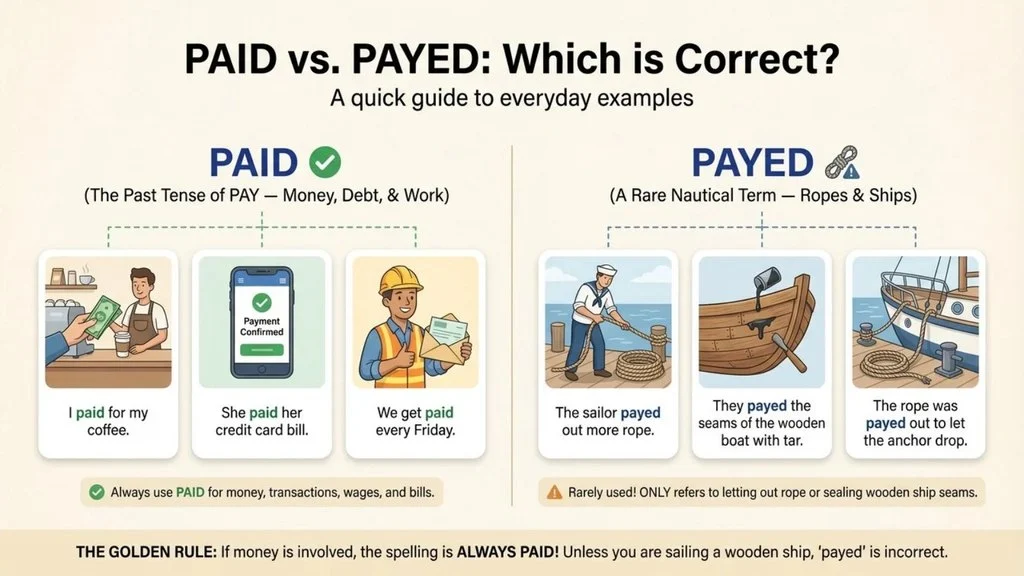
The best way to learn these words is to see them in real situations.
Here are examples from everyday writing.
1. In Emails
When writing an email about a payment, always use paid.
Example:
“Hello,
I have paid the invoice today. Please let me know if you need a copy of the payment receipt.
Thank you.”
This is clear and professional.
2. In News Articles
News writers use paid when reporting about salaries, bills, and financial matters.
Examples:
- The company paid its employees before the holiday.
- The government paid the outstanding debt.
- The customer paid a record amount for the property.
3. On Social Media
People often use paid when sharing purchases or personal achievements.
Examples:
- Finally paid off my student loan!
- I paid for my first car today.
- My hard work finally paid off!
These sentences are correct and natural.
4. In Formal Writing
Use paid in academic work, reports, and official documents.
Examples:
- The total amount was paid in advance.
- All employees must be paid according to their contracts.
- The customer has paid the required fee.
5. In Everyday Conversations
You will hear paid in normal conversations.
Examples:
- Who paid for lunch?
- I already paid you back.
- Have you paid the water bill?
- She paid me yesterday.
In all these examples, paid is the correct choice.
Paid or Payed Google Trends & Usage Data
People often search for paid or payed because both spellings look reasonable. However, their meanings and usage are very different.
Paid is the standard spelling used in everyday English across the United States, United Kingdom, Canada, Australia, and other English-speaking countries.
Payed appears much less often. Its use is mainly limited to specialized nautical language and a few technical contexts.
Which Word Is More Popular?
Paid is far more common in everyday writing because people regularly discuss:
- Paying bills
- Receiving salaries
- Buying products
- Settling debts
- Paying for services
Payed has a much narrower use.
Usage by Country
| Country | Correct spelling for money | Special nautical spelling |
| United States | Paid | Payed |
| United Kingdom | Paid | Payed |
| Canada | Paid | Payed |
| Australia | Paid | Payed |
| New Zealand | Paid | Payed |
| India | Paid | Payed |
Why Do People Search for Paid or Payed?
There are several reasons:
- Both words sound almost the same.
- Many English verbs use the -ed ending.
- People may not know that pay is irregular.
- Spell-check tools may not explain the difference in meaning.
- Students and professionals want to avoid spelling mistakes.
Note: This section describes general usage patterns, not verified live Google Trends figures or country-by-country search volumes.
Paid vs Payed: Side-by-Side Comparison Table
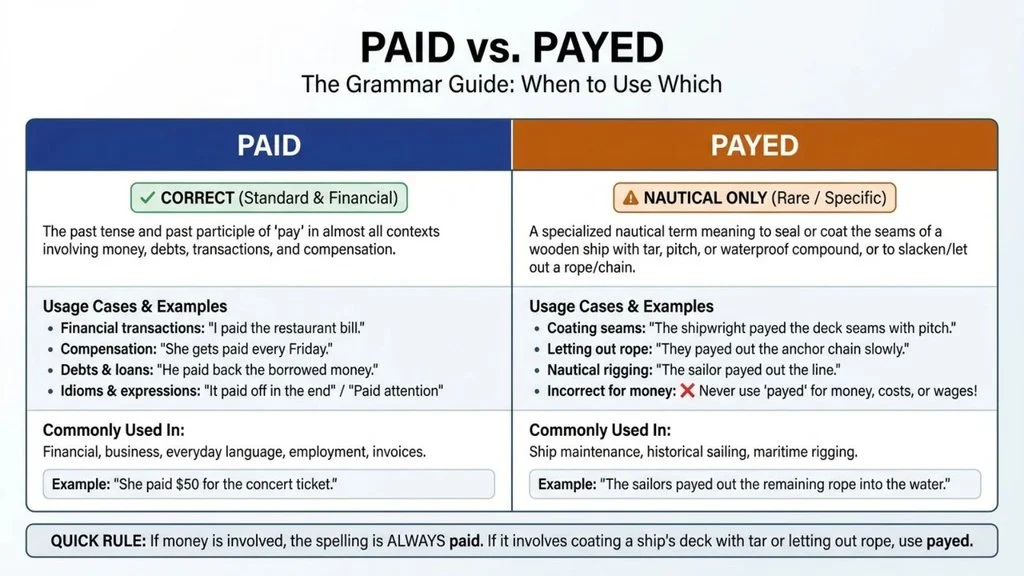
Here is a quick comparison to help you remember the difference.
| Feature | Paid | Payed |
| Word type | Past tense and past participle | Rare past-tense form |
| Main meaning | Gave money | Let out rope or cable |
| Everyday use | Very common | Very rare |
| Business writing | Correct | Usually incorrect |
| American English | Correct for payments | Special technical use |
| British English | Correct for payments | Special technical use |
| Example | I paid the bill. | The sailor payed out the rope. |
Easy rule: If money is involved, use paid. If you are describing a special nautical action, payed may be correct.
FAQs About Paid or Payed
1. Is It Paid or Payed?
Paid is correct when talking about money. Payed is a rare technical word used mainly in nautical contexts.
Example: I paid my rent yesterday.
2. Is Payed Ever a Correct Word?
Yes. Payed is a real English word, but it has limited uses. It can describe letting out rope or cable on a ship or covering a surface with tar or pitch.
3. Why Is Paid Not Spelled Payed?
The verb pay has an irregular past tense. Instead of adding -ed, its past form changes to paid.
Similar irregular verbs include:
- Say → Said
- Lay → Laid
- Pay → Paid
4. Is Paid Correct in British English?
Yes. British English uses paid when talking about money. The spelling is the same in American English.
5. Is Paid Correct in American English?
Yes. Paid is the standard American English spelling for the past tense and past participle of pay.
6. Should I Write Paid or Payed in an Email?
Use paid in emails about invoices, bills, salaries, or purchases.
Correct: “I have paid the invoice.”
Incorrect: “I have payed the invoice.”
7. Is It Paid Off or Payed Off?
The correct phrase is paid off.
Example: “I finally paid off my car loan.”
You can also use it in another way:
“All my hard work paid off.”
Conclusion
Understanding the difference between paid or payed is simple once you learn the main spelling rule.
Paid is the correct word whenever you talk about money, bills, salaries, purchases, or debts. It is used in both British and American English, so you do not need to worry about regional spelling differences.
Payed is not always wrong, but it has a very limited use. It mainly appears in nautical language when describing the action of letting out rope or cable. It can also refer to covering a surface with tar or pitch.

I am Ethan Whitmore is the founder and lead writer of Grammlii.com, passionate about exploring meanings, language, literature, and insightful ideas. Through well-researched and engaging content, he helps readers discover the deeper significance behind words, expressions, and everyday concepts.