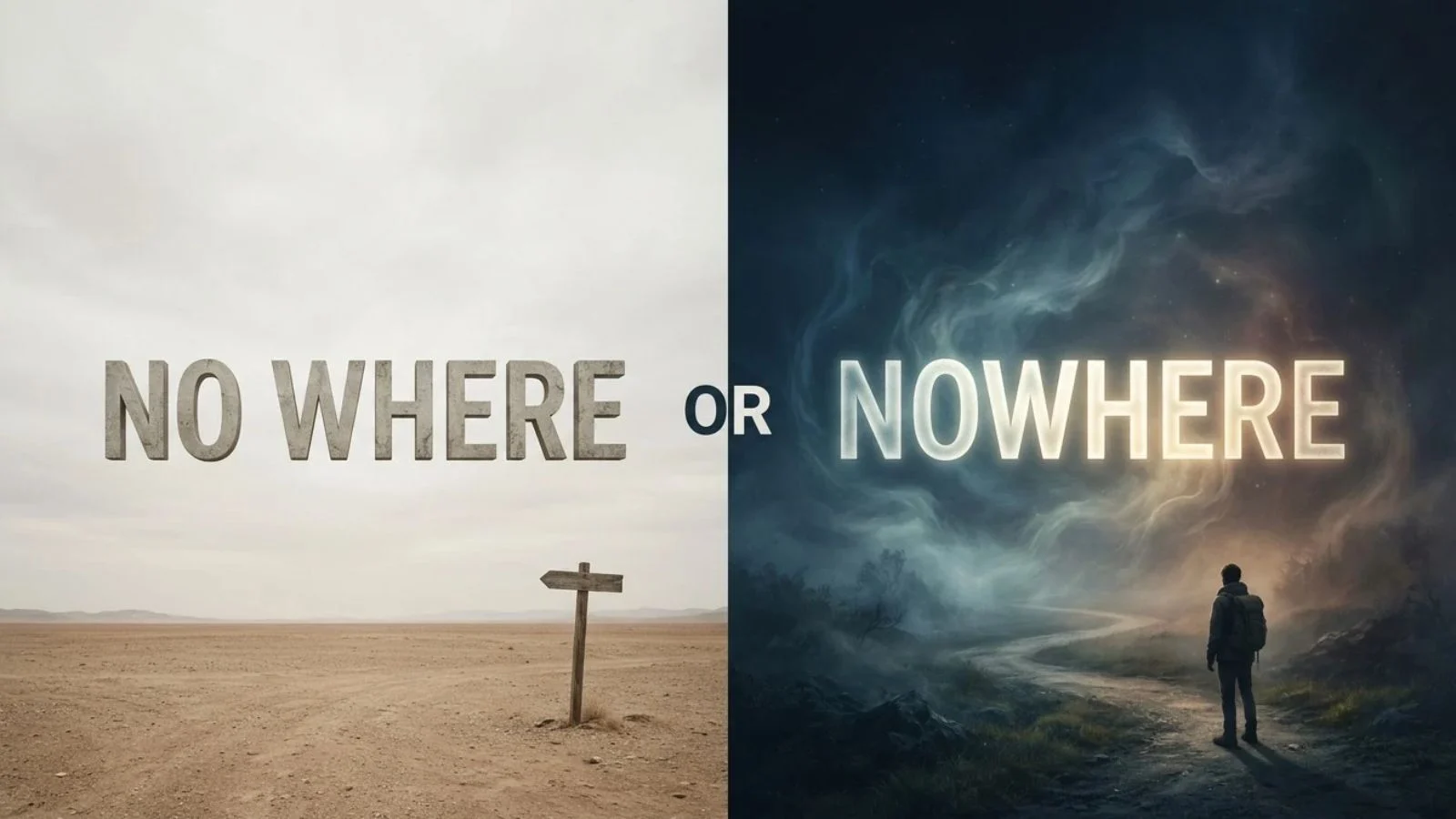
Have you ever wondered whether to write “no where” or You are not alone. Many people get confused by these two forms because they look almost the same. However, only one is the standard spelling in modern English.
The word means no place or not in any place. It is used when you want to say that something cannot be found, does not exist in a location, or has no destination.
For example, “My keys are to be found.”
On the other hand, “no where” is not normally correct as a standard English word. Some writers may use these two words separately in special sentence structures, but this is rare.
This spelling confusion often appears in emails, schoolwork, online searches, and everyday writing. Knowing the correct form helps you write clearly and avoid common grammar mistakes.
In this guide, you will learn the meaning, origin, spelling rules, and correct usage of along with simple examples to help you remember it.
No Where or Nowhere – Quick Answer
“Nowhere” is the correct standard spelling when you mean no place. It is one word, not two.
The word is an adverb that describes a place that does not exist or cannot be found.
Examples:
- My phone is to be found.
- There is to sit.
- We have to go.
- This road leads.
Is “no where” ever correct?
The phrase “no where” is rarely used as two separate words. It may appear when “no” describes a separate use of “where” in unusual sentence structures. However, it is not the correct replacement.
Nowhere
Correct
Means no place.
Example: I can find my bag.
No where
Usually incorrect
Not the standard spelling for the meaning “no place.”
The Origin of No Where or Nowhere

The word comes from two older English words: “no” and “where.”
Word “no” means not any or none word “where” asks about or describes a place.
When these words joined together, they formed which means no place.
Over time, English began using many combinations of words as single words. Examples include:
- Somewhere
- Anywhere
- Everywhere
These words are now written as one word because they have become established English terms.
The spelling has remained standard in both British and American English. Although people sometimes separate it into “no where,” this is generally a spelling mistake when they mean no place.
British English vs American English Spelling
British English and American English often use different spellings. For example, British English uses “colour,” while American English uses “color.”
However, “nowhere” is spelled the same way in both varieties of English.
There is no difference in its spelling, meaning, or basic grammatical use.
British English Examples
- There is to park.
- I have nowhere to go.
- The missing book is to be found.
American English Examples
- There is to sit.
- We have to stay.
- My wallet is in sight.
British vs American Spelling Comparison Table
| Word or Phrase | British English | American English |
| No place | Nowhere | Nowhere |
| Some place | Somewhere | Somewhere |
| Any place | Anywhere | Anywhere |
| Every place | Everywhere | Everywhere |
| Separate form | No where (usually incorrect) | No where (usually incorrect) |
Both British and American writers should use when they mean no place.
Which Spelling Should You Use?
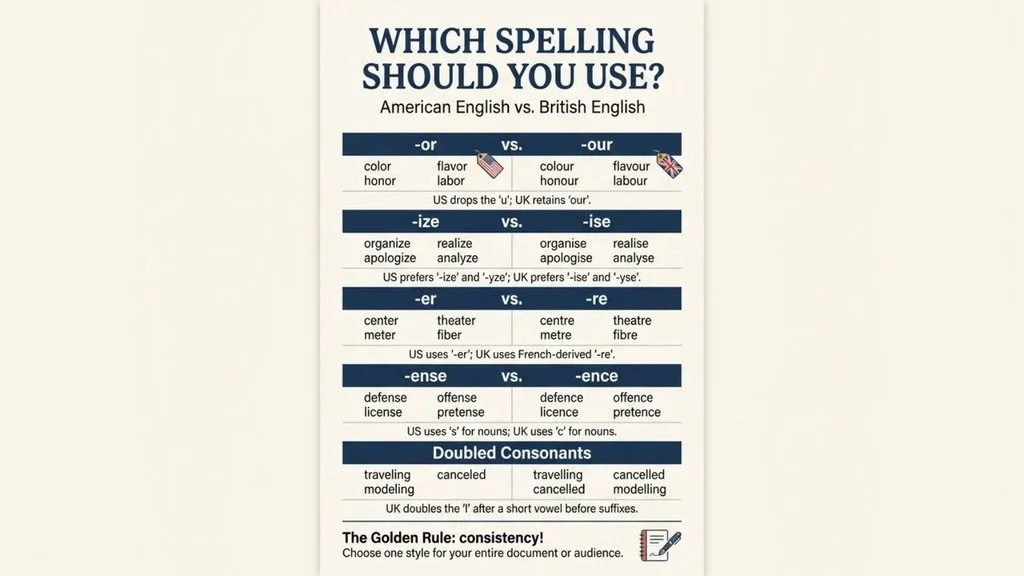
The correct spelling depends on what you want to say. If you mean no place, always choose.
Here is some advice for different audiences.
1. For American English
Use in schoolwork, business writing, emails, and everyday conversations.
Example: There is to park near the office.
2. For British English
British writers also use “nowhere” as one word.
Example: We have to stay tonight.
3. For Canadian and Australian English
The same spelling rule applies in Canada, Australia, and other Commonwealth countries.
Example: The lost dog was nowhere to be seen.
4. For International English
If you write for a global audience, use “nowhere.” It is widely understood and accepted.
Professional advice: Always write when you mean no place. It is the safest and most widely accepted choice.
Common Mistakes with No Where or Nowhere
Many people make small spelling mistakes when writing quickly. Here are some common errors and their corrections.
| Incorrect Usage | Correct Usage |
| I have no where to go. | I have nowhere to go. |
| My keys are no where. | My keys are nowhere. |
| We found no where to sit. | We found nowhere to sit. |
| The road goes no where. | The road goes nowhere. |
| She is going no where. | She is going nowhere. |
Mistake 1: Writing Two Words
Incorrect: There is no where to hide.
Correct: There is nohere to hide.
Mistake 2: Confusing Nowhere with Somewhere
“Nowhere” means no place, while “somewhere” means an unknown or unspecified place.
- Nowhere: I have to go.
- Somewhere: I want to go somewhere.
Mistake 3: Confusing Nowhere with Anywhere
“Nowhere” means no place. “Anywhere” means any place.
- I cannot find it anywhere.
- Anywhere: You can sit anywhere.
Mistake 4: Using the Wrong Form in Formal Writing
Writing “no where” instead of can make your work look unprofessional. Always check the spelling before submitting important documents.
No Where or Nowhere in Everyday Examples
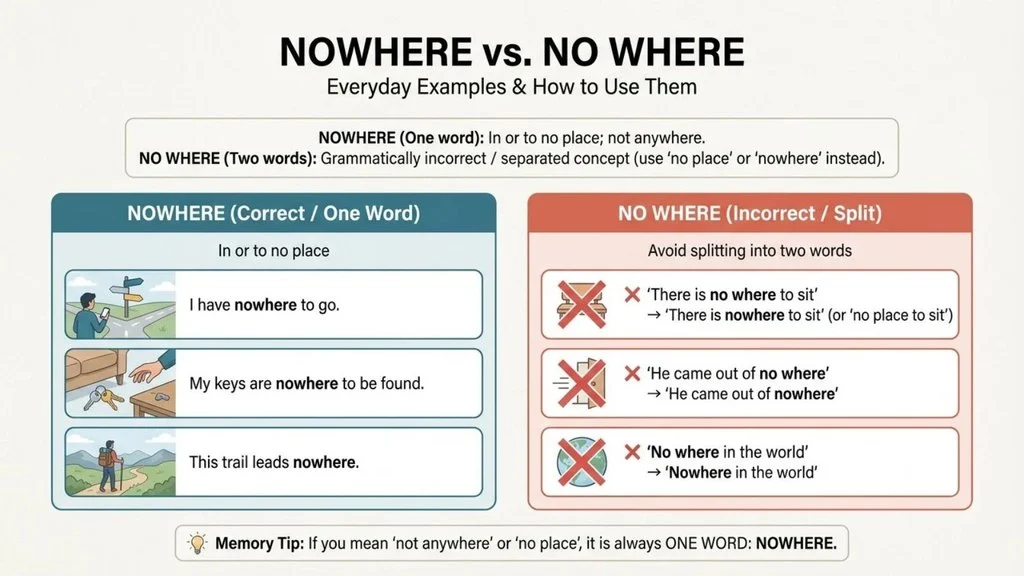
The word is common in daily communication. You can use it in emails, news stories, social media posts, and formal writing.
Here are some examples.
1. In Emails
Use when explaining that something is missing or that there is no available place.
Examples:
- The document is in my inbox.
- There is to store the extra files.
- I searched everywhere, but the report is to be found.
2. In News
News writers use “nowhere” to describe situations where something is missing or has no clear destination.
Examples:
- The missing vehicle was to be found.
- The road leads beyond the village.
- The investigation appears to be going.
3. On Social Media
People often use “nowhere” in casual posts and comments.
Examples:
- My weekend plans went!
- This conversation is going.
- I feel like I am getting with this project.
4. In Formal Writing
“Nowhere” is also suitable for professional documents, reports, and academic writing.
Examples:
- The study found nowhere that supported the claim.
- There was in the report where this issue was discussed.
- The proposed plan leads without proper funding.
No Where or Nowhere Google Trends & Usage Data
People often search for “no where or because they want to know whether the expression should be written as one word or two.
The standard spelling is in all major English varieties.
Why Do People Search for This Keyword?
There are several reasons:
- They are unsure whether is one word or two.
- They want to improve their English grammar.
- They are writing an email or school assignment.
- They want to check their spelling before publishing content.
- They confuse “nowhere” with “somewhere” and “anywhere.”
Usage Across Different Countries
“Nowhere” is used in English-speaking countries around the world.
| Country | Standard Spelling | Common Context |
| United States | Nowhere | Everyday writing |
| United Kingdom | Nowhere | Formal and informal writing |
| Canada | Nowhere | School and business writing |
| Australia | Nowhere | Everyday communication |
| New Zealand | Nowhere | Professional writing |
| India | Nowhere | Education and online writing |
Search Interest and Popularity
Search interest can change over time and across countries. However, is the established spelling, while “no where” is generally a spelling query or error.
Google Trends does not provide a fixed measure of spelling correctness. For accurate search comparisons, users should check the keyword data for a selected country and date range.
The main takeaway is simple: use in your writing, regardless of your location.
No Where vs Nowhere: Comparison Table
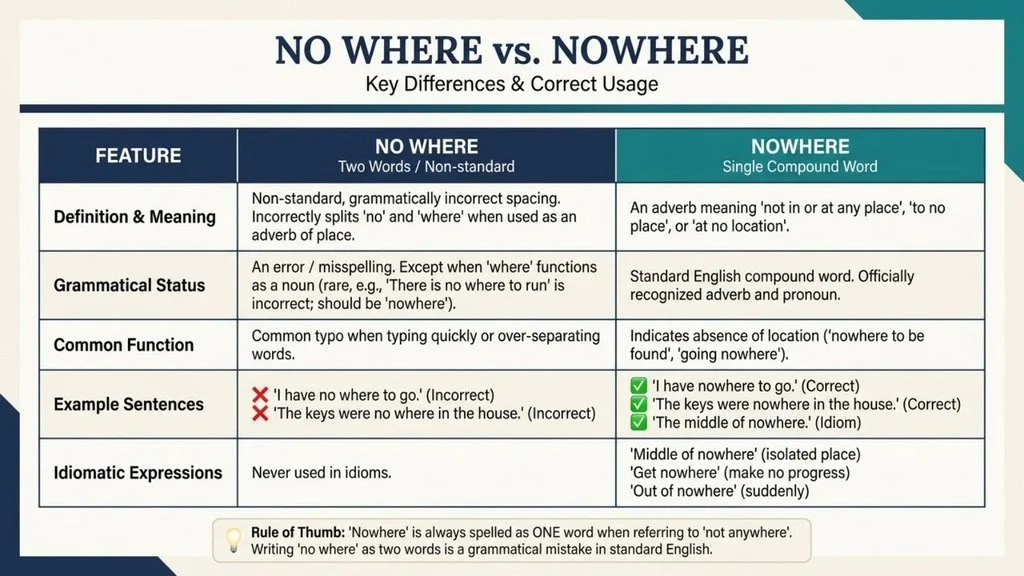
Here is a quick comparison to help you understand the difference.
| Feature | No Where | Nowhere |
| Spelling | Two words | One word |
| Standard usage | Usually incorrect for this meaning | Correct |
| Meaning | No standard combined meaning | No place |
| Grammar | Separate words in rare constructions | Adverb |
| British English | Not standard for this meaning | Correct |
| American English | Not standard for this meaning | Correct |
| Example | I have no where to go. | I have nowhere to go. |
Remember: When you want to say “no place.
FAQs About No Where or Nowhere
1. Is it nowhere or no where?
“Nowhere” is the correct spelling when you mean no place. It should be written as one word.
Example: There is nowhere to park.
2. Is nowhere one word or two?
“Nowhere” is one word. It combines “no” and “where” to create a word that means no place.
3. Is no where ever correct?
The phrase “no where” is not normally correct when you mean no place. In unusual sentence structures, the words may appear separately, but “nowhere” is the standard form.
4. What does nowhere mean?
“Nowhere” means no place or not in any place.
Example: My wallet is nowhere to be found.
5. Is nowhere the same in British and American English?
Yes. Both British and American English use the spelling “nowhere.” There is no spelling difference between them.
6. What is the opposite of nowhere?
The opposite depends on the context. “Somewhere” is often used to describe an unspecified place.
Examples:
- Nowhere: I have nowhere to go.
- Somewhere: I want to go somewhere.
7. How do you use nowhere in a sentence?
You can use “nowhere” to describe a place that does not exist or cannot be found.
Examples:
- We have nowhere to stay.
- My phone is nowhere to be seen.
- This road leads nowhere.
Conclusion
Choosing between “no where” and “nowhere” is easy once you understand the meaning. “Nowhere” is the correct standard spelling when you want to say no place. It is written as one word in both British and American English.
The word comes from “no” and “where,” and it is commonly used in everyday conversations, emails, news, social media, and formal writing. For example, you can say, “There is to go” or “My keys are to be found.”
Although some people write “no where” by mistake, it is not the standard form for this meaning. You should also remember the related words “somewhere,” “anywhere,” and “everywhere,” which follow a similar one-word spelling pattern.

I am Oliver Bennett is the founder and writer behind Grammlii.com, where he shares insightful content on language, meanings, expressions, and effective communication. Passionate about making knowledge simple and accessible, he helps readers explore words, ideas, and their deeper significance.