Have you ever wondered whether to write “some time” or “sometime”? You are not alone. These two expressions look almost the same, but they have different meanings. Using the wrong one can make your writing confusing or incorrect.
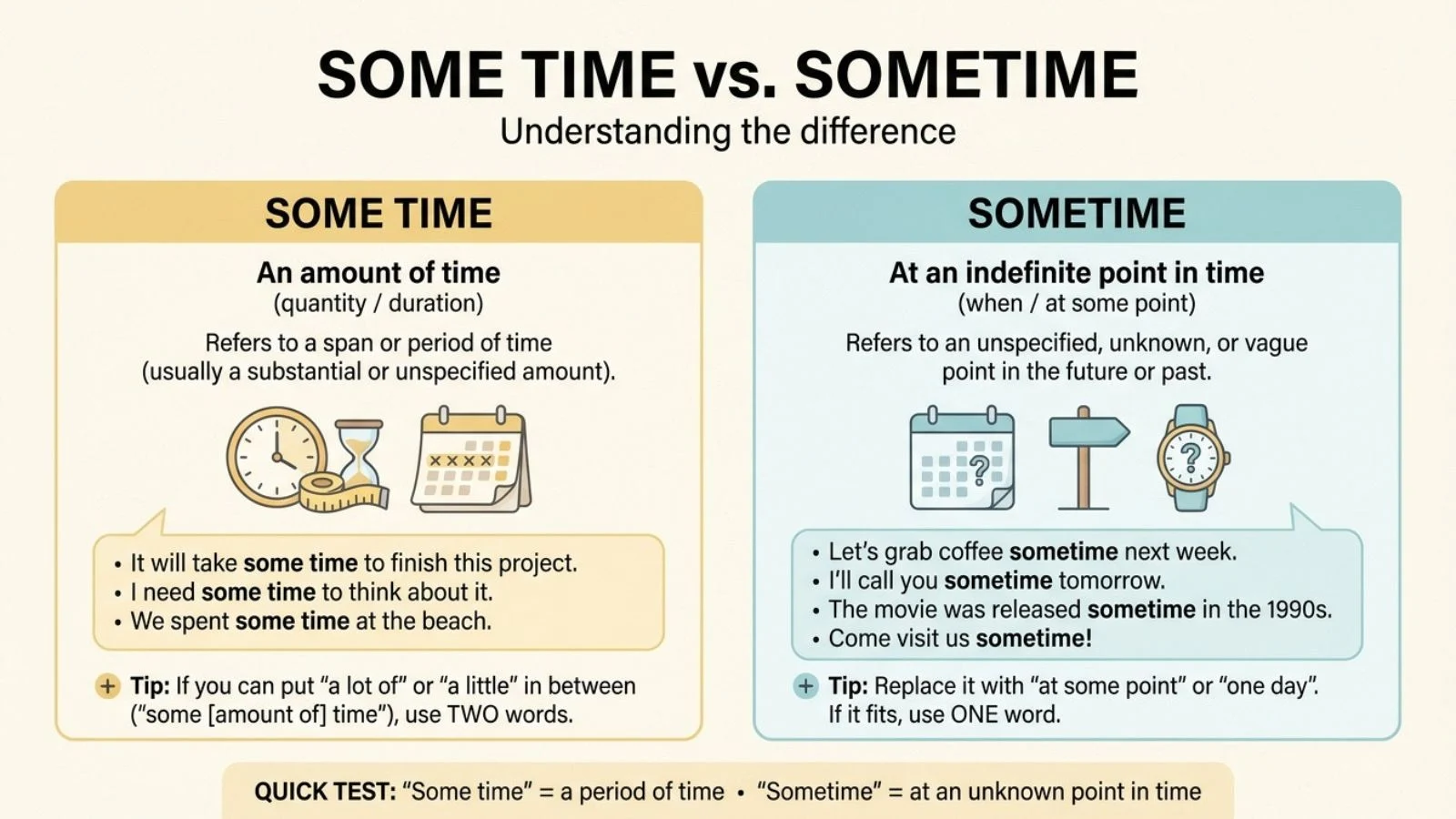
The main difference is simple. “Some time” means a period of time, while “sometime” means an unknown or unspecified time.
For example, you might say, “I need some time to finish my work.” However, you would write, “Let’s meet sometime next week.”
Many people search for this difference because both forms sound alike when spoken. They also look similar in emails, text messages, school assignments, and professional documents. This can make it hard to know which spelling is correct.
Some Time or Sometime – Quick Answer
The correct choice depends on what you want to say.
- Some time: Two separate words that mean a period or amount of time.
- Sometime: One word that means at an unknown or unspecified time.
Examples of Some Time
- I need some time to think about your offer.
- She spent some time learning English.
- It takes some time to understand new rules.
- We have some time before the meeting starts.
Examples of Sometime
- Let’s have lunch sometime next week.
- I will visit you sometime this summer.
- We should meet sometime soon.
- She called me sometime yesterday.
Easy trick: If you mean a period of time, use “some time.” If you mean an unknown time, use “sometime.”
The Origin of Some Time or Sometime
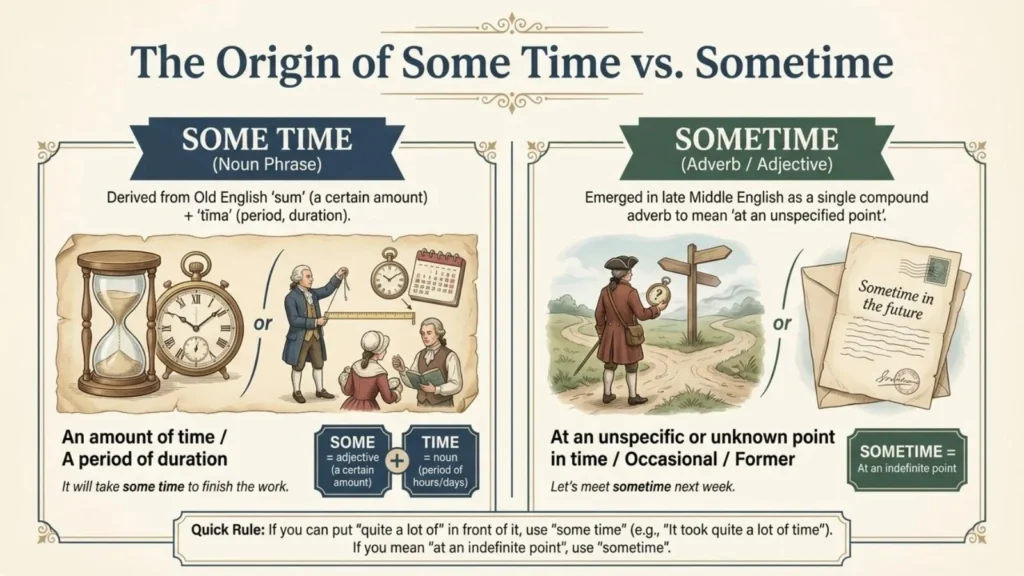
The expressions “some time” and “sometime” come from the same basic English words: “some” and “time.” However, their meanings developed in different ways.
The word “some” refers to an amount, number, or unspecified quantity. The word “time” refers to a period, moment, or point in a sequence of events.
When written separately, these words keep their individual meanings. Together, “some time” refers to an amount or period of time.
Over time, English speakers also began using “sometime” as one word to describe an unspecified point in time. This single-word form became a common adverb.
Today, both forms are accepted in standard English. The difference is not about British or American spelling. It is about grammar and meaning.
Why Are There Two Different Forms?
English often combines words to create new meanings. Sometimes, the combined form develops a meaning that is different from the original words.
That is what happened with “sometime.” It became an adverb that describes an unknown or uncertain time.
For example:
- Some time: He needs some time to prepare.
- Sometime: He will arrive sometime tomorrow.
Both expressions are correct, but they serve different purposes.
British English vs American English Spelling
There is no spelling difference between British English and American English when using “some time” and “sometime.”
Both forms are written in exactly the same way in the United States, the United Kingdom, Canada, Australia, and other English-speaking countries.
The important thing is to understand their meanings and use them correctly.
Comparison Table
| Expression | British English | American English | Meaning |
| Some time | Some time | Some time | A period of time |
| Sometime | Sometime | Sometime | At an unspecified time |
| Sometimes | Sometimes | Sometimes | On certain occasions |
Examples in British and American English
British English:
- I need some time to finish this task.
- We should meet sometime next month.
- She sometimes visits her grandparents.
American English:
- I need some time to finish this project.
- We should meet sometime next month.
- She sometimes visits her grandparents.
As you can see, the spelling remains the same in both varieties.
What About Sometimes?
Do not confuse “sometime” with “sometimes.”
- Sometime: At an unknown or unspecified time.
- Sometimes: Occasionally or on certain occasions.
Example:
- Let’s meet sometime this week.
- I sometimes go swimming after work.
These words have different meanings, so they cannot always replace each other.
Which Spelling Should You Use?
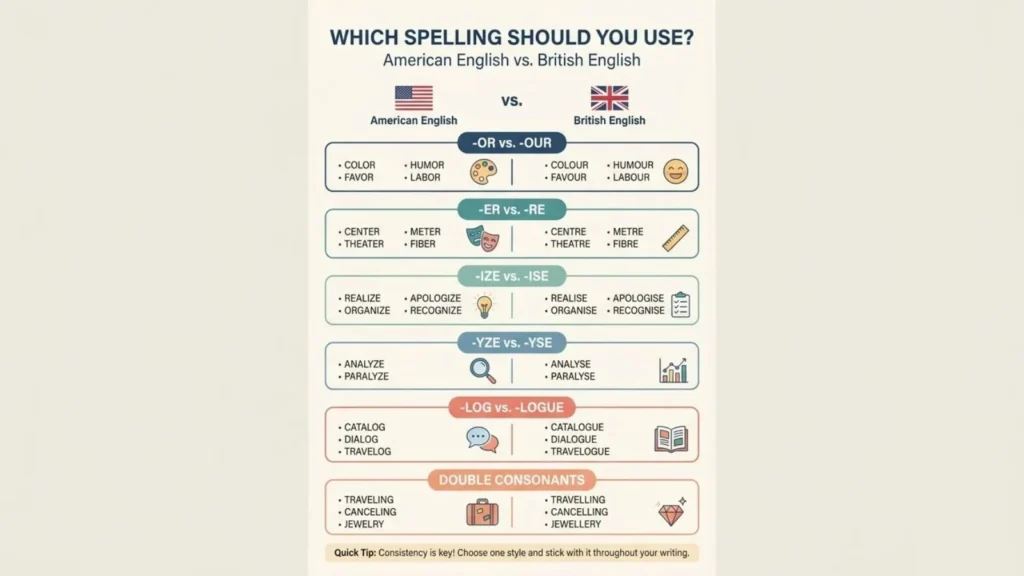
Choosing between “some time” and “sometime” depends on your intended meaning, not your location.
Here is how to use them in different situations.
For American English Readers
If you are writing for an American audience, use “some time” when talking about a period of time.
Example: “I need some time to complete the project.”
Use “sometime” when the exact time is not known.
Example: “Let’s talk sometime this weekend.”
For British and Commonwealth Readers
British, Australian, Canadian, and other Commonwealth readers follow the same basic rules.
Example:
- We spent some time at the beach.
- I hope to see you sometime soon.
There is no need to change the spelling for these audiences.
For Global English Readers
If your content is for an international audience, follow the same distinction.
Use simple sentences to make your meaning clear. This is especially helpful in business emails, online articles, educational content, and professional communication.
Professional advice: Always check the meaning of the sentence before choosing the spelling. Both forms are correct, but they are not interchangeable.
Common Mistakes with Some Time or Sometime
Many writers confuse these expressions because they look and sound similar. Here are some common mistakes and their corrections.
Mistake 1: Using Sometime for a Period of Time
Incorrect: I need sometime to finish my homework.
Correct: I need some time to finish my homework.
Why? The sentence refers to an amount of time, so the two-word form is correct.
Mistake 2: Using Some Time for an Unspecified Moment
Incorrect: Let’s meet some time tomorrow.
Correct: Let’s meet sometime tomorrow.
Why? The sentence refers to an unspecified moment tomorrow.
Mistake 3: Confusing Sometime with Sometimes
Incorrect: I sometime drink coffee in the morning.
Correct: I sometimes drink coffee in the morning.
Why? The sentence describes a repeated habit, so “sometimes” is the correct word.
Mistake 4: Assuming Both Forms Mean the Same Thing
Incorrect: She needs sometime to relax.
Correct: She needs some time to relax.
Why? She needs a period of time, not an unspecified point in time.
Mistake 5: Using the Wrong Form in Emails
Incorrect: Can we discuss this some time next week?
Better: Can we discuss this sometime next week?
Why? The writer is suggesting an unspecified meeting time.
Quick Tips to Avoid Mistakes
- Use “some time” for a period or amount of time.
- Use “sometime” for an unspecified point in time.
- Use “sometimes” for something that happens occasionally.
- Read the sentence aloud to check its intended meaning.
- Check the sentence before sending professional emails.
Some Time or Sometime in Everyday Examples
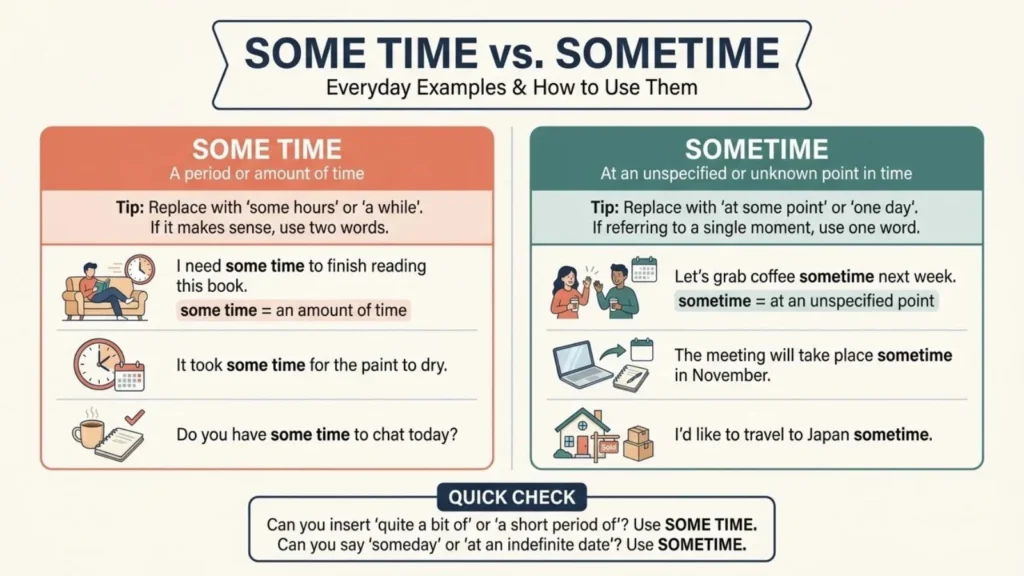
Understanding these expressions becomes easier when you see them in everyday situations.
1. In Emails
Professional emails often use both expressions.
Example:
- Please give me some time to review your request.
- Can we schedule a meeting sometime next week?
- I will need some time to prepare the report.
- Let’s discuss the proposal sometime tomorrow.
Use “some time” when requesting a period to complete something. Use “sometime” when suggesting an unspecified meeting time.
2. In News Writing
News articles may use both forms to describe events and periods.
Example:
- The investigation may take some time to complete.
- Officials expect the new policy to begin sometime next year.
- The company spent some time reviewing its plans.
- The new project will launch sometime in December.
These expressions help writers explain duration and uncertain timing.
3. On Social Media
People often use these words in casual posts, comments, and messages.
Example:
- I need some time away from social media.
- Let’s catch up sometime soon!
- We should go on a road trip sometime.
- I spent some time with my friends today.
Both forms are natural in everyday conversations.
4. In Formal Writing
Academic and professional writing also requires the correct form.
Example:
- The research team spent some time collecting information.
- The results will be published sometime next year.
- Students should take some time to review their answers.
- The organization plans to introduce new rules sometime in January.
Correct word choice makes your writing clearer and more professional.
Some Time or Sometime Google Trends & Usage Data
People often search for “some time or sometime” because the expressions have similar spellings but different grammatical meanings.
Both forms appear in everyday English, but their usage depends on the context.
Search Interest by Country
The question is relevant to English speakers and English learners around the world, including people in:
- United States
- United Kingdom
- Canada
- Australia
- India
- Pakistan
However, search interest can change depending on the time of year, educational needs, and writing trends.
Why Do People Search for These Expressions?
There are several common reasons:
- Grammar learning: Students want to understand the difference between the two forms.
- Professional writing: Workers want to avoid mistakes in business emails and reports.
- English exams: Learners need to understand correct word usage.
- Content writing: Bloggers and writers want to improve spelling and grammar.
- Everyday communication: People want to write clear messages and social media posts.
Which Form Is More Common?
“Sometime” is commonly used when discussing an uncertain future or past moment. “Some time” is common when describing a period, amount, or duration.
The word “sometimes” is also widely used, but it has a separate meaning.
Note: Google Trends measures relative search interest, not the total number of times a word appears in writing. Without a live comparison, exact country rankings and search-volume figures should not be assumed.
Some Time vs Sometime vs Sometimes: Comparison Table
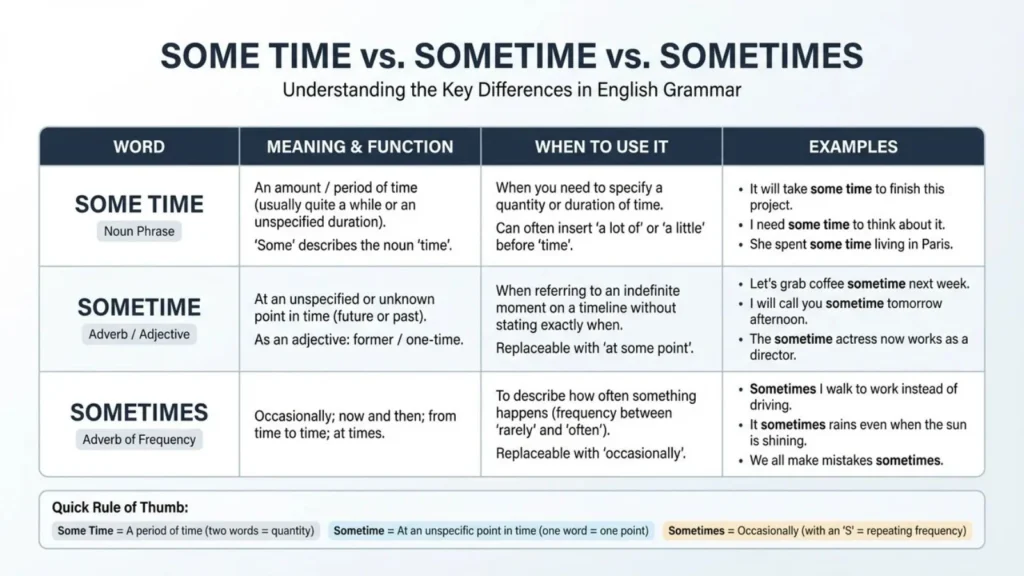
Here is a simple comparison to help you remember the differences.
| Word or Phrase | Meaning | Example |
| Some time | A period of time | I need some time to rest. |
| Sometime | At an unspecified time | Visit me sometime next week. |
| Sometimes | Occasionally | I sometimes read before bed. |
| Some times | Certain occasions or instances | I have visited that place some times before. |
Easy Memory Trick
Think about these three expressions:
- Some time = How much time?
- Sometime = When?
- Sometimes = How often?
This simple trick can help you choose the correct expression in most everyday sentences.
FAQs About Some Time or Sometime
1. Is It Some Time or Sometime?
Both are correct, but they have different meanings. “Some time” means a period of time, while “sometime” means at an unspecified moment.
Example: “I need some time” and “Let’s meet sometime.”
2. What Is the Difference Between Some Time and Sometime?
“Some time” refers to a length or amount of time. “Sometime” refers to an unknown or unspecified point in time.
Example: “She needs some time to study.” “She will visit sometime next week.”
3. Is Sometime One Word or Two Words?
“Sometime” is one word when it means at an unspecified time. “Some time” is two words when it means a period or amount of time.
4. Is Sometimes the Same as Sometime?
No. “Sometimes” means occasionally or from time to time. “Sometime” means at an unspecified point in time.
Example: “I sometimes travel.” “I will travel sometime next year.”
5. Is Some Time Correct in British English?
Yes. “Some time” is correct in British English when referring to a period of time. British writers also use “sometime” for an unspecified moment.
6. Is Sometime Correct in American English?
Yes. American English uses “sometime” as one word when referring to an unspecified time. It also uses “some time” for a period of time.
7. How Do You Remember the Difference?
Remember this simple rule: “Some time” means a period, “sometime” means an unspecified moment, and “sometimes” means occasionally.
Conclusion
Understanding the difference between “some time” and “sometime” can make your English writing clearer and more accurate. Although these expressions look similar, they have different meanings and grammatical uses.
Use “some time” when you are talking about a period or amount of time.
For example, “I need some time to finish my work.” Use “sometime” when you mean an unspecified moment.
For example, “Let’s meet sometime next week.”
Also, remember that “sometimes” is a different word. It means occasionally or on certain occasions. Keeping these three expressions separate will help you avoid common grammar mistakes.

I am Ethan Whitmore is the founder and lead writer of Grammlii.com, passionate about exploring meanings, language, literature, and insightful ideas. Through well-researched and engaging content, he helps readers discover the deeper significance behind words, expressions, and everyday concepts.